Languages
Tuesday, September 22, 2026



News and Views from the Global South
Labour

From Tony Blair to Mette Frederiksen
Social Democrats, who had been steadily disappearing following the crisis of 2008, have been making a small comeback in the last year. Now they are in power in Spain, Portugal, Sweden, Finland and, most recently, in Denmark.
An Economic No-Brainer: Empower Women, Empower Economies
As the first woman to lead the International Monetary Fund (IMF), and a leader in advocating for increased investment and action toward gender equality, Christine Lagarde helps Deliver for Good explore the steps needed to build sustainable financing & economic opportunities for girls and women.
Colombia – Trade Unionism Under Threat of Death
Miguel Morantes was almost murdered. Ever since, three bodyguards are part of his everyday life in one of the most dangerous countries for trade union members.
Let’s Train Humans First … Before We Train Machines
We humans are at the absurd stage in our technological evolution when we seem to have abandoned our common sense. Billions are spent by governments, corporations and investors in training computer-based algorithms (i.e. computer programs) in today’s mindless rush to create so-called “artificial” intelligence, widely advertised as AI.
Global Hunger Is Threatening Families Because of Climate Change
There is barely a corner of human life that will not be affected by climate change, and some of its impacts are already being felt. Consider this, 821 million people are now hungry and over 150 million children stunted, putting the hunger eradication goal, SDG 2, at risk. Today 15 May, is the United Nations International Day of Families and the theme for this year is, ‘Families and Climate Action’.
Devastating Epidemic of Crime & Insecurity in Latin America & Caribbean
Development is a very uneven process, accompanied by heterogeneity in outcomes across sectors, across regions and across income groups. Such process, Albert Hirschman elegantly established about 60 years ago, constantly generates tensions and demands for redistribution of resources and power. In this sense, conflict is inherent to development.
Privatization Solution Worse than Problem
Privatization has not provided the miracle cure for the problems (especially inefficiencies) associated with the public sector. The public interest has rarely been well served by private interests taking over from the public sector. Growing concern over the mixed consequences of privatization has spawned research worldwide.
“We Move from Job to Job and Earn from Feast to Famine”
The fast-growing motion picture industry of South Africa is aiming for the stars. But the boom has a flipside. The South African Guild of Actors (SAGA) is fighting against precarious working conditions, being shut out of social security systems, and unfair copyright laws. This, and the legacy of apartheid.
Buyers more concerned about prices than factory conditions
(The Daily Star) - Most of the western buyers are more concerned about the prices of garment items than the working conditions in the factories they source from, according to a new study by the Human Rights Watch.
4 Revolutionary Tips to Stop Aquaculture and Fisheries Ignoring, Resisting or Eroding Gender Equality
In my years in fisheries research in Australia, few researchers were women, all fishers were assumed to be men, "girly" calendars were occasionally pinned on the office, lab or tea room wall at work and the workplace rules of engagement for women were still being worked out by trial and error. I vividly remember when my colleague, “Jessie”, the only woman technician in our research agency, was assigned to go into the field for a week to support a fish tagging project run by men scientists. The men took umbrage and went to the Union to protest this affront to their work conditions. The Union warned them that they could be sacked for discriminating against a woman. So change was at hand - or so it seemed.
Rewriting the Rules on #MeToo Globally
I have been working to protect the rights of women workers for 25 years, and whether I speak to domestic workers, election workers, farmers, or activists, their experience of sexual harassment and violence has been a common thread. The other commonality? The almost complete absence of redress in any of those cases, spanning Asia, Africa, the Middle East, and the United States.
“In Venezuela, Union Organising is Illegal”
Maduro or Guaidó? Neither, according to José Bodas. He is the former General Secretary of the FUTPV, Venezuela’s main oil workers trade union, and according to him, neither the president nor the challenger from the opposition has the people’s best interests in mind.
Privatization Promotes Collusion and Corruption
At the risk of reiterating what should be obvious, the question of private or public ownership is distinct from the issue of competition or market forces. Despite the misleading claim that privatization promotes competition, it is competition policy, not privatization, that promotes competition.
“A Question of Life or Death”
The mining industry is one of the world's most dangerous industries. Globally, the death toll is at least 14,000 workers per year. But how many lives are actually lost is something that neither trade unions, national governments or the United Nations know.
The Crucial Role of the Military in the Venezuelan Crisis
In January 2019 Venezuela’s opposition-led National Assembly swore in congressman Juan Guaidó as the country’s interim president. Guaidó’s claim to power is a severe blow against the already weakened government of Nicolás Maduro, whose re-election as president in May 2018 was widely rejected by the international community and deemed illegitimate by over 50 foreign governments.
Has Privatization Benefitted the Public?
In most cases of privatization, some outcomes benefit some, which serves to legitimize the change. Nevertheless, overall net welfare improvements are the exception, not the rule. Never is everyone better off. Rather, some are better off, while others are not, and typically, many are even worse off. The partial gains are typically high, or even negated by overall costs, which may be diffuse, and less directly felt by losers.
Belt and Road Initiative vs Washington Consensus
With the Washington Consensus from the 1980s being challenged, President Donald Trump withdrawing the United States from the Trans-Pacific Partnership (TPP), and China pursuing its Belt and Road Initiative (BRI), most notably with its own initiatives such as the multilateral Asian Infrastructure Investment Bank (AIIB), the political and economic landscape in East Asia continues to evolve. Jomo Kwame Sundaram was interviewed about likely implications for developing countries in the region and beyond.
It’s Simple, but Requires Determination
I am drafting this on International Women’s Day - March 8 - with an eye towards World Water Day on March 22. On International Women’s Day we celebrate progress in gender equality. At the same time, we recognize how much remains to be done: how many women remain excluded from decision-making across many professions. Changing this is urgent. Water – clean and accessible – is getting scarcer at an alarming rate. While working to change this, we cannot afford to exclude women.
HER LOST LAND
(The Daily Star) - I do not usually write very easily. As someone working mostly with people with little or no literacy, my forte, as I would like to call it, is the oral tradition. I speak, I talk, I converse. I write today based on my perceptions from my work with rural women with whom I have lived and learnt from over the last four decades.
Women, Work, and Migration
Social barriers have historically been blamed for the lack of gender parity in the workplace. But there are other dimensions to this age-old discourse.
Promoting Privatization
Privatization has been central to the ‘neo-liberal’ counter-revolution from the 1970s against government economic interventions associated with Roosevelt and Keynes as well as post-colonial state-led economic development. Many developing countries were forced to accept privatization policies as a condition for credit or loan support from the World Bank and other international financial institutions, especially after the fiscal and debt crises of the early 1980s. Other countries voluntarily embraced privatization, often on the pretext of fiscal and debt constraints, in their efforts to mimic new Anglo-American criteria of economic progress.« Previous Page — Next Page »


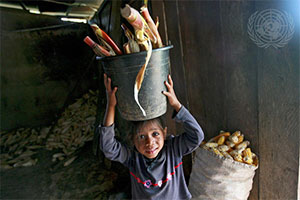 Timorese Girl with Fresh-Picked Corn. Credit: UN Photo/Martine Perret
A global common denominator is the need for a decent job. The economic realities of each country determine just how difficult it is to find one. Despite the labour movement's achievements, serious challenges persist: gender discrimination, child labour, worker migration, the digital divide and AI automation, evaporating pensions, unsafe workplaces, corporate pressure against union organising, negative impacts of trade agreements, and the precariousness of informal employment. The 2025 UN SDG Report identifies jobs and social protections as one of the six priority areas requiring urgent action, with progress either stalled or reversing in many developing nations.
In recent years, the fight to protect labour equality has taken on new dimensions with the rise of Environmental, Social and Governance standards. With the Social aspect aiming to promote equality and human rights, ESG principles have strengthened labour advocacy within corporate and governmental regulatory landscapes. In particular, ESG has become much more institutionalized in emerging economies such as Brazil and China. IPS follows the world’s workers as they confront these challenges - their setbacks and their successes.

The Week with IPS

NEXT STOP - SDGs
Tracking global progress towards a sustainable world
Tracking global progress towards a sustainable world
