Languages
Tuesday, November 17, 2026



News and Views from the Global South
Natural Resources

U.S.: New Oil Pipeline Sparks Civil Disobedience
On the tenth day of a protest wave that has been gaining momentum since Aug. 20 and will continue until Sep. 3, nearly 300 people gathered in Lafayette Park directly across from the White House in Washington D.C., chanting, "When I say 'tar sands', you say 'no!' When I say 'action', you say 'go!'"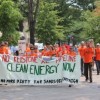
NORTH AMERICA: Keystone XL: A Pipeline to Europe?
The promoters of Keystone XL, a huge new oil pipeline from northern Canada to the U.S. Gulf Coast, claim that it will reduce U.S. reliance on oil imports from unfriendly countries.
SOUTH SUDAN: Inter-Ethnic Clashes Become More Frequent and Deadly
Thousands of women and children are being abducted and over 1,000 people have died this year as communities in oil-rich South Sudan war over a precious commodity – cattle.PAKISTAN: Gem of a Plan Against Taliban
Mining gems and other valuable minerals may provide, the Pakistan government hopes, alternate careers to militancy in the restive Federally Administered Tribal Areas (FATA), bordering Afghanistan.
CLIMATE CHANGE: Welcome to Bizarro World
Canada and the United States are now the centre of Bizarro World. This is where leaders promise to reduce carbon emissions but ensure a new, supersized oil pipeline called Keystone XL is built, guaranteeing further expansion of the Alberta tar sands that produce the world's most carbon-laden oil.OP-ED: The Missing Truth in the BP Oil Disaster
More than a year after a private company operating in public waters retched 170 million gallons of crude and two million gallons of toxic dispersants into the Gulf of Mexico, creating an environmental catastrophe, we still lack reliable statistics on the BP oil disaster's impact on the health of residents.
CUBA: Petrochemical Complex Poses Major Environmental Challenge
As it gears up for the creation of a major petrochemical complex of regional scope, this Cuban city faces the challenge of ensuring the sustainability of development that could compromise the health of the Bay of Cienfuegos, its main natural resource.
IRAN: New Oil Minister Cements Ties with Military
Last week's appointment of a ranking member of Iran's influential Revolutionary Guard Corps (IRGC) as the country's new oil minister could lead to a more unaccountable and unpredictable military with greater influence on the government in Tehran, analysts say.ECUADOR: Big Bucks from China Drive Domestic Development
Ecuador sees the loans it has agreed with China as "good news," because they are long-term, and all that is required in return is "oil, and not the horrendous adjustments imposed by the IMF (International Monetary Fund)," leftwing Ecuadorian President Rafael Correa told analysts critical of the size and high interest rates of the loans.NIGERIA: Refined Oil Shortage Continues for Africa’s Largest Producer
"We are suffering in the midst of plenty." That was how Nelson Ilemchi summed up his plight as he spent an entire day queuing to buy kerosene. Since January Africa’s largest producer of crude oil has been experiencing a protracted nationwide scarcity of the refined product.U.S.: BP Disaster a Year Later, Healthcare Crisis Worsens
When news of the disastrous BP oil well explosion reached the residents of Jean Lafitte, Louisiana last April, Mayor Tim Kerner did the only thing he could think of to stop the oil from destroying his community. He encouraged everyone in his town to join him on the water, working day and night throughout the disaster to clean-up the spill.SOUTH SUDAN: Row Over Exorbitant Fees for Pipeline Use
Less than three weeks after gaining independence, South Sudan is embroiled in a row with Sudan over pipeline fees charged by the latter to export oil.Latin America Has One-Fifth of Global Oil Reserves
Fossil fuels are an energy source condemned by environmentalists, but do not appear to be on the way out in Latin America and the Caribbean, given the rise in the region's proven oil reserves in recent years.U.S. Warns of Dark Path Ahead Without Cooperation in Sudan
As South Sudan was admitted as the 193rd member of the United Nations on Thursday, officials in Washington said the hard work in the fragile new country has just begun.ECUADOR: Fate of Untapped Oil Hangs in the Balance – of Trust Fund
"Ecuador will not wait ad infinitum" for a decision by the international community, and "at the end of the year" President Rafael Correa will decide whether to extract oil that was to have been left underground at the Yasuní nature reserve, non-renewable natural resources minister Wilson Pástor has announced.South Sudan’s Independence Clouded by Unresolved Issues
Two days before celebrating the independence of South Sudan in Juba, senior U.S. officials warned Thursday that unresolved issues between the new country and Khartoum, as well as ongoing conflicts along or near their common border, threaten the stability of both states.
BOLIVIA-PERU: Major Efforts Still Needed to Clean Up Lake Titicaca
Efforts to combat pollution in Lake Titicaca, which straddles the borders of Peru and Bolivia high up in the Andes mountains, have shown slightly better results in Puno Bay on the Peruvian side, but have barely made a difference in Cohana Bay on the Bolivian side, according to local fishers and specialists interviewed by Tierramérica.TRADE: Brazil and Africa Ready to Do the Samba
African trade with India and China flourished over the past decade but, with unemployment rising and industrialisation failing to take hold, cracks are appearing in Africa’s much-vaunted "Look East" doctrine. Meanwhile, from across the Atlantic, Brazil is making inroads into the continent.ZIMBABWE: “Blood Diamonds” Slip Through Watchdog’s Cracks
Following a recent procedural breakdown of one of the world's leading "blood diamond" watchdogs, experts warn that controversial stones from the Marange fields of Zimbabwe may soon find their way into the hands of unknowing consumers.
Q&A: “Africa Can Provide More Than Minerals in South-South Trade”
South-South co-operation is firmly on Africa’s agenda. Leading the way is South Africa, which has recently joined up with Brazil, Russia, India and China’s BRIC formation to form a new global grouping of emerging markets, known as BRICS.BOLIVIA: Women Fight Superstition, Machismo in Mining Cooperatives
Hundreds of women belonging to mining cooperatives in Bolivia are striving for the right to mine seams of tin and silver in the country's western highlands, where an age old superstition maintains that the presence of women "scares away" the minerals.« Previous Page — Next Page »


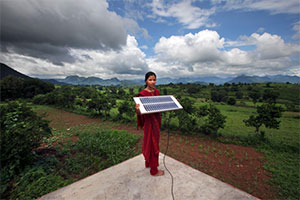 Bringing clean energy to rural India. Credit: Abbie Trayler-Smith / Panos Pictures / Department for International Development
Large reserves of oil, gas and minerals in developing countries generate opulent revenues. They could be used to stimulate economic growth and reduce poverty, but often result in environmental destruction and conflict, benefiting large companies and corrupt governments. Furthermore, competition over natural resources often manifests through geopolitical conflict. For example, before the US-Iraq war, Iraq’s domestic oil industry was nationalized. With US aggression came weakened Iraqi institutions and foreign intervention, thus eventually leading to the privatization of Iraqi oil, leaving the industry now largely dominated by Western companies. As another example, China’s rising investments within the lithium sector in South America are increasing the US-China rivalry across the Western Hemisphere. Notably, Bolivia has the largest reserves of lithium in the world, and the nation’s state-owned lithium extraction firm recently signed a contract with China’s CBC Consortium, while rejecting the entry of Western firms into the nation. In Bolivia’s case, rising Chinese investment in the nation’s lithium sector also raises concerns about environmental sustainability and the sociopolitical rights of Indigenous communities. More broadly, Sub-Saharan Africa holds nearly 30% of global reserves of critical minerals required for low-carbon technologies. Despite this, the region attracts less than 10% of global exploration investment, depicting a critical barrier to both the clean energy transitions and Sub-Saharan Africa’s economic development. Furthermore, resource wealth continues to fuel conflict like Sudan’s civil war, which has led to 9.1 million internally displaced people and is intensely connected to competition over gold, water, and agricultural land. IPS covers news about major oil, gas, and mining projects, their effects on the environment and local communities, and the ideas and actions of the interest groups involved.

The Week with IPS

NEXT STOP - SDGs
Tracking global progress towards a sustainable world
Tracking global progress towards a sustainable world
