Languages
Wednesday, November 18, 2026



News and Views from the Global South
Natural Resources
CUBA: Zeolite, Mineral of a Thousand Uses
Cuba, which has major reserves of zeolite, aims to boost exploitation of the mineral, whose properties and uses in products and technologies contribute to protecting the environment.U.S.: Obama Losing Control of Iran Policy
In a surprisingly swift move on Thursday night that could have wide-ranging implications, the U.S. Senate passed a bill containing broad unilateral sanctions to punish foreign companies that export gasoline to Iran or help expand its domestic refinery capabilities.POLITICS: U.N. Faulted for Toothless Sanctions in Civil Wars
The United Nations estimates that at least 40 percent of civil wars during the last 60 years have been fought either over natural resources - including diamonds, gold, timber, oil, gas, and cocoa - or sustained by revenues from rich minerals and commodities.EL SALVADOR: Activists Link Mining Co. to Murders
Environmental activists in El Salvador allege that managers of a gold mine owned by a Canadian corporation are implicated in the murders of three anti-mining activists.
CANADA: Hunt for Oil Patch Bomber Takes New Twist
Looking increasingly desperate after a 15-month-long hunt for a saboteur who has blown up six natural gas installations in northern Canada, police arrested an outspoken oil industry critic and then set him free a day later without pressing charges.
SOUTH SUDAN: Tension Builds as Peace Agreement Marks Anniversary
Sudan is at a crossroads. Its future looks grim. "Only a miracle can save it from disintegrating. The signs are already on the wall," says Khamis Lako, a petty trader in Juba, the capital of South Sudan.
ANGOLA: Togo Footballers Attacked
Armed men have opened fire on a bus carrying Togo's national football squad to the Africa Cup of Nations tournament in Angola, killing the driver and wounding at least two players, officials have said.POLITICS: Backlash against Rogue Chinese Investors Alarms Beijing
As China moves up in the world and the need for investment in its own infrastructure declines, Chinese investors and financiers are eyeing lucrative contracts in less developed countries, winning bids to build dams, power plants and highways from Burma to Uzbekistan and Angola.
TANZANIA: Community Still Worried By Mine Contamination
Susanna Solomon is still tending her shamba, but she won't eat the harvest from her farm when it's ready.IRAN: Revolutionary Guards Tighten Economic Hold
News that Iran's Revolutionary Guard Corps is withdrawing a billion dollars from the country's Foreign Reserve Fund in order to complete Phases 15 and 16 of the gigantic South Pars gas project has generated concern among Iranian analysts, who believe the move reveals the military organisation's excessive power over Iran's economy.
CLIMATE CHANGE: History Was Not Made
There is no Copenhagen climate treaty. History was not made here and no deal was sealed.U.S.: Aging Coal Plants Still a Fixture in South
As governments negotiate future greenhouse gas emissions in Copenhagen, a recent report from Environment America has highlighted the problem of the United States' older coal-fired power plants, which generated nearly three-quarters of U.S. carbon dioxide emissions from power plants in 2007.
Q&A: “We’re Here to Insert Some Reality into an Unreal Situation”
Bill McKibben is a U.S. writer, environmentalist and the founder of 350.org, an international climate campaign. His first book, "The End of Nature", was published in 1989 and is regarded as the first book written for a general audience about climate change.
CLIMATE CHANGE: Latin American Women Want Modified Trade Rules
"We don't need to change the climate, we need to change trade," said Brazilian activist Marta Lago at Klimaforum, the civil society meeting held in parallel with the climate change summit in the Danish capital.
OIL: A Market Psychology of Fear?
With or without a binding deal at the climate talks in Copenhagen this month, it seems the world may have to cut its oil consumption, as emerging geological and economic trends limit the availability and affordability of petroleum.U.S.: Climate Policy Derailed by Corporate Interests
As the U.S. climate delegation arrives in Copenhagen nearly empty-handed, watchdog groups back at home say they know why: a political system gone astray due to the influence of huge amounts of corporate cash.CLIMATE CHANGE: The Danish Example
Whether a new internationally binding treaty to reduce greenhouse gases and forestall climate change will be signed next month remains to be seen. What is clear though, is that if there is a place in the world that deserves to be the stage where this treaty ought to be signed, it is the Danish capital of Copenhagen.
AFRICA: We Are the Government
As if they were going to the races, Emma Musako and Monica Mhango showed up in their finest outfits to attend a meeting on the health, social and environmental impacts of uranium mining. They came because they, like the other attendees, no longer want to remain uninformed citizens.
Q&A: Peruvian Cardinal Does Not Want Rebel Priest as President
Catholic priest Marco Arana, who is also a social and environmental activist, has not yet officially decided to run in Peru's next presidential elections, but he is already facing opposition from the highest-level Catholic Church officials in the country.
ECUADOR: Oil Giant Is Gone, Legal and Environmental Mess Remains
The story began almost 40 years ago, but when filmmaker Joe Berlinger "saw villagers eating canned tuna fish because the fish in their rivers were too contaminated to eat, [he] knew [he] had to do something".ECONOMY-AFRICA: Pros and Cons to Huge Chinese Investment in DRC
Concerns abound about a nine billion dollar Chinese investment in the Democratic Republic of the Congo, especially around environmental consequences and transparency. And, on the Chinese side, investors complain not only about the lack of security in the DRC but about their own government not providing enough support.« Previous Page — Next Page »


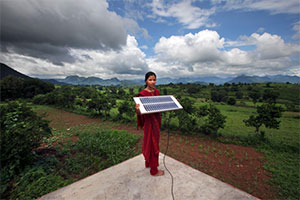 Bringing clean energy to rural India. Credit: Abbie Trayler-Smith / Panos Pictures / Department for International Development
Large reserves of oil, gas and minerals in developing countries generate opulent revenues. They could be used to stimulate economic growth and reduce poverty, but often result in environmental destruction and conflict, benefiting large companies and corrupt governments. Furthermore, competition over natural resources often manifests through geopolitical conflict. For example, before the US-Iraq war, Iraq’s domestic oil industry was nationalized. With US aggression came weakened Iraqi institutions and foreign intervention, thus eventually leading to the privatization of Iraqi oil, leaving the industry now largely dominated by Western companies. As another example, China’s rising investments within the lithium sector in South America are increasing the US-China rivalry across the Western Hemisphere. Notably, Bolivia has the largest reserves of lithium in the world, and the nation’s state-owned lithium extraction firm recently signed a contract with China’s CBC Consortium, while rejecting the entry of Western firms into the nation. In Bolivia’s case, rising Chinese investment in the nation’s lithium sector also raises concerns about environmental sustainability and the sociopolitical rights of Indigenous communities. More broadly, Sub-Saharan Africa holds nearly 30% of global reserves of critical minerals required for low-carbon technologies. Despite this, the region attracts less than 10% of global exploration investment, depicting a critical barrier to both the clean energy transitions and Sub-Saharan Africa’s economic development. Furthermore, resource wealth continues to fuel conflict like Sudan’s civil war, which has led to 9.1 million internally displaced people and is intensely connected to competition over gold, water, and agricultural land. IPS covers news about major oil, gas, and mining projects, their effects on the environment and local communities, and the ideas and actions of the interest groups involved.

The Week with IPS

NEXT STOP - SDGs
Tracking global progress towards a sustainable world
Tracking global progress towards a sustainable world
