Languages
Thursday, November 19, 2026



News and Views from the Global South
Population
SPAIN: Biofuels – Good for Business, Bad for the Poor, Say Activists
Making fuels from plants is strongly supported by the business community in Spain, but equally strongly criticised by environmental organisations because of its negative impact on food production.MEXICO: Politicians Make Hay With Flood Aid
In the southeastern Mexican state of Tabasco, hundreds of thousands of people made homeless by unprecedented flooding are queuing for up to six hours to collect food and water, a large part of which has been donated by ordinary Mexicans, but which is being used by some authorities and politicians to their own advantage.IBERO-AMERICA: Portugal Wants a Bigger Role
The Portuguese government has decided on a new strategy in Latin America: to cease being a wallflower at Ibero-American summits and take on a more active role, beyond the confines of Brazil, in relation to the Spanish-speaking countries.
DEVELOPMENT: Aid "Dismally Slow" in Reaching Poorest
Aid strategies must be retooled and bigotry stamped out if a rising tide of global wealth is to reach the poorest of the poor, says a new report.MEXICO: People, Nature Share Responsibility for Tabasco Tragedy
Hit by torrential rains in the last 15 days, 80 percent of the southwestern Mexican state of Tabasco is under water, one million people have been left homeless and damages are estimated at five billion dollars. Recovery will take years.SPAIN: Europe’s Gateway for Cocaine Clamps Down on Trafficking
The Spanish government plans to use more modern technology and strengthen its intelligence services to fight drug trafficking, both domestic and across its borders. Spain is the main gateway for drugs into Europe, and is also the European country with the highest levels of consumption.
CUBA: Churches Tackle Divisions by Discussing Ethics, Not Doctrine
A group of Christian denominations and ecumenical organisations in Cuba have launched an ethical dialogue aimed at smoothing over their historical differences and fomenting mutual understanding, knowledge, and openness to debate.IRAQ: Millions Trapped in Their Own Country
At least five million Iraqis have fled their homes due to the violence under the U.S.-led occupation, but half of them are unable to leave the country, according to well-informed estimates.GUATEMALA: Journalists Face Threats Over Report on Candidate
"Where are you? Hurry up, we’re waiting for you!" barked the voice on the telephone. Guatemalan journalist Enrique Castañeda had just finished writing an investigative article on rightwing presidential candidate Otto Pérez’s alleged links with organised crime, and this was the first phonecall he received.MEXICO-US: Anti-Drug Plan Shrouded in Suspicion
Doubt, mistrust and political friction have arisen over the so-called Merida Initiative, negotiated virtually in secret by the governments of Mexico and the United States. Although it is being touted as an anti-drug assistance programme, it also includes measures for tighter border security and action against terrorism.
DEVELOPMENT: Our Youth, Their Future
With young people a growing segment of the world's poorest, their voices in setting global development policies at the highest levels have never been more important.PERU: Disappointing Talks on Mining Miss the Point
Peruvian Prime Minister Jorge del Castillo signed a memorandum of understanding with mayors and governors opposed to the Majaz mining company’s Río Blanco project, which the people of the Piura highlands in northern Peru have been opposing for five years.MIGRATION: Italy to Be Home to 10 Million
Regular migrants have reached 6.2 percent of the population of Italy, above the European average of 5.6 percent. In the next 20-30 years, Italy is destined to become one of the EU countries with the highest population of migrants and people of migrant origin - more that 10 million - according to an annual report on migrations released Tuesday.SOUTH ASIA: Youth Demand Sex Education in Schools
Sahinaz Khatun, who is preparing for her school finals in a village in West Bengal state, has for the last two years kept condoms (and birth control pills) at her home and thinks nothing of discussing subjects like menstruation hygiene and masturbation with other adolescents.DOMINICAN REPUBLIC: Gov’t Turns Deaf Ear to UN Experts on Racism
Discrimination against Haitians and their descendants "only exists in the minds of a few sick people" who wish to do the Dominican Republic harm, said governing coalition legislator José Taveras in response to a critical report by United Nations observers.DEVELOPMENT-CAMBODIA: Getting Water to the Poor – And Making Profits Too
A Cambodian public official has weathered assassination threats and a slow-moving bureaucracy in this post-conflict country to create one of the most trusted and safest water supply systems in Asia.
CUBA: A Church Embraces Those Who Have Lost Their Way
In the heart of Balcón Arimao, a poor barrio on the fringes of the Cuban capital, a small evangelical church combines spirituality and community work, combating alcoholism, prostitution, crime and family breakdown.RIGHTS-ASIA: 'Fundamentalism Plays Out on Women's Bodies'
They twisted it, turned it and tore it apart, but the term ‘religious fundamentalism’ defied definition. But they were certain that it worked against women’s rights.RIGHTS-EL SALVADOR: Twenty Years of Deja Vu
Rosa Anaya was leaving her home early on her way to school that morning of Oct. 26, 1987 in El Salvador, when she saw her father, a few steps ahead of her, crumple beside his car, hit by six bullets.SOCIETY-BALKANS: Facing 'Extinction', Nations Seek Babies
A young woman lost her job in a small town in Serbia after she gave birth to a baby boy and was to be absent from work for a year. That sacking shook up a nation.
ELECTIONS-COLOMBIA: The Going Rate for Votes
What was the going rate for a vote? "About 100,000 pesos (50 dollars)," says Víctor Raúl Mosquera, the ombudsman for the northwestern Colombian department (province) of Chocó.« Previous Page — Next Page »


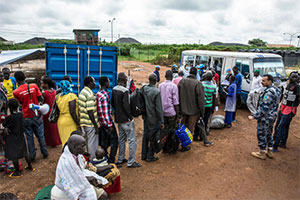 One Thousand Internally Displaced Persons (IDPs) Relocated from Tomping Camp in South Sudan. Credit: UN Photo/Isaac Billy
It took hundreds of thousands of years for the world’s human population to cross one billion in 1804. Approximately 200 years later, the population has multiplied sevenfold. In 2023, the global population crossed 8 billion, and is expected to reach 9 billion before 2050. With the planet more crowded than ever, it is essential to keep track of population trends, urbanization, migration, and reproduction across the world.
Life expectancy has seen significant strides in the past century, largely due to economic development and increased standards of living. On the contrary, trends in global fertility are shifting, with certain regions in Africa and Asia reporting higher rates, while parts of Europe and North America report stagnant or lower rates. This is in part due to differences in sexual and reproductive healthcare, as well as societal and economic conditions around the world. For example, child marriage is prevalent in certain societies, where childbearing is also considered a familial duty. Meanwhile, stagnating economies frequently experience lower marriage and childbearing rates.
The increase in migration and urban development around the world is also linked to global population trends. By 2050, it is expected that approximately 66 percent of all people will live in cities. Furthermore, global crises such as warfare and natural disasters also prompt transnational migration. Transnational migration is linked to a variety of socioeconomic issues in both host and receiving countries: migrants often leave developing countries with less access to educational and economic opportunities and arrive in developed countries where they are frequently the targets of ethnic, racial, and cultural discrimination, and economic exploitation. Recent crises in Europe and the United States demonstrate the importance of advocating for migrants worldwide. As migrants from the Global South are increasingly stripped of their legal and civic rights in unlawful deportations, or targeted in acts of identity-based violence, it is essential to keep track of population trends and protect the human rights of migrant populations. Climate-related disasters are now a major driver of displacement, with nearly half of all new internal displacements in 2025 being disaster-related.
IPS is devoted to covering issues surrounding population trends, migration, and reproduction through its compelling articles, which use both statistics and human stories to provide readers with robust and informative viewpoints.

The Week with IPS

NEXT STOP - SDGs
Tracking global progress towards a sustainable world
Tracking global progress towards a sustainable world
