Languages
Thursday, November 19, 2026



News and Views from the Global South
Population
RIGHTS: ‘Refugees Tortured in Greece’
Serious indication of torture, widespread violation of human rights, systematic abuse and complete neglect of human life is what refugees and undocumented immigrants face on the south-eastern border of the European Community.POPULATION-ASIA: Gendercide at Apocalyptic Levels – Experts
Experts at the 4th Asia Pacific Conference on Reproductive and Sexual Health and Rights are painting an apocalyptical vision of the Asian region where 163 million women are ‘missing’ and the sex ratio continues to decline as a result of easy access to modern gender selection techniques.CUBA: Separating the Wheat from the Chaff – Studying the Soviet Legacy
Although Cuba survived the demise of its communist allies in the early 1990s, the legacy of its close relationship with the Soviet Union and Eastern Europe may still have a bearing on the future of socialism on this Caribbean island nation.RIGHTS-EUROPE: 'Non-lethal Weapons' Tackle Protests Against Globalisation
Several European governments are arming their police forces with a new range of "non-lethal weapons" to put down protests against globalisation, and among immigrants.LEBANON: Palestinian Refugees Face Systematic Discrimination
Denied access to social services, education, adequate housing and employment, Palestinian refugees in Lebanon continue to suffer discrimination and marginalisation.POLITICS-SUDAN: Little Hope for Success Ahead of Darfur Talks
Long-awaited peace talks between Sudan's government and rebel groups from the country's war-torn Darfur region are due to begin in the Libyan port city of Sirte Saturday.
Q&A: "If You Are Poor, You Are Out"
Miloon Kothari, the U.N. special rapporteur for housing, recently visited Canada on a fact-finding mission to look at homelessness, aboriginal and women's housing issues, and the impact of the 2010 Olympic Games in Vancouver.ELECTIONS-ARGENTINA: President Kirchner’s Legacy, Pending Challenges
When Néstor Kirchner took over the presidency in 2003, Argentina was in a state of collapse. He managed to establish a model of economic growth that brought down the soaring unemployment and poverty rates. But whoever succeeds him in December will still have challenges to face.PAKISTAN/AFGHANISTAN: Civilians Flee Air Strikes on Militant Targets
Civilians are fleeing Pakistan’s lawless border areas abutting Afghanistan following heavy artillery fire and air strikes by the military against militant targets.
DRC: Hospital’s Tale Reveals Missing Children, Brutalised Women
Long after fighting in the Ituri region of the Democratic Republic of Congo (DRC) has largely subsided, civilian populations there continue to face high levels of violence from all sides, according to the global humanitarian group Doctors Without Borders/Médecins Sans Frontières (MSF).NICARAGUA: Of Forests, Floods, Fatalities and Famine
The forces of nature are giving Nicaragua no respite. After the hurricane that devastated the country’s northeastern Caribbean coast in September, weeks of torrential rains have claimed lives and caused economic damages, and now the Food and Agriculture Organisation (FAO) is warning of famine.MIGRATION: Fortress Europe Should Lower Its Drawbridge, Says NGO
The European Union is set to open its doors wide to qualified immigrants with its blue card system, and at the same time slam them even more tightly shut to undocumented workers, of whom there are 10 million in the bloc, including 700,000 in Spain.DEVELOPMENT: Good or Bad, Globalisation Marches On
The phenomenon of globalisation is on the rise in several regions of the world not usually thought of as heavyweights on the international stage, according to the seventh annual "Globalisation Index" released here Monday by Foreign Policy magazine.DEVELOPMENT: Pakistanis Challenge World Bank Over Water Works
Pakistani plaintiffs say the World Bank has yet to make good on promises to fix flaws blamed for lost lives and livelihoods along the world's largest irrigation system.
Q&A: “We Don’t Believe Gbagbo Will Organise Transparent Elections”
Will it be third time lucky for Ivorian opposition leader Alassane Ouattara during presidential elections which many hope will take place in Cote d'Ivoire next year?RIGHTS-ARGENTINA: Tortured Labour, Stolen Newborns
"Torture with the electric prod when she was close to term induced accelerated labour," says the report "Maternidades Clandestinas" (Motherhood in Clandestine Prisons), which tells the stories of dozens of women illegally imprisoned during Argentina’s 1976-1983 dictatorship.PARAGUAY: Environmentalists Up in Arms Over Mega-Port
Residents, environmentalists and local and national authorities in Paraguay are at odds over the pros and cons of a port complex being built by U.S. agribusiness giant Cargill on the outskirts of the capital.
CULTURE-VIETNAM: Drawing Tourist Dollars – Sans Noise, Sleaze
As Vietnam vies for a slice of South-east Asia's tourism pie, it finds itself grappling with a familiar problem - how to let the locals make a living out of the industry while maintaining the peace and exclusivity that foreign tourists seek.POLITICS-CUBA: Women, Local Elections and People’s Power
Marisol Cabrera has become quite at ease as president of the municipal government of the Cuban town of Placetas. But nine years ago it was another story, and she herself had doubts. "I wondered whether I was capable of this, it felt like a huge challenge. There was no tradition of women in this post," she says.CLIMATE CHANGE: South American Scientists Call for Social Commitment
Counteracting the effects of climate change in Latin America requires the involvement of society, two of the South American scientists on the IPCC, which was awarded the 2007 Nobel Peace Prize, said in Ecuador.SYRIA: Rights Groups Fly By Ever Darker Night
The fragile human rights situation in Syria shows little prospect of improving, with authorities moving consistently in the wrong direction and the international community, politically weakened in the region, able to do little more than watch, a major rights group said Wednesday.« Previous Page — Next Page »


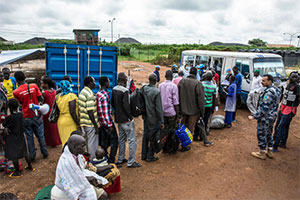 One Thousand Internally Displaced Persons (IDPs) Relocated from Tomping Camp in South Sudan. Credit: UN Photo/Isaac Billy
It took hundreds of thousands of years for the world’s human population to cross one billion in 1804. Approximately 200 years later, the population has multiplied sevenfold. In 2023, the global population crossed 8 billion, and is expected to reach 9 billion before 2050. With the planet more crowded than ever, it is essential to keep track of population trends, urbanization, migration, and reproduction across the world.
Life expectancy has seen significant strides in the past century, largely due to economic development and increased standards of living. On the contrary, trends in global fertility are shifting, with certain regions in Africa and Asia reporting higher rates, while parts of Europe and North America report stagnant or lower rates. This is in part due to differences in sexual and reproductive healthcare, as well as societal and economic conditions around the world. For example, child marriage is prevalent in certain societies, where childbearing is also considered a familial duty. Meanwhile, stagnating economies frequently experience lower marriage and childbearing rates.
The increase in migration and urban development around the world is also linked to global population trends. By 2050, it is expected that approximately 66 percent of all people will live in cities. Furthermore, global crises such as warfare and natural disasters also prompt transnational migration. Transnational migration is linked to a variety of socioeconomic issues in both host and receiving countries: migrants often leave developing countries with less access to educational and economic opportunities and arrive in developed countries where they are frequently the targets of ethnic, racial, and cultural discrimination, and economic exploitation. Recent crises in Europe and the United States demonstrate the importance of advocating for migrants worldwide. As migrants from the Global South are increasingly stripped of their legal and civic rights in unlawful deportations, or targeted in acts of identity-based violence, it is essential to keep track of population trends and protect the human rights of migrant populations. Climate-related disasters are now a major driver of displacement, with nearly half of all new internal displacements in 2025 being disaster-related.
IPS is devoted to covering issues surrounding population trends, migration, and reproduction through its compelling articles, which use both statistics and human stories to provide readers with robust and informative viewpoints.

The Week with IPS

NEXT STOP - SDGs
Tracking global progress towards a sustainable world
Tracking global progress towards a sustainable world
