Languages
Friday, September 18, 2026



News and Views from the Global South
Population

Guatemalan Peasants Overcome Drought in the Dry Corridor
Water scarcity that relentlessly hits the rural communities in eastern Guatemala, located in the so-called Central American Dry Corridor, is a constant threat due to the challenges in producing food, year after year. But it is also an incentive to strive to overcome adversities.
Women’s Leadership at the Heart of Disaster Risk Reduction
Climate and environmental challenges are hitting harder and more often, reshaping people’s lives around the world. While disasters touch everyone, their impacts are not felt equally. The most marginalized, especially women and girls, are too often the first to suffer and the last to recover.
XDR-TB Drug Trial Participants Continue to Celebrate its Success
When Tsholofelo Msimango joined a small trial of a new drug regimen for tuberculosis (TB) treatment a decade ago, she had no idea whether the medicines she was about to be given would help her.
Connecting the Dots: Policy Shifts, Realities and Lessons
The Asia-Pacific region has long served as a springboard for transforming socio-economic implementation gaps into development opportunities. With the 2030 deadline for the Sustainable Development Goals fast approaching, policymakers are stepping up efforts to translate policy announcements into tangible impacts.
Parliamentarians Seek Solutions to Protect Children from Digital Abuse
Vulnerable children are being targeted online faster than parliamentarians and law enforcers can act, a conference convened by the Asian Population and Development Association (APDA) heard. Yet, with international cooperation and sharing of ideas, lawmakers believe the scourge of online abuse can be addressed.
Beijing+30: A Culmination of International, Intergenerational Dialogue
Thirty years since the UN Fourth World Conference on Women in Beijing, the resolve that defined and united the world toward a global agenda for gender equality make it just as relevant in 2025.
African Voices at UNGA80: Building Sustainable and Self-Reliant Systems Through Innovation
On September 24, African-led organizations convened a high-level side event during the 80th session of the United Nations General Assembly (UNGA80) The event - African-led Innovation: Shaping Sustainable Futures With or Without Aid - was organized in partnership with eHealth Africa, Population Services International (PSI), Population Council, and Reach Digital Health. The dialogue amplified voices from African-led organizations and highlighted the importance of homegrown innovations for sustainability—regardless of the availability of foreign aid—amid shrinking donor funding and widening global inequalities.
Ending Child Marriage Needs a Culture of Accountability, Respect for the Rule of Law
Global leaders came together at the sidelines of this year’s UN General Assembly to commit to ending child marriage, calling on all world leaders to make concerted efforts to ensure accountability and enforce the laws that prohibit it.
Food Insecurity Rising in Africa, Falling in Latin America and Caribbean
The 2025 State of Food Security and Nutrition in the World (SOFI) report shows a modest global decline in hunger since 2022, with 673 million people facing hunger in 2024, indicating a decrease of 22 million compared to 2022. While progress is seen in Asia and South America, hunger is rising in Africa and Western Asia.
How Stigma Undermines Contraceptive Use Among Women in Sierra Leone
Eunice Dumbuya, a young activist in Freetown, Sierra Leone, still remembers being called promiscuous after getting a contraceptive implant a few years ago. She knew the risks of an unplanned pregnancy in her conservative country, so she made a choice.
Most of This Population Wants Immigrants, But Not the Government
Most of the population in this country wants immigrants, but the current government does not share the same sentiment. The country in question is the United States, often referred to as “a nation of immigrants”, home to more immigrants than any other country worldwide, having received over 100 million immigrants since its founding in 1776.
Rise of the Planet of the Aged
It is becoming increasingly apparent that planet Earth is evolving into the planet of the aged. In nearly every country around the world, the numbers and percentages of the aged, commonly defined as individuals aged 65 years or older, have increased rapidly.
Hypertension and Diabetes Grows Among India’s Poor Communities
Generally thought to be diseases of the wealthier classes, non-communicable diseases (NCDs) like hypertension and diabetes are on the rise among India’s underprivileged working classes in semi-urban and rural sprawls.
Aid Funding Crisis Means Parliamentarians’ Visionary Leadership Even More Crucial
As funding for sexual and reproductive health rights was on a “cliff edge,” parliamentarians now needed to play a “visionary” leadership role because “financing strong, resilient health systems for all their people rests with governments,” said Dr. Alvaro Bermejo, Director General of the International Planned Parenthood Federation (IPPF).
Sexual Health Rights: Contradictions in East African Laws, Policies
Sarah Namukisa nearly missed her final year exams earlier this year. She was subjected to a mandatory pregnancy test—the 25-year-old student at the Medical Laboratory Training School in Jinja was then expelled because she was pregnant.
The Hidden Backbone of Maternal Health: Asia’s Midwifery Gap
Asia-Pacific’s midwives are a healthcare lifeline capable of delivering nearly 90 percent of essential maternal and newborn services. Yet the region grapples with severe shortages, underinvestment, and systemic neglect.
Solar-Powered Fish Farming Feeds Indigenous Communities in the Peruvian Amazon
"Our organization is showing that it is indeed possible to move toward energy transition and not depend on oil," said Elaina Shajian, president of the Regional Coordinator of Indigenous Peoples of San Lorenzo (Corpi-SL), in the Peruvian Amazon.
Women From Landlocked Developing Countries Set Sights on Open Horizons
“Progress towards gender equality and equity remains uneven and far too slow. One in four women in landlocked developing countries (LLDCs) live in extreme poverty, and this is nearly 75 million women,” said Rabab Fatima, Secretary-General of the Third United Nations Conference on Landlocked Developing Countries or LLDC3 ongoing in Awaza, Turkmenistan.
Africa’s ‘Land-Linked’ Nations Chart a New Trade Route to Prosperity
Once relegated to the periphery of Africa’s economic map due to their lack of coastline, the continent’s landlocked developing countries (LLDCs) are now reframing their geographic constraints as gateways to opportunity.
Spotlight on Landlocked Developing Countries Ahead of Third UN Conference
Landlocked developing countries face a unique set of challenges. Without coastal ports, they rely on transit nations, causing higher trade costs and delays.
An Ageing World on a Heating Planet: Why Older People Must Be Central to Climate Policy
I've just returned from the east coast of India, where I saw for myself the harsh challenges that older people in artisanal fishing communities confront daily. I saw how the community elders — the keepers of marine traditions and the coastal environment — are being forsaken by climate policy and their governments.« Previous Page — Next Page »


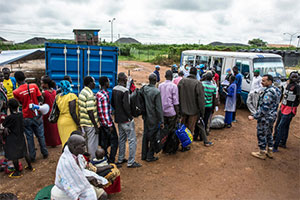 One Thousand Internally Displaced Persons (IDPs) Relocated from Tomping Camp in South Sudan. Credit: UN Photo/Isaac Billy
It took hundreds of thousands of years for the world’s human population to cross one billion in 1804. Approximately 200 years later, the population has multiplied sevenfold. In 2023, the global population crossed 8 billion, and is expected to reach 9 billion before 2050. With the planet more crowded than ever, it is essential to keep track of population trends, urbanization, migration, and reproduction across the world.
Life expectancy has seen significant strides in the past century, largely due to economic development and increased standards of living. On the contrary, trends in global fertility are shifting, with certain regions in Africa and Asia reporting higher rates, while parts of Europe and North America report stagnant or lower rates. This is in part due to differences in sexual and reproductive healthcare, as well as societal and economic conditions around the world. For example, child marriage is prevalent in certain societies, where childbearing is also considered a familial duty. Meanwhile, stagnating economies frequently experience lower marriage and childbearing rates.
The increase in migration and urban development around the world is also linked to global population trends. By 2050, it is expected that approximately 66 percent of all people will live in cities. Furthermore, global crises such as warfare and natural disasters also prompt transnational migration. Transnational migration is linked to a variety of socioeconomic issues in both host and receiving countries: migrants often leave developing countries with less access to educational and economic opportunities and arrive in developed countries where they are frequently the targets of ethnic, racial, and cultural discrimination, and economic exploitation. Recent crises in Europe and the United States demonstrate the importance of advocating for migrants worldwide. As migrants from the Global South are increasingly stripped of their legal and civic rights in unlawful deportations, or targeted in acts of identity-based violence, it is essential to keep track of population trends and protect the human rights of migrant populations. Climate-related disasters are now a major driver of displacement, with nearly half of all new internal displacements in 2025 being disaster-related.
IPS is devoted to covering issues surrounding population trends, migration, and reproduction through its compelling articles, which use both statistics and human stories to provide readers with robust and informative viewpoints.

The Week with IPS

NEXT STOP - SDGs
Tracking global progress towards a sustainable world
Tracking global progress towards a sustainable world
