Languages
Wednesday, July 29, 2026



News and Views from the Global South


UN80 – Is it time for the Re-emergence of the Global Ministerial Environment Forum?
“We shall have to do more with less” was the summary message from a meeting in Oslo, Norway, this spring (2025), where the Minister of Foreign Affairs of Norway, Espen Barth Eide and Guy Ryder, Under-Secretary-General for Policy at the UN and Chair of UN80, both spoke about UN80 and the necessity to reform the UN.
The Humanitarian Sector is at a Breaking Point: Here’s How to Fix It
As world leaders convene in New York, September 22-30, for the 80th session of the UN General Assembly, they will confront a humanitarian sector in crisis. With only 9% of the $47 billion requested for global humanitarian needs currently funded, the sector faces what UN Emergency Relief Coordinator Tom Fletcher calls "a crisis of morale and legitimacy" alongside devastating funding cuts. So where do we go from here?
How Stigma Undermines Contraceptive Use Among Women in Sierra Leone
Eunice Dumbuya, a young activist in Freetown, Sierra Leone, still remembers being called promiscuous after getting a contraceptive implant a few years ago. She knew the risks of an unplanned pregnancy in her conservative country, so she made a choice.
To Sanctify Bigotry: The Case of Charlie Kirk
On September 11, Charlie Weimers, a Swedish Member of the European Parliament and active within the European Conservatives and Reformists Group, rose up during a Parliamentary session and asked for a minute of silence to honour the memory of Charlie Kirk, who the day before had been shot and killed during a political meeting at the Utah Valley University in the U.S.
146 Land and Environmental Defenders Killed or Disappeared in 2024
At least 146 land and environmental defenders were murdered or forcibly disappeared in 2024 for standing up against powerful state and corporate interests, according to a new report released by Global Witness.
Frontline of a Planetary Emergency: Africa Demands Climate Justice and Action
The room at the Swiss Inn Nexus Hotel in Bole was silent but tense as Sunita Narain, one of the world’s most influential environmental voices, fixed her gaze on rows of African journalists, scientists, and policymakers. Her tone was gentle, but the words cut deep.
Outsourcing Cruelty: Trump’s Mass Deportation Machine
Thousands of Afghans who fled to the USA when the Taliban took over in August 2021 now face the prospect of deportation to countries they’ve never been to. People who risked everything to escape persecution, often because they helped US forces, now find themselves treated as unwanted cargo under the Trump administration’s anti-migration policy.
New Report Investigates Violence Against Women and Girls Through Surrogacy, Sparks Global Dialogue
A United Nations report calling for the global abolition of surrogacy has sparked intense debate among experts, with critics arguing that blanket bans could harm the very women the policy aims to protect.
World Leaders Should Commit to Human Rights, International Justice
World leaders gathering at the United Nations General Assembly from September 22-30, 2025, should commit to protecting the UN from powerful governments seeking to defund and undermine the organization’s capacity to promote human rights and international justice, Human Rights Watch said today.
Gender Equality: The Key to Peace, Prosperity, and Sustainability
On Monday, three decades on from the historic Fourth World Conference on Women, the General Assembly meets to discuss recommitting to, resourcing, and accelerating the implementation of the 1995 Beijing Platform for Action – an historic agreement which mapped the path to achieving gender equality and the empowerment of all women and girls.
A Meeting of Over 150 World Leaders Under One Roof—& the Day UN Came Under a Terror Attack
When the high-level meeting of the General Assembly takes place, September 22-30—with over 150 world political leaders in town--the UN will be in a locked down mode with extra tight security. With a rash of threats and political killings in the US—including an attempted assassination of Donald Trump when he was campaigning for the US presidency in July 2024-- the list continues.
Nepal’s Gen Z protest: How Fake News Tried to Rewrite a Revolution
Claims that Ravi Laxmi Chitrakar, wife of former Nepali Prime Minister Jhala Nath Khanal, was burned alive in her home—fake. The reports of an angry mob destroying and vandalizing the Pashupatinath Temple—fake. Allegations that protesters were demanding a Hindu nation in Nepal—fake. As Kathmandu and other Nepali cities erupted in unrest last week, the fire of fake news spread just as fiercely across Nepal and into neighboring India and the rest of the world.
Loss and Damage at COP30: Indigenous Leaders Challenge Top-Down Finance Models
As climate-induced disasters continue to devastate the Global South, nations are steadily mounting pressure at the United Nations for wealthier countries to deliver on long-promised climate reparations through the Loss and Damage Fund. For Indigenous peoples, whose territories are often the most ecologically intact yet most damaged by climate change, these negotiations define survival, sovereignty and recognition as rights-holders in global climate governance.
UN Independent Commission Finds That Israeli Forces Have Committed Genocide in Gaza
On September 16, the Israeli military began its ground offensive in Gaza City, accompanied by intensified bombardment of residential areas and a surge in civilian displacement. Concurrently, the United Nations Independent International Commission of Inquiry on the Occupied Palestinian Territory, including East Jerusalem and Israel, issued a report in which it found that Israel is responsible for committing genocide in Gaza, citing deliberate efforts to destroy Palestinian life, carried out with near-total impunity.
‘The Authoritarian Regime Uses Collective Punishment to Discourage Any Challenge to Its Authority’
CIVICUS discusses the deaths of Indigenous activists in custody in Tajikistan with Khursand Khurramov, an independent journalist and political analyst.

Struggle For Water Continues Following Israeli Attacks on Lebanon
Just under a year into a fragile ceasefire, 150,000 people in southern Lebanon continue to deal with the potentially lethal aftermath of Israeli bombing, highlighting the devastating long-term effects of conflict.
Better Use of the World’s Expertise in Navigating the Polycrisis
Other articles in this series on clustering conventions that are addressed by the Triple Environmental Crisis of pollution (Stanley-Jones), biodiversity (Schally) and climate change (Azores) I have touched on the idea of clustering not only conventions but the science-policy bodies established separately to serve them. We address the question of the negative consequences of maintaining status quo and identify how “consolidating knowledge” might make a difference.
When Civil Society is Kept Outside, We Should Build a Bigger Room
The recent IPS article, "UNGA’s High-Level Meetings: NGOs Banned Again," served as a stark and painful reminder of a long-standing paradox: the United Nations, an organization founded on the principle of "We the Peoples," often closes its doors to the very communities it was created to serve.
Why the Awaza Declaration Could Rewrite the Future for the World’s Landlocked Nations
The theater of diplomacy can be more revealing than the speeches. Under a scorching Caspian sun in Awaza, two marines lowered their flags with the precision of a ballet. The green silk of Turkmenistan, folded into a neat bundle before the UN’s blue-and-gold standard, fluttered briefly and vanished into waiting hands.
AfDB Commits 11 Billion Dollars To Support Early Warning Systems, Food Security in Rural Africa
As increasingly frequent droughts and devastating floods are affecting agricultural productivity, leaving millions of people food insecure in Africa amid a lack of climate finance, the African Development Bank (AfDB) has committed USD 11 billion to support various climate-resilient and infrastructure projects in rural areas.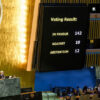
The Cruel Deceptions of Peace in Palestine
In a long past due move, the UN General Assembly voted 142-10 to approve a plan called “The New York Declaration” that hopes to revive the long dead Two State Solution for Palestinian Independence.« Previous Page — Next Page »


Want to keep up with the latest news and views from the Global South? Sign up for IPS Daily News Report for daily emails with our top stories about international development, climate change, gender and more. (Formerly IPS TerraViva since 1993).

The Week with IPS

NEXT STOP - SDGs
Tracking global progress towards a sustainable world
Tracking global progress towards a sustainable world
