Languages
Wednesday, August 26, 2026



News and Views from the Global South
Trade & Investment

Opinion: Brazil Poised on Verge of Unstable Equilibrium
As the political situation in Brazil appears to be reaching a state of unstable equilibrium, or more bluntly, as it is transformed from instability to impasse, the economy continues to deteriorate.
China’s Economy Has Sounded the Alert; Will Latin America Listen?
For years, Latin America has exported its raw materials to China’s voracious factories, fuelling economic growth. But now that the Asian giant is putting a priority on domestic consumption over industrial production, how will this region react?
Opinion: Misinformation Hides Real Dimension of Greek “Bailout”
The long saga on Greece is apparently over – European institutions have given Athens a third bailout of 86 billion euros which, combined with the previous two, makes a grand total of 240 billion euros.
Time to Work Out a Plan C for Greece
Just over a month ago, Greek citizens were asked to go to the polls for a referendum that posed the country with an unprecedented existential dilemma and challenged the EU with the possibility of its collapse.
Presalt Oil Drives Technological Development in Brazil
The extraction of deepwater oil, the most abundant kind in Brazil, is costly but foments technological and industrial development, requiring increasingly complex production equipment and techniques.
Opinion: Kerry Going Back Home
Recovering from a broken femur following a bicycle accident suffered in Switzerland, U.S. Secretary of State John Kerry – former senator and former presidential candidate – is anxious to accelerate his convalescence and will visit Cuba on Friday Aug. 14, where he will hoist the Stars and Stripes flag over the emblematic U.S. embassy building in Havana.
Opinion: Crisis, Emergency Measures and Failure of the ISDS System: The Case of Argentina
The investor-state dispute settlement (ISDS) system has come under increasing criticism in recent years.
Money, Knowledge and Controversy in Brazil’s Development Bank
Brazil’s rush to build hydroelectric dams, refineries, railways, ports and other megaprojects since the last decade, not only at home but in other countries as well, has been fueled by the sheer volume of financing from its development bank.
Opinion: The Road to Paris and the Path to Renewable Energy
Renewable energy is now being seen by many people around the world as a cost-effective development solution both for developed and developing nations. Countries have slowly been realising that the use of coal and the huge amount of carbon emissions it generates harms the environment and impacts our daily activities.
U.N. Post-2015 Development Agenda Adopted Amidst Closed-Door Deals
At about a quarter to seven on the evening of Sunday, Aug. 2, the member states of the United Nations adopted the post-2015 development agenda outcome document, titled "Transforming Our World: The 2030 Agenda."
Trans Fat Substitute May Lead to More Deforestation
Following growing concerns in the United States about the risks of trans fat since 1999, demand for palm oil, a cheap substitute for trans fat, more than doubled over the last decade and is expected to increase, eliciting concerns about deforestation in several Southeast Asian countries that provide 85 percent of the world’s palm oil.
Opinion: No Aid, No Tax, No Development
The Addis Ababa Action Agenda is widely seen as a major disappointment for developing countries as well as others hoping for adequate means of implementation to realise national development ambitions and the Sustainable Development Goals (SDGs).
U.N. Taps Private Sector to Fund Development, Advocate Social Causes
When the United Nations seeks outside financial assistance either for development needs or to advocate social causes, it invariably turns to the private sector these days.
Suez Canal Reopens to Fanfare but Not Shared by All
Ships at sea around the world will blast their horns on Aug 6 to mark the re-opening of the world-famous centenarian waterway in Egypt, local officials there say.
Belo Monte Dam Marks a Before and After for Energy Projects in Brazil
Paulo de Oliveira drives a taxi in the northern Brazilian city of Altamira, but only when he is out of work in what he considers his true profession: operator of heavy vehicles like trucks, mixers or tractor loaders.
Even the Rich Have Not Harnessed Full Potential of Digital Economy
The digital economy permeates countless aspects of the world economy, impacting sectors as varied as banking, retail, energy, transportation, education, publishing, media or health. But the full potential of the digital economy has yet to be realised even in the world’s most advanced and emerging countries, says a new report.
Opinion: Developing Nations Set to Challenge Rich Ahead of SDG Summit
The final round of negotiations on the Sustainable Development Goals – the successor to the Millennium Development Goals, due to be inaugurated in September at the U.N. General Assembly – is now underway in New York.
Opinion: European Federalism and Missed Opportunities
"A serious political and social crisis will sweep through the euro countries if they do not decide to strengthen the integration of their economies. The euro zone crisis did not begin with the Greek crisis, but was manifested much earlier, when a monetary union was created without economic and fiscal union in the context of a financial sector drugged on debt and speculation.”
Mideast Arms Build-up Negative Fallout from Iran Nuclear Deal
The nuclear agreement concluded last week between Iran and six big powers, the United States, Britain, France, Russia, China and Germany, is threatening to trigger a new Middle East military build-up – not with nuclear weapons but with conventional arms, including fighter planes, combat helicopters, warships, missiles, battle tanks and heavy artillery.
Opinion: Addis Outcome Will Impact Heavily on Post-2015 Agenda – Part 2
The United Nations is the only universal forum that connects systemic issues to the global partnership for development. The latter recognises North-South cooperation based on historical responsibility and varying levels of development and capacity among member states of the U.N.
Opinion: A BRICS Bank to Challenge the Bretton Woods System?
The formal opening of the BRICS Bank in Shanghai on Jul. 21 following the seventh summit of the world’s five leading emerging economies held recently in the Russian city of Ufa, demonstrates the speed with which an alternative global financial architecture is emerging.« Previous Page — Next Page »


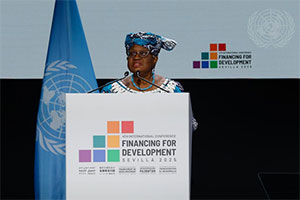 Opening of 4th International Conference on Financing for Development. Credit: UN Photo/Mariscal
International trade and investment are crucial elements of the world economy. While they can be powerful stimulators of development, they can also lead to global imbalances and dynamics of exploitation. In 2025, international trade entered a period of immense disruption, driven in part by a new wave of United States tariffs that reshaped global supply chains and investment flows. The increase in the US tariff rate, the highest since the 1930s, has forced bilateral renegotiations with global trading partners. Furthermore, the debt crisis in developing nations has accelerated while Official Development Assistance (ODA) has substantially dropped 7.3% in 2024.
In the 21st century, advancements in economic diversification in formerly colonized nations have propelled them into more central roles in the global economy. For example, both China and Mexico were able to develop their manufacturing sector and channel this development into booming export flows, thus advancing into the position of emerging economies. Foreign investment also plays an essential role in providing capital for developing countries, although they are oftentimes accompanied by social and environmental exploitation. For example, rising Chinese investments in natural resources in Latin America have often been met with tension as these investment projects fail to properly mitigate environmental risks and protect workers’ rights. In a more multifaceted vein, Sino-African relations have led to infrastructure development in Sub-Saharan Africa while also heightening the region’s economic dependency on China. IPS reports on global news in trade and investment, while shining a light on the nuanced nature of these endeavors.

The Week with IPS

NEXT STOP - SDGs
Tracking global progress towards a sustainable world
Tracking global progress towards a sustainable world
