Languages
Wednesday, October 7, 2026



News and Views from the Global South
Education Cannot Wait. Future of Education is here

Education Cannot Wait Interviews Ramiz Alakbarov, UN Resident Coordinator and Humanitarian Coordinator in Ethiopia
Dr. Ramiz Alakbarov was appointed as the UN Resident Coordinator and Humanitarian Coordinator in Ethiopia by the UN Secretary-General António Guterres in August 2023.
World Day of Social Justice Statement by Education Cannot Wait Director Yasmine Sherif
The central theme of this year’s World Day of Social Justice is to “strengthen a just transition for a sustainable future.” Education is the very foundation for achieving social justice. Without an education we cannot end extreme poverty and advance economic growth. Without an education we cannot empower young girls to become teachers, doctors, nurses, lawyers, engineers, let alone financially self-reliant. Without an education we cannot achieve good governance, the rule of law and peaceful co-existence.
Not an Option. A Call for Action
A global alert is not an option. It requires global action. Over the past three years, the number of crisis-impacted school-aged children in need of urgent quality education support has grown by an alarming 35 million, according to Education Cannot Wait’s new Global Estimates Report.
Education Cannot Wait Interviews Adenike Oladosu, ECW Global Climate Champion and BBC 100 Women 2024
Adenike Oladosu is a leading Nigerian ecofeminist, climate justice leader and researcher. She was appointed as an ECW Global Climate Champion on World Environment Day in June 2024. In December of last year, Adenike was honored by #BBC100Women, selected as one of the BBC’s 100 most influential and inspiring women from around the world. She was also a finalist for the Pritzker Emerging Environmental Genius Award.

Education Cannot Wait Interviews UN Special Rapporteur on the Situation of Human Rights in Afghanistan Richard Bennett
Richard Bennett was appointed as the Special Rapporteur on the situation of human rights in Afghanistan in April 2022. He has served in Afghanistan on several occasions in different capacities, including as the Chief of the Human Rights Service with the United Nations Assistance Mission in Afghanistan. He has previously played a role in the promotion and protection of human rights in Afghanistan and supported the United Nations on a number of human rights issues, such as protection of civilians, transitional justice, child rights, rule of law, rights of people with disabilities, protection of human rights defenders and a range of economic, social and cultural rights.

We Can and Must Do Our Best
As 2024 comes to a close, I dare to say that this has been an especially gruesome year for millions upon millions of young children, their parents and their teachers. The world has witnessed one horrific crisis of cruelty, dispossession and human suffering after another.
Bold Donor Action Urgently Needed to Give Ethiopia’s Crisis-Impacted Children a Lifeline
Ethiopia’s education system is buckling under the weight of complex, competing challenges. The aftermath of a deadly war in the north, ongoing violence, climate-induced disasters, and widespread forced displacements have converged to push as many as 9 million children out of school. With close to 18 percent of schools in the country destroyed or damaged and persisting intercommunal conflicts in various regions, there are fears that many might never find their way back to school.
Embedding Education into Climate Finance Will Deliver Desired Learning, Climate Action Outcomes
Education is under threat as multiple crises push children out of school and into harms way. COP29 Baku could break historical barriers that hold back education from playing a unique, critical role to accelerate the ambition of nationally determined contributions (NDCs) to the Paris Agreement, protecting people and planet from life-threatening risks of climate change.
Education Cannot Wait Interviews Matthias Schmale, UN Resident and Humanitarian Coordinator in Ukraine
Matthias Schmale is the Assistant Secretary-General, UN Resident and Humanitarian Coordinator in Ukraine. Schmale brings more than 30 years of experience in humanitarian and development work. He previously served as Senior Adviser to the UN Development Coordination Office’s regional team for Africa, as Resident and Humanitarian Coordinator (a.i) in Nigeria, and in several high-level positions with the United Nations Relief and Works Agency for Palestine Refugees in the Near East (UNWRA), including Director for UNRWA Affairs in Lebanon, Gaza and New York, acting Chief of Staff and acting Deputy Commissioner General.

Transforming Africa with the Power of Education
Africa has the youngest population in the world today. Around 40% of the population is 15 or younger. They have a non-negotiable right to an inclusive and continued quality education, just like young people everywhere across the globe.
May Teacher Voices Echo Around the Globe
We must build a new social contract for education – a contract based on equality, equity, and universal human rights. At the center of our global efforts to ensure education for all, we must put teachers first in everything we do. They are frontlines heroes who deliver every day to educate children, cultivate young talent, and build a strong society. They are the substitute parents, the mentors and the ones who contribute to shaping the identify of a child in war, in refuge or in climate change.
Education Cannot Wait Interviews UNICEF Representative in Egypt Jeremy Hopkins
Jeremy Hopkins is half Kenyan and half British and graduated with a MA in Arabic and Social Anthropology (Edinburgh) and a MSc in Development Studies (SOAS – University of London). He started his career with WFP in Somalia and then moved to UNICEF also in Somalia as a Child Protection specialist but with an overview on Youth, HIV and C4D portfolios. He worked again as a child protection specialist in Mozambique after which he was a Deputy Representative in Central African Republic, Yemen and Somalia (again!). He has been acting Representative in South Sudan for a short while, Representative in Burundi and is currently Representative in Egypt. Outside the professional realm Jeremy enjoys music, travelling, surfing and photography.
Cultivating a Culture of Peace
The longing for peace transcends time, geography and religion. Based on justice, human rights and universal values outlined in the UN Charter, a culture of peace brings us all together in our common agenda for humanity. We can only co-exist by aligning ourselves with such a world order.
We Stand with the Girls and Women of Afghanistan
Today, we stand with solemn hearts as the world marks this week the three-year ban on girls’ secondary education in Afghanistan. Today and every day, we must stand up for the millions of Afghan girls and women living under the yoke of gender-apartheid: systematized and institutionalized oppression, exclusion, and marginalization based exclusively on their gender. However, standing in solemnity for their suffering is not enough. We must act to remove the oppression and injustice. Against all odds, we must continue to deliver results to provide the girls access to an education well beyond grade sixth.
Global Community Urged to Help Deliver Quality, Holistic Education for Ukrainian Children
In a major escalation of a conflict that started in 2014 and which is the largest in Europe since World War II, Russia invaded Ukraine in February 2022. Since then, thousands of Ukrainian civilians—many of them women and children—have lost their lives. Countless others have been displaced from their homes, clinging to what remains of the education system as their communities disintegrate.
Fast-Acting Interventions Needed for Sudanese Refugee Children as Needs Outpace Response
As peace eludes war-torn Sudan, thousands of displaced people fleeing the deadly battle between the Sudanese Armed Forces (SAF) and Rapid Support Forces (RSF) have found refuge in neighboring countries, including Egypt.
Rohingya Refugees Must Not Be Forgotten
Seven years ago, a brutal campaign of violence, rape and terror against the Rohingya people ignited in Myanmar’s Rakhine State. Villages were burned to the ground, families were murdered, massive human rights violations were reported, and around 700,000 people – half of them children – fled their homes to seek refuge in Bangladesh.
Education Cannot Wait Interviews UNRWA Commissioner-General Philippe Lazzarini
On 18 March 2020, Philippe Lazzarini was appointed Under-Secretary-General of the United Nations and Commissioner-General of the United Nations Relief and Works Agency for Palestine Refugees in the Near East (UNRWA) by United Nations Secretary-General António Guterres. He took up his post with UNRWA on 1 April 2020.

Power to the Youth
We live in a divided world of the haves and the have nots. The rich get richer, the poor get poorer. There is learning poverty, technology poverty, healthcare poverty, and food poverty. When you think about the dynamics of the world today, there is even empathy and humanity poverty.
Gaza Children’s Education, Mental Health Targeted With Emergency Response Grant
Since October 2023, 625,000 children enrolled in schools across Gaza have had no access to education, and more than 370 schools have sustained damage from attacks, according to the United Nations.
Education Cannot Wait Interviews The Sunday Times Chief Foreign Correspondent, Best-Selling Author and ECW Global Champion, Christina Lamb
Christina Lamb is Chief Foreign Correspondent at The Sunday Times and one of Britain’s leading foreign journalists as well as a bestselling author. She has been awarded Foreign Correspondent of the Year six times as well as Europe’s top war reporting prize, the Prix Bayeux, and was recently given the prestigious Lifetime Achievement Award by the British Society of Editors and the Outstanding Impact Award by Amnesty International.
« Previous Page — Next Page »





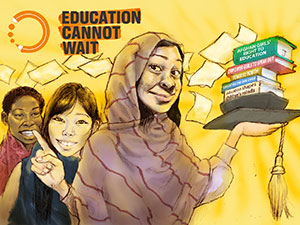
Education Cannot Wait has reached 5 million children and youth since its inception. Yet, the scale and the depth of the education emergency in crisis-affected countries needs to be matched by adeguate and scaled up financial investments to end the learning crisis for those left furthest behind, and to swiftly shift the course towards the SDGs. With 20 times more funding, the estimated 75 million children and youth can be reached. Indeed, financing stands between what is possible and what is not for these vulnerable girls and boys.
- Videos -
- Quote cards -


The Week with IPS

NEXT STOP - SDGs
Tracking global progress towards a sustainable world
Tracking global progress towards a sustainable world
