Languages
Saturday, October 24, 2026



News and Views from the Global South
Nuclear Energy - Nuclear Weapons
NPT Meet Draws Thousands of Anti-Nukes Activists
Japanese women in kimonos carrying signs urging "No More Hiroshima", an 80-year-old grandmother, and 18 mayors from around the world were just some of the almost 15,000 people who marched in New York City Sunday to rally for the abolition of nuclear weapons.
Q&A: Nuclear Non-Proliferation Regime Has Triple Standards
The abolition of nuclear weapons - and a halt to the spread of the deadly armaments - will be a major talking point at the month-long Review Conference on the Nuclear Non-Proliferation Treaty (NPT), scheduled to take place at the United Nations beginning next week.U.S./IRAN: Sanctions Debate Heats Up
Wednesday's highly unusual public launch of a "conference committee" of both houses of Congress to hash out differences in long-pending legislation to impose unilateral sanctions on Iran marks a new stage in the escalating debate over what to do about Tehran's nuclear programme.U.S. Nuclear Option on Iran Linked to Israeli Attack Threat
The Barack Obama administration's declaration in its Nuclear Posture Review (NPR) that it is reserving the right to use nuclear weapons against Iran represents a new element in a strategy of persuading Tehran that an Israeli attack on Iranian nuclear sites is a serious possibility if Iran does not bow to the demand that it cease uranium enrichment.
Is the U.S. Going Soft on Israeli, Indian & Pakistani Nukes?
When a much-ballyhooed two-day nuclear security summit ended in Washington early this week, there were several lingering questions that remained unanswered - even by the host of the high-powered 47-nation gathering, U.S President Barack Obama.Nukes Lobbying Brings Obama’s Foreign Policy into Focus
The past two weeks have been marked by major foreign policy accomplishments for U.S. President Barack Obama, including the Nuclear Posture Review (NPR), the signing of a new Strategic Arms Reduction Treaty, and what appear to be improvements in the increasingly tense Washington-Beijing relationship.MIDEAST: Israel Trapped in Nuclear Isolation
As the world grapples with controlling the spread of nuclear weapons, it's a time of complex choices in a Middle East edging between possible confrontation with Iran and possible movement towards Israeli-Palestinian peace.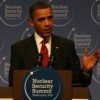
POLITICS: Nuclear Security Summit Boosts Disarmament Agenda
On the second and last day of the largest gathering of world leaders ever in Washington, U.S. President Barack Obama connected the commitments made here on securing vulnerable nuclear materials to the broader goal of a "nuclear-free world".DISARMAMENT: NGOs Praise U.S. Leadership on Nukes
One of the largest gatherings of world leaders ever on U.S. soil began Monday with representatives of 47 countries gathering here for the Nuclear Security Summit.DISARMAMENT: U.N. Chief Doubts Mideast Nuke-Free Zone
Against the backdrop of a major summit meeting of world leaders on nuclear non-proliferation hosted by the United States, Secretary-General Ban Ki-moon expressed strong doubts about the longstanding proposal to create a nuclear-free zone in the militarily-volatile Middle East.POLITICS: World Leaders to Meet on Nuclear Security
On Apr. 12 and 13, U.S. President Barack Obama will host over 40 world leaders in Washington to develop a strategy to secure nuclear materials and prevent nuclear terrorism, following up on his announcements this week that that the U.S. would significantly modify its nuclear strategy and reduce the number of nuclear warheads in its stockpile by one-third.DISARMAMENT: Hollywood Documentary Calls for Zero Nuclear Weapons
Hollywood and Silicon Valley leaders have teamed up with Middle Eastern royalty and high-level U.S. diplomats to send a message to heads of state who are gathering here in Washington next week: the world needs to reduce its nuclear arsenal to zero as soon as possible.DISARMAMENT: Mixed Reviews for Obama’s Nuclear Strategy
U.S. President Barack Obama Tuesday unveiled a new Nuclear Posture Review (NPR) that will significantly limit the circumstances under which Washington would use nuclear weapons as part of a strategy to bolster the Nuclear Non-Proliferation Treaty (NPT) and other efforts to halt and reverse the spread of nuclear arms.
Q&A: “They Knew I Was Not a Spy”
When world leaders meet in Washington later this month for a summit on nuclear security that is expected to include discussion of sanctions on Iran, they should also address the country's human rights situation, says Iranian-American journalist Roxana Saberi.US-CHINA: Spring Thaw in the Air?
Springtime appears to be bringing a thaw in U.S.-China relations, with U.S. President Barack Obama and Chinese President Hu Jintao holding an hour-long phone conversation Thursday in which both leaders expressed a desire to build a more positive bilateral relationshipIRAN: Obama Sanctions Strategy Complicated by Congress
President Barack Obama is hoping that relatively quick approval by the U.N. Security Council of a new round of sanctions against Iran will relieve growing pressure on Capitol Hill to take stronger measures against Tehran.
Q&A: To Try With Nukes as With Mines
Since the expiration of the Strategic Arms Reduction Treaty (START) in December, U.S. and Russian negotiators have been busy hammering out a new pact that will reduce the number of nuclear warheads deployed in both countries by about one-quarter, according to Washington./UPDATE*/POLITICS: U.S., Russia Nuclear Reductions START Again
When U.S. President Barack Obama accepted his Nobel Peace Prize last fall he said, "I'm working with [Russian] President [Dmitri] Medvedev to reduce America and Russia's nuclear stockpiles." Three and a half months later, that work has come to fruition.POLITICS-INDIA: Bhopal Legacy Haunts Nuclear Liability Bill
The U.S.-based multinational Union Carbide got away lightly after causing the world’s worst industrial tragedy at Bhopal, but that legacy has come to haunt U.S. corporations seeking to tap India’s newly opened market for nuclear power equipment.DISARMAMENT: Japan Pushes for Progress in U.S. Nuclear Review
Japanese parliamentarians and activists pin high hopes on the hotly debated and much anticipated U.S. Nuclear Posture Review (NPR) to which the Barack Obama administration is reported to be giving finishing touches.MIDEAST: Iran, Israel Spoiling for a Fight?
Iran and Israel appear to be spoiling for a fight, going by recent belligerent statements emanating from several regional capitals.« Previous Page — Next Page »





At first it was the United States. Then came Russia, China, Britain and France. Everyone wanted their own atomic bombs and atomic energy. While Israel quietly nurtured its nuclear programme, in Asia, rivals India and Pakistan, and most recently North Korea, joined the global nuclear club. Are nuclear weapons stockpiles adequately safeguarded? Is nuclear energy worth the risk? Read IPS.

The Week with IPS

NEXT STOP - SDGs
Tracking global progress towards a sustainable world
Tracking global progress towards a sustainable world
