Languages
Friday, November 13, 2026



News and Views from the Global South
Education
BALKANS: Religious Differences Go To School
When parents of today's school children went to school, religion was a private matter, something talked about at home or among friends and relatives in communist former Yugoslavia.POLITICS-US: Vets Press McCain to Back Greater Benefits
A leading political action committee founded by Iraq and Afghanistan veterans has launched a new internet video and petition demanding Republican presidential candidate Sen. John McCain throw his support behind a new G.I. Bill to provide improved education benefits for soldiers returning home from the two wars.COLOMBIA: Violent Society, Violent Schools
In a survey carried out in 807 public and private primary and secondary schools across the social spectrum in the Colombian capital, 56 percent of students said they had been robbed within the school premises.EDUCATION-SOUTH AFRICA: Making the Blackboard Jungle Less So
Violence in South African schools has claimed the lives of a number of children in recent years, while many more have been hospitalised with injuries.
Q&A: "A World 'Unfit' for 2.2 Billion Children"
As the United Nations plans to commemorate the 20th anniversary of its landmark Convention on the Rights of the Child next year, the world's 2.2 billion children continue to suffer the consequences of growing poverty, rising illiteracy, increasing sexual abuse and widespread military conscription in conflicts worldwide.HEALTH-BRAZIL: Education, the Only Weapon Against Dengue
After taking a number of emergency measures to combat the current dengue epidemic in Rio de Janeiro, health officials in Brazil have committed themselves to investing in education and awareness-raising in the future, as the only effective means of preventing further outbreaks of the disease.KENYA: Free Secondary Schooling Policy Faces Testing Times
When Kenya's government introduced free primary schooling in 2003, vast numbers of additional pupils were brought into the education system overnight, putting it on a steep learning curve.
EDUCATION-PAKISTAN: Religious Schools – Boon or Bane?
Mehboob Illahi, 15, cannot wait to leave Pakistan and the Jamia Binoria, the largest madrassa (religious school) in Karachi, forever.THAILAND: Islamic Teachers Blamed For Violent Separatism
As Thailand’s new government searches for fresh options to quell an escalating insurgency in the country’s south, its stance towards the region’s pondoks (Islamic schools), will be keenly watched.POLITICS: A Textbook Tale of Two Reports
Iran's post-revolutionary education system continues to teach children to discriminate against women and religious minorities, according to a report released Tuesday by Freedom House, a Washington-based nonprofit group that seeks to encourage democracy in the world.
KENYA: Education Amidst Displacement
With the new academic year in Kenya underway, teacher Moses Simiyu Kalenda is once again instructing children - just not in the place where he expected to be doing so.
BRAZIL: Small Fishermen Trade in Nets for Oyster Farms
In a modest restaurant on a beach at the southern tip of the Brazilian island of Florianópolis, a couple celebrates, with champagne and oysters, "one more year of vacations and love."
LEBANON: Children Get to Work Early
Walid is a wide-eyed boy of 10. His frail figure, of the kind common in such poverty-stricken areas, seems smaller than for a child his age. His hands are covered in dirt and paint. Here, in Ard Jalloul (the land of Jalloul), located in the populous Tarik Jdideh neighbourhood of Beirut, he works as a painter from 8am to 6pm for 7 dollars a day.
BRAZIL: Keeping Indigenous Identity Intact in “Urban Village”
"I desperately want to go back. I feel like I’m living in a prison here, but I stay on because I love my children," says Conceição Gonçalves, who misses the indigenous village of Taunay where she lived until last year, when she moved to the capital of the Brazilian state of Mato Grosso do Sul.
Q&A: As Civil Wars End, Child Soldiers Decline
The number of child soldiers, who are forcibly pressed into military service in conflicts worldwide, has declined: from about 300,000 in 1997 to an estimated 250,000 now, says U.N. Under-Secretary-General Radhika Coomaraswamy.
BRAZIL: Guarani Education Empowers Women Leaders
Leia Aquino gave up her plans to work in a hospital in order to be near her husband, a nurse, the day she saw a motorcyclist badly injured in an accident. Her aversion to the sight of so much blood led her to become a teacher instead, and now she runs a school for indigenous children on the Brazil-Paraguay border.RELIGION-CUBA: Catholic Church Wants More Freedom to Do Its Work
Ten years after the historic visit to Cuba by Pope John Paul II, who passed away in 2005, the Catholic Church continues to call for "unlimited" scope and "due freedom" for its social action initiatives in this socialist country, as one of its most important demands.
SCIENCE: Latin America Lags in Innovation and Technology
Brazil is the world leader in manufacturing small aircraft. In Argentina it was discovered that substances in the impotence drug Viagra can also treat sleep disorders. A non-polluting reactor was developed in Mexico to separate gold and silver from ore. All of this thanks to the work of home-grown scientists.LABOUR: ‘Migrants More Likely To Be Overqualified’
Rich countries must do more to integrate migrants into their societies and labour markets if they want to reap the economic benefits of skilled migration, says an OECD report released in Paris Wednesday.LATIN AMERICA: Gender Stereotypes Still Firmly Entrenched, Despite Progress
Constructing gender equality in Latin American societies remains an apparently arduous task. The issue is still confined to the ivory towers of academia, far away from the media, and is seldom included in the debates that really capture people’s attention.
Q&A: World's Children Have Progressed and Regressed
Most of the world's 2.2 billion children are languishing in extreme poverty, ignorance and exploitation, according to Reverend Keishi Miyamoto, who is described as the guiding spirit behind the Tokyo-based Global Network of Religions for Children (GNRC).« Previous Page — Next Page »


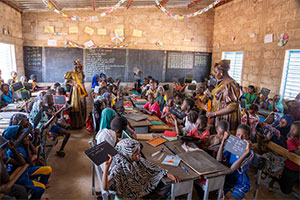 Two teachers work in a classroom in Forces Vives School in Dori, Burkina Faso. Credit: UNICEF/UNI978361
Safe and uninterrupted education is a fundamental right for all children. Education is paramount to global development, as it has been proven that investing in education – especially for girls and children – contributes significantly to economic growth and prosperity. Although more than 1 billion children go to school, many are subjected to conditions that are not conducive to a proper learning environment, including makeshift facilities, a lack of supplies, violence in classrooms, inadequate sanitation, untrained instructors, and widespread school closures. Since 2015, there have been immense gains in education with an increase of 109 million children in school. However, as of 2023, 272 million children are still out of school.
High poverty levels in developing countries also impede children’s access to a proper education. For example, from the early to mid 2000s, Sub-Saharan African nations witnessed a dramatic decline in trained teachers due to inadequate funding in the education sector. Furthermore, major cuts to United States international aid threaten an estimated 23 million additional children's access to education, as USAID‑funded school programmes across Africa and Asia face closure.
Various other factors contribute to the decline of education, notably hunger, which has increased as conflict and climate change interfere with global food production and dissemination. Meanwhile, certain social and cultural practices also impede children’s access to education, with gender inequality, discrimination, child labour, and child marriages preventing millions of children from attending school. Economic conditions such as the inaccessibility of higher education also affect disenfranchised communities across the world. In extreme situations, such as warfare where educational facilities are destroyed in their totality, notably in Gaza and Sudan, entire generations of children might grow up without access to education. Rebuilding educational infrastructure is a long and arduous process, especially when violence persists across generations, and this significantly stunts the development of societal prosperity and stability.
IPS is dedicated to telling the shocking truths about worldwide education through impassioned opinion pieces and comprehensive articles, highlighting global issues that impede worldwide education and the courses of action being taken by organizations such as UNICEF and Education Cannot Wait.

The Week with IPS

NEXT STOP - SDGs
Tracking global progress towards a sustainable world
Tracking global progress towards a sustainable world
