Languages
Friday, November 13, 2026



News and Views from the Global South
Education
ASTRONOMY-COLOMBIA: Dazzled by Stars, Dreams and Doubts
Esteban Felipe is six years old and wants to be a policeman when he grows up. Or better still, an astronomer, he says as he plays with a plastic rocket that he decorated with coloured paper at one of the children’s workshops at the 11th Festival of self-taught astronomers.CUBA: Student Denies Arrest, Says Criticism Was ‘Within the System’
A Cuban university student who made headlines around the world when a videotape of him questioning aspects of the country’s socialist system was posted on the Internet defended his right Tuesday to express constructive criticism from within the system and said that contrary to rumour, he was never arrested for speaking out.ARGENTINA: Public Employees Go for IT
In keeping with its aim to shore up the strong role played by the state, which was badly weakened during the years when free-market economic policies were predominant, the Argentine government is implementing a successful programme of electronic learning for its employees that is already being requested by a dozen Latin American countries interested in replicating the experience.IRAQ: The Road to Learning Can Be Dangerous
University professors now enjoy increased pay, but in the face of threats and isolation, there is little they are able to do in the world of academics.RIGHTS: Ignoring Girls' Welfare Carries High Price
Investing in young women and girls in developing regions must be a top priority for governments, multilateral agencies and the private sector, say the authors of a report released here this week.EDUCATION-SOUTH AFRICA: ‘We Need All Hands on Deck to Solve The Crisis’
Teachers who are not trained properly, teacher strikes and HIV/AIDS are taking a huge toll on the educational system in South Africa.SUDAN: Some Southerners Have Hope For Unity By 2011
Citizens from Sudan’s southern region, long caught in a power struggle with their country’s northern-controlled government, are looking with a mixture of hope and uncertainty to 2011 when they will vote in a referendum on whether or not the south will remain part of Sudan.EDUCATION-ZIMBABWE: Getting Harder To Keep Children In School
Alois Mufundisi, a media professional, earns 200 million Zimbabwean dollars, about 50 U.S. dollars on the thriving parallel market.
PERU: Intercultural University Scores Poorly on Equality
Peru’s only intercultural university was established in the country’s Amazon jungle region to provide higher education for indigenous people, thanks to a concerted struggle by native leaders. Yet only 40 percent of the students are actually from indigenous communities, while the majority are "mestizos" (people of mixed-race) from urban areas.SPAIN: Alliance of Civilisations Gets Off to an Auspicious Start
The First Forum of the Alliance of Civilisations sponsored by Turkey and Spain concluded in Madrid with concrete commitments, including generous funding, and the announcement that the second forum will be held in Turkey in 2009.ENVIRONMENT-NIGERIA: As E-Waste Dump, Lagos Imperils People
Nigeria’s commercial capital is arguably one of the largest dumps for obsolete electronic items otherwise called e-wastes.
Q&A: ‘We Want to Prepare Voters For the Election and the Post-Election Scenario’
"If you run an inherently unfair election it will lead to political unrest in a post- election scenario," Lovemore Madhuku, chairman of the National Constitutional Assembly (NCA) told IPS.RIGHTS-RWANDA: Children of the Genocide Struggle to Cope
What Gilbert Nshimyumukiza remembers most about the Rwandan genocide is that it started to rain as he and his brothers tried to carry his mortally wounded father back into their house.EDUCATION-SWAZILAND: Urban Youth Slipping Through The Cracks
As the new school year begins here many destitute or orphaned children are in need of assistance to pay for their educations. An unknown number of urban youngsters, however, are slipping through the social welfare net.LATIN AMERICA: Young People on the Fringes of Society
Seven million young Brazilians and nearly 800,000 youngsters in Argentina swell the ranks of a veritable army of Latin American youths who neither work nor study - a phenomenon that threatens to continue reproducing poverty unless effective measures are urgently taken to integrate them in society, say experts.ARGENTINA: Mixed Marks for Educational System
Successive economic and social crises in Argentina have left their mark on the public education system, which since the late 19th century has been a key factor of social integration and mobility in this South American country.EDUCATION-US: Seminole School Thriving In Florida
Elementary school children in U.S. public schools are preparing for their winter holiday vacations, but at a charter school here on the Seminole Indian Tribe of Florida’s Brighton Reservation, the children are enjoying their education so much that some of them want to keep on attending classes throughout the holidays.BRAZIL: Films, Music as Damage Control in Prisons
Cultural activities in Brazilian jails these days include film screenings, live bands and libraries with shelves packed with books - part of an attempt to combat the consequences of the appalling living conditions in prison.
Q&A: Righting Past Wrongs – Defending the Right to Sexual Diversity in Cuba
Cuban sexologist Mariela Castro shocked the world, and a good number of people in Cuba, this year when she announced a proposed legal reform in this socialist Caribbean island nation which would include the full recognition of the rights of gays, lesbians, transsexuals, transvestites and transgender persons.LATIN AMERICA: The Hand that Rocks the Cradle… Forfeits Equal Pay
To avoid reproducing gender inequality, governments should implement integrated policies that recognise, for instance, the unpaid work done by women, according to an ECLAC report on the fulfilment of the third Millennium Development Goal (MDG).HEALTH: South Joins Hands to Reach Child MDGs
The U.N. children's agency UNICEF says that increased cooperation among developing countries is benefiting the lives of poor children around the world, particularly in the critical first months of life.« Previous Page — Next Page »


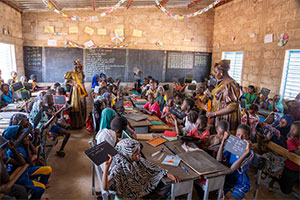 Two teachers work in a classroom in Forces Vives School in Dori, Burkina Faso. Credit: UNICEF/UNI978361
Safe and uninterrupted education is a fundamental right for all children. Education is paramount to global development, as it has been proven that investing in education – especially for girls and children – contributes significantly to economic growth and prosperity. Although more than 1 billion children go to school, many are subjected to conditions that are not conducive to a proper learning environment, including makeshift facilities, a lack of supplies, violence in classrooms, inadequate sanitation, untrained instructors, and widespread school closures. Since 2015, there have been immense gains in education with an increase of 109 million children in school. However, as of 2023, 272 million children are still out of school.
High poverty levels in developing countries also impede children’s access to a proper education. For example, from the early to mid 2000s, Sub-Saharan African nations witnessed a dramatic decline in trained teachers due to inadequate funding in the education sector. Furthermore, major cuts to United States international aid threaten an estimated 23 million additional children's access to education, as USAID‑funded school programmes across Africa and Asia face closure.
Various other factors contribute to the decline of education, notably hunger, which has increased as conflict and climate change interfere with global food production and dissemination. Meanwhile, certain social and cultural practices also impede children’s access to education, with gender inequality, discrimination, child labour, and child marriages preventing millions of children from attending school. Economic conditions such as the inaccessibility of higher education also affect disenfranchised communities across the world. In extreme situations, such as warfare where educational facilities are destroyed in their totality, notably in Gaza and Sudan, entire generations of children might grow up without access to education. Rebuilding educational infrastructure is a long and arduous process, especially when violence persists across generations, and this significantly stunts the development of societal prosperity and stability.
IPS is dedicated to telling the shocking truths about worldwide education through impassioned opinion pieces and comprehensive articles, highlighting global issues that impede worldwide education and the courses of action being taken by organizations such as UNICEF and Education Cannot Wait.

The Week with IPS

NEXT STOP - SDGs
Tracking global progress towards a sustainable world
Tracking global progress towards a sustainable world
