Languages
Friday, November 13, 2026



News and Views from the Global South
Education
CONGO-BRAZZAVILLE: Success Stories Amongst Growing Numbers of Street Kids
Sixteen-year-old Bamanandoki Pitchou hasn't finished his apprenticeship in hairdressing yet, but he already has a small business. A former street child who lives in Kinsoundi - a suburb in the south of the Congolese capital, Brazzaville - Pitchou trains in the morning, and attends to clients in the afternoon.CANADA: Peace Scholars See Shrinking Space for Dissent
Can Canadians have a fair debate on their military mission in southern Afghanistan when so many of the sources quoted in the domestic press are bankrolled by the Department of National Defence (DND)?EDUCATION-US: Ivory Tower Still Blindingly White
A premier U.S. research institute has agreed to address possible racial discrimination in hiring, following a 12-day hunger fast by one of its African American scientists.DEVELOPMENT-ZIMBABWE: A Herculean Effort Is Needed
‘‘You cannot talk of halving poverty when our country is going in the opposite direction. We are totally lost,’’ says Maxwell Tambarare, a teacher in Chiredzi, a region to the south east of Zimbabwe.HEALTH-CHILE: Teen Pregnancy Bucks Global Downward Trend
She is only 24 and has already had three children. The first was born when she was 14, the second when she was 20, and the third, who she gave in adoption, was born just a few weeks ago. Her story is a reflection of teen pregnancy and early motherhood, which are on the rise in Chile.HEALTH-INDONESIA: Mothers Join Bird Flu Awareness Campaign
Not content with the government’s public awareness campaign against bird flu, a group of parents in Bekasi regency has taken the initiative in educating the poor and the marginalised about the deadly disease.CULTURE-ARGENTINA: Recuperating Indigenous Languages
With the aim of strengthening linguistic diversity in Argentina, the University of Buenos Aires language school has launched a successful programme providing instruction in the country’s most widely-spoken indigenous languages.CUBA: Snail’s-Pace Internet Is Washington’s Fault
Authorities in Cuba blame the U.S. embargo for the high local cost of Internet connections, and for the serious problems in web services in this socialist Caribbean island nation.TECHNOLOGY-AFRICA: A Rural-Urban Digital Divide Challenges Women
Janet Malika owes her success to the little gadget that is her cell phone. Formerly a struggling food hawker in the Kenyan capital of Nairobi, she has become a cafeteria owner since acquiring the device about five years ago, and using it to conduct business.DEVELOPMENT-TANZANIA: High Growth Still to Benefit the Poor
Just more than a year after Jakaya Kikwete was elected president of Tanzania his name was mentioned in the halls at the Africa Union (AU) summit in January in Addis Ababa, Ethiopia, as the possible new chairperson of the AU.POLITICS-US: Bush Library to Boost a Sagging Legacy
In the midst of the United States Senate debate over whether to allow a non-binding resolution opposing President George W. Bush's 21,000-plus troop surge in Iraq, and the United Nations climate change panel's report attributing global warming to human activity, it seems a little strange perhaps that a debate over a proposed presidential library would stir so many passions.EDUCATION-MOZAMBIQUE: Orphans’ Choice: School or Survival?
The school year kicks off in Mozambique with more children enrolling for primary school than ever in the past. But educational prospects remain bleak for orphans like Regina Massango.DEVELOPMENT-SUDAN: Oil Boom Causing Land Prices to Skyrocket
Sudan's oil reserves paired with a dearth of water make it a nation of fierce battles for land - most notably in Darfur and southern Sudan where, for centuries, squabbles over rich terrain have ignited into brutal conflicts.HUMAN RIGHTS-MALAWI: Violence Threatens Women’s Meagre Gains
Chanju Mwale is a true role model. Not only does the 28-year-old possess good academic credentials as a lawyer, landing her the job of the Malawi Defence Force’s legal officer, but she is also the only female officer in the force who holds the rank of captain.SOUTH AFRICA: Fallen Anti-Apartheid Icon Leaves Behind Inequality
Leading anti-apartheid campaigner Adelaide Tambo's struggle for equality in South Africa has paid off in areas of political participation, but the economy still remains in the hands of the country's white minority, say researchers and campaigners.SWAZILAND: Keep School Doors Open to AIDS Orphans, Vulnerable Kids
AIDS orphans aren't the only children suffering in Swaziland. Those who have lost one or both parents to the epidemic have it rough, but so do tens of thousands of other Swazi children vulnerable to food shortages, scant medical care, and unsettled home life.IRAQ: Students, Professors Flee to the Kurdish North
Academic life in Iraq's volatile southern and central regions has become increasingly paralysed, with hundreds of students and professors targeted and many more abandoning their educational institutions in search of a refuge.DEVELOPMENT: Morocco on a Slow March to Literacy
Morocco's "march towards light" as its literacy programme is called is brightening up as official figures go, but with far too many shady areas still.CHALLENGES 2006-2007: The Struggle Continues for Mozambican Women
The contradictions in Maria’s life are typical of many women in Mozambique.ENVIRONMENT-CHILE: UV Radiation, the Dark Side of the Sun
The hole in the ozone layer over Antarctica, where the ozone thins out every southern hemisphere springtime, is recovering for the time being, but all regions in Chile will receive extremely high levels of ultraviolet radiation this month.COLOMBIA: Open Your Books, Please, Bogota
For the first time, a Latin American city has been named World Book Capital. Bogotá will have this honour in 2007 by courtesy of UNESCO, with the main aim of promoting a dying habit: reading.« Previous Page — Next Page »


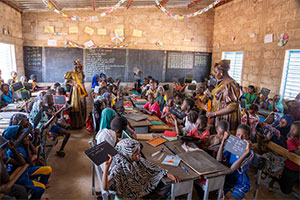 Two teachers work in a classroom in Forces Vives School in Dori, Burkina Faso. Credit: UNICEF/UNI978361
Safe and uninterrupted education is a fundamental right for all children. Education is paramount to global development, as it has been proven that investing in education – especially for girls and children – contributes significantly to economic growth and prosperity. Although more than 1 billion children go to school, many are subjected to conditions that are not conducive to a proper learning environment, including makeshift facilities, a lack of supplies, violence in classrooms, inadequate sanitation, untrained instructors, and widespread school closures. Since 2015, there have been immense gains in education with an increase of 109 million children in school. However, as of 2023, 272 million children are still out of school.
High poverty levels in developing countries also impede children’s access to a proper education. For example, from the early to mid 2000s, Sub-Saharan African nations witnessed a dramatic decline in trained teachers due to inadequate funding in the education sector. Furthermore, major cuts to United States international aid threaten an estimated 23 million additional children's access to education, as USAID‑funded school programmes across Africa and Asia face closure.
Various other factors contribute to the decline of education, notably hunger, which has increased as conflict and climate change interfere with global food production and dissemination. Meanwhile, certain social and cultural practices also impede children’s access to education, with gender inequality, discrimination, child labour, and child marriages preventing millions of children from attending school. Economic conditions such as the inaccessibility of higher education also affect disenfranchised communities across the world. In extreme situations, such as warfare where educational facilities are destroyed in their totality, notably in Gaza and Sudan, entire generations of children might grow up without access to education. Rebuilding educational infrastructure is a long and arduous process, especially when violence persists across generations, and this significantly stunts the development of societal prosperity and stability.
IPS is dedicated to telling the shocking truths about worldwide education through impassioned opinion pieces and comprehensive articles, highlighting global issues that impede worldwide education and the courses of action being taken by organizations such as UNICEF and Education Cannot Wait.

The Week with IPS

NEXT STOP - SDGs
Tracking global progress towards a sustainable world
Tracking global progress towards a sustainable world
