Languages
Monday, October 19, 2026



News and Views from the Global South
Education

The Price Women Pay for Climate Change
Global warming, widely believed to be a universal crisis, will actually impact girls and women far more than boys and men. It is already known that we live in a patriarchal world, one in which men are afforded far greater opportunities for success while women generally hold less societal power and have access to fewer resources. This especially pertains to developing countries in which agriculture related work, usually delegated to females, depends on a variety of environmental factors and subsequently, significantly hurts their livelihoods.
Zimbabwe Needs Awareness, Advanced Tech to Beat Cancer
Earlier this year, then 46-year-old Lydia Musundiwa, based in the Zimbabwean capital Harare, was diagnosed with colon cancer, which, already at an advanced stage, killed her in less than two months. Now, Landeni, her 49-year-old widower, has to contend with the burden of looking after their three children single-handedly.
Emergency Response: Building Resilient Education Systems in Haiti Amid Multiple Crises
Haiti is witnessing unprecedented levels of lawlessness and brutality from armed gangs, which target schools and hospitals. The groups have plunged the country into a crisis and apart from the gun violence accusations, disturbing reports of ruthless sexual violence, including gang rape. Millions of children are in harm's way; many are out of school and it is estimated that between 30 and 50 percent of armed group members are children.
Smartphones: Children’s Blessing or Curse?
Habits can change extremely fast, particularly within so-called “developed” nations, where children, even more than grownups are affected by life changing events. Gone are the times when kids could move around freely and invent games and adventures together with their friends. Far away from the scrutinizing control of parents and authorities they learned to interact with other kids, taking risks and solving problems. It could be tough and often quite merciless times, but educative, beneficent, and fun as well.
Can Scientific Freedom Deliver Development for Africa?
Scientific research has led to social and economic gains worldwide, but the scientists who make it happen face significant challenges.
New Child Marriages, Cohabitation With a Child Law in Sierra Leone Lauded
“A person shall not contract marriage with a child,” Sierra Leone’s landmark Prohibition of Child Marriage Act 2024 says, outlawing, in no uncertain terms, child marriage, giving consent to and attempted child marriage, officiating, attending and promoting child marriage, and use of force or ill-treatment of a child.
AFGHANISTAN: ‘The Doha Meeting Has Raised Concerns the UN Is Indirectly Legitimising the Taliban’
CIVICUS discusses the exclusion of women from international talks on Afghanistan currently being held in Qatar with Sima Samar, former chairperson of the Afghan Independent Human Rights Commission (AIHRC). The AIHRC is the Afghan national institution devoted to the promotion, protection and monitoring of human rights. Its status is now a matter of contention: on returning to power, the Taliban decreed its dissolution, but the AIHRC refuses to abide by the decision due to the illegitimate nature of the Taliban regime.

Justice, not Impunity, for Sexually Assaulted Indigenous Girls in Peru
The main fear facing women leaders who have denounced the systematic rape of girls from the Awajún indigenous people in the northeastern Peruvian department of Amazonas is that, despite the media coverage and sanctions announced by the authorities, it will all come to nothing.
Investing in Teachers, School Leaders Key in Keeping Girls in School UN-African Union Study Finds
Investing in teachers and school leaders in Africa is the most important factor in promoting educational opportunities for girls, keeping them in school and ending child marriage, ultimately reducing gender inequality through education.
Education Cannot Wait Interviews The Sunday Times Chief Foreign Correspondent, Best-Selling Author and ECW Global Champion, Christina Lamb
Christina Lamb is Chief Foreign Correspondent at The Sunday Times and one of Britain’s leading foreign journalists as well as a bestselling author. She has been awarded Foreign Correspondent of the Year six times as well as Europe’s top war reporting prize, the Prix Bayeux, and was recently given the prestigious Lifetime Achievement Award by the British Society of Editors and the Outstanding Impact Award by Amnesty International.

Special Report: Exposing Afghanistan’s Pervasive, Methodical System of Gender Oppression
The UN Special Rapporteur’s annual report on human rights in Afghanistan lays bare the alarming phenomenon of an institutionalized system of discrimination, segregation, disrespect for human dignity and exclusion of women and girls. In the new report, Richard Bennett, the UN’s Special Rapporteur, provides an intersectional analysis of the establishment and enforcement of this institutionalized system of unparalleled gender oppression. It paints a picture of a worsening situation for women and girls.
Today, We Stand in Solidarity with Refugees Worldwide, Today, We Stand for Human Rights
On World Refugee Day, we must stand in solidarity with the 120 million forcibly displaced people – including 43 million refugees worldwide – who have lost their homes and their human rights as the result of persecution and conflict.
Peoples’ Climate Vote Shows Global Support for Stronger Climate Action
The global public opinion research on climate change reveals that 80 percent, or four out of five, of people globally want their governments to take stronger action to tackle the climate crisis.
Conflict Deprives Children of Education in Northern Syrian IDP Camps
Twelve-year-old Walid Al-Hussein, displaced from the city of Kafranbel to a camp for internally displaced people (IDP) in northern Idlib on the border with Turkey, has given up his dream of becoming a lawyer. "The distance of schools from our home (in the camp) made me leave education and give up my dream and my mother's dream of becoming a lawyer who defends the rights of the oppressed," Al-Hussein told IPS.
Stand Up and Speak Out to End Gender Apartheid in Afghanistan
For 1,000 days girls in Afghanistan have been banned from secondary school education. We must now stand up and speak out together for the girls and women of Afghanistan with a clarion call to the de facto authorities and world leaders to end the ban on girls’ secondary education in Afghanistan.
Education Cannot Wait’s #AfghanGirlsVoices Campaign Highlights Real-Life Testimonies of Hope, Courage and Resilience by Afghan Girls Denied Their Right to Education
Today, people across the globe mark a tragic milestone for human rights, children’s rights and girls' rights: 1,000 days since girls were banned from attending secondary school in Afghanistan. To commemorate and reflect on this unacceptable milestone, Education Cannot Wait (ECW), as global fund for education in emergencies and protracted crises within the United Nations, is launching the second phase of its compelling #AfghanGirlsVoices campaign.
1,000 Days—Afghan Girls’ Voices Campaign Enters Second Phase
The global community is marking a tragic milestone for human rights, children's rights, and girls' rights, as it has been 1,000 days since girls were banned from attending secondary school in Afghanistan. The ban has wiped out decades’ worth of education and development gains, as approximately 80 percent of school-aged Afghan girls and young women are out of school.
Rage, Rage Against the Dying of the Light
Few will disagree with the nearly universal concern that we – the human family – are once more faced with an era of darkness. An era whose burdens are mainly carried on the tiny shoulders of crises-affected children and adolescents, their teachers and families, all left furthest behind.
Let’s play!
For the first time ever, we will commemorate the joy of playing with an International Day of Play“ on June 11, 2024. On their website, the UN state that this „marks a significant milestone in efforts to preserve, promote, and prioritize playing so that all people, especially children, can reap the rewards and thrive to their full potential“. But why ist playing so important?
Education Cannot Wait Interviews Bruno Maes, UNICEF Representative to Haiti
Bruno Maes is the UNICEF Representative in Haiti. He officially took office in August 2020. A Belgian national, Mr. Maes previously served as UNICEF Representative in Madagascar from 2007 to 2012, in Chad from 2012 to 2015, and recently in Egypt from September 2015 to 2020.

Education Cannot Wait’s #ShareTheirVoices Global Advocacy Campaign Launched by ECW Executive Director Yasmine Sherif in Lead Up to United Nations Summit of the Future
In the lead up to United Nations Secretary-General António Guterres’ Summit of the Future, taking place on 22-23 September 2024, Education Cannot Wait is supporting the global #ActNow Campaign with an urgent call to increase funding for the +226 million crisis-impacted children worldwide urgently in need of an education through ECW’s global #ShareTheirVoices campaign.« Previous Page — Next Page »





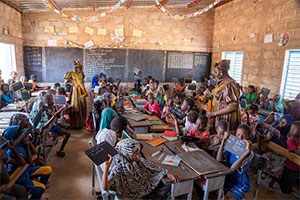 Two teachers work in a classroom in Forces Vives School in Dori, Burkina Faso. Credit: UNICEF/UNI978361
Safe and uninterrupted education is a fundamental right for all children. Education is paramount to global development, as it has been proven that investing in education – especially for girls and children – contributes significantly to economic growth and prosperity. Although more than 1 billion children go to school, many are subjected to conditions that are not conducive to a proper learning environment, including makeshift facilities, a lack of supplies, violence in classrooms, inadequate sanitation, untrained instructors, and widespread school closures. Since 2015, there have been immense gains in education with an increase of 109 million children in school. However, as of 2023, 272 million children are still out of school.
High poverty levels in developing countries also impede children’s access to a proper education. For example, from the early to mid 2000s, Sub-Saharan African nations witnessed a dramatic decline in trained teachers due to inadequate funding in the education sector. Furthermore, major cuts to United States international aid threaten an estimated 23 million additional children's access to education, as USAID‑funded school programmes across Africa and Asia face closure.
Various other factors contribute to the decline of education, notably hunger, which has increased as conflict and climate change interfere with global food production and dissemination. Meanwhile, certain social and cultural practices also impede children’s access to education, with gender inequality, discrimination, child labour, and child marriages preventing millions of children from attending school. Economic conditions such as the inaccessibility of higher education also affect disenfranchised communities across the world. In extreme situations, such as warfare where educational facilities are destroyed in their totality, notably in Gaza and Sudan, entire generations of children might grow up without access to education. Rebuilding educational infrastructure is a long and arduous process, especially when violence persists across generations, and this significantly stunts the development of societal prosperity and stability.
IPS is dedicated to telling the shocking truths about worldwide education through impassioned opinion pieces and comprehensive articles, highlighting global issues that impede worldwide education and the courses of action being taken by organizations such as UNICEF and Education Cannot Wait.

The Week with IPS

NEXT STOP - SDGs
Tracking global progress towards a sustainable world
Tracking global progress towards a sustainable world
