Languages
Tuesday, October 27, 2026



News and Views from the Global South
Education

Conflict Deprives Children of Education in Northern Syrian IDP Camps
Twelve-year-old Walid Al-Hussein, displaced from the city of Kafranbel to a camp for internally displaced people (IDP) in northern Idlib on the border with Turkey, has given up his dream of becoming a lawyer. "The distance of schools from our home (in the camp) made me leave education and give up my dream and my mother's dream of becoming a lawyer who defends the rights of the oppressed," Al-Hussein told IPS.
Stand Up and Speak Out to End Gender Apartheid in Afghanistan
For 1,000 days girls in Afghanistan have been banned from secondary school education. We must now stand up and speak out together for the girls and women of Afghanistan with a clarion call to the de facto authorities and world leaders to end the ban on girls’ secondary education in Afghanistan.
Education Cannot Wait’s #AfghanGirlsVoices Campaign Highlights Real-Life Testimonies of Hope, Courage and Resilience by Afghan Girls Denied Their Right to Education
Today, people across the globe mark a tragic milestone for human rights, children’s rights and girls' rights: 1,000 days since girls were banned from attending secondary school in Afghanistan. To commemorate and reflect on this unacceptable milestone, Education Cannot Wait (ECW), as global fund for education in emergencies and protracted crises within the United Nations, is launching the second phase of its compelling #AfghanGirlsVoices campaign.
1,000 Days—Afghan Girls’ Voices Campaign Enters Second Phase
The global community is marking a tragic milestone for human rights, children's rights, and girls' rights, as it has been 1,000 days since girls were banned from attending secondary school in Afghanistan. The ban has wiped out decades’ worth of education and development gains, as approximately 80 percent of school-aged Afghan girls and young women are out of school.
Rage, Rage Against the Dying of the Light
Few will disagree with the nearly universal concern that we – the human family – are once more faced with an era of darkness. An era whose burdens are mainly carried on the tiny shoulders of crises-affected children and adolescents, their teachers and families, all left furthest behind.
Let’s play!
For the first time ever, we will commemorate the joy of playing with an International Day of Play“ on June 11, 2024. On their website, the UN state that this „marks a significant milestone in efforts to preserve, promote, and prioritize playing so that all people, especially children, can reap the rewards and thrive to their full potential“. But why ist playing so important?
Education Cannot Wait Interviews Bruno Maes, UNICEF Representative to Haiti
Bruno Maes is the UNICEF Representative in Haiti. He officially took office in August 2020. A Belgian national, Mr. Maes previously served as UNICEF Representative in Madagascar from 2007 to 2012, in Chad from 2012 to 2015, and recently in Egypt from September 2015 to 2020.

Education Cannot Wait’s #ShareTheirVoices Global Advocacy Campaign Launched by ECW Executive Director Yasmine Sherif in Lead Up to United Nations Summit of the Future
In the lead up to United Nations Secretary-General António Guterres’ Summit of the Future, taking place on 22-23 September 2024, Education Cannot Wait is supporting the global #ActNow Campaign with an urgent call to increase funding for the +226 million crisis-impacted children worldwide urgently in need of an education through ECW’s global #ShareTheirVoices campaign.
Panama’s Elections: Has Impunity Prevailed?
Regional experts called it Panama’s most important election since the 1989 US invasion that deposed de facto president General Manuel Noriega. Panamanians went to the polls amid high inflation and unemployment, with a stagnating economy. Endemic corruption was also high on their long list of concerns, along with access to water, education and a collapsing social security system.
From Dorms to Demonstrations
The campus protests that have spread to universities in every part of the United States are not about the war between Israel and Hamas, despite the heated rhetoric around this topic. Most of the students who are protesting know little about the conflict, its history and its ramifications for international politics.
Educating the Mind Without Educating the Heart is No Education at All
The words above, by the ancient Greek philosopher Aristotle, serve as a reminder that we still have a long way to go to in educating ourselves. In doing so, we will naturally ensure that the young generation can access an inclusive quality education and use their knowledge to build a world of justice, equity, peace and security.
Working to Keep Náhuat, the Language of the Pipil People, from Vanishing in El Salvador
A group of children participating in an immersion program in Náhuat, the language of the Pipil people and the only remaining pre-Hispanic language in El Salvador, are the last hope that the language will not die out.
1.8 Million More Palestinians Doomed to Poverty if Gaza War Persists
Nearly seven months into the Gaza war, the UN warns that to rebuild and restore the buildings lost in this period, it would take several decades, and to revitalize Palestine’s economy, it would be a great undertaking. Meanwhile, the great losses in housing and public services and the economic stall only threaten to push even more Palestinians into poverty.
Education Cannot Wait Interviews Amy Clarke, Co-Founder and Chief Impact Officer for Tribe Impact Capital LLP
Amy Clarke is Co-Founder and Chief Impact Officer of the multi award-winning Tribe Impact Capital, a dedicated impact wealth manager and B Corps, based in London. She has over 29 years of experience in sustainability, both leading in-house teams (Microsoft and Bank of America) and as a management consultant specialising in climate and sustainability (PwC and EY). Amy serves as a Trustee to B Lab UK and is also an Advisor to fellow B Corps, Greenheart Consulting and Black Seed Ventures. She sits on the Global Steering Group of the Global Ethical Finance Initiative (GEFI) and the Investment Committee of The Blue Cross (having previously served as a Trustee). Amy has both BSc and MSc degrees in environmental studies. In her spare time, she serves as Head of Catering and Entertainment for her three-legged rescue Staffordshire Bull Terrier.

Niger’s Military Coup Triggers Child Marriages, Sex Work in Neighboring Countries
A group of young girls aged between 15 and 17 sit tight, following attentively a lesson being taught by a Mualim (Islamic teacher) in a makeshift madrassah (Qur’anic school) located in one of the impoverished townships of Benin’s economic capital, Cotonou. They arrived in Benin recently, fleeing poverty, hunger, climate change, and rising insecurity in their home country, Niger, in the aftermath of the military coup that toppled democratically-elected president Mohamed Bazoum.
Portable Ginnery Could Revive Kenya’s Ailing Cotton Industry
Kirinyaga University may have just breathed new life into Kenya’s ailing cotton industry as varsity dons develop a portable cotton ginnery. For an industry that has been struggling to survive, this news came as a relief to cotton farmers, whose lives the invention is expected to change, and to a government pushing for job creation and self-reliance through manufacturing.
Education Cannot Wait in Responding to the Regional Crisis Stemming From the Armed Conflict in Sudan
The conflict in Sudan is one of the worst in the world today, and millions of children and adolescents bear the brunt within and across the border from Sudan.
Secondary Education Is a Bottleneck in Brazil
Alice went for eight weeks without Portuguese language classes after starting her first year of high school on Feb. 5 in this Brazilian city. Her chemistry teacher taught only two classes and disappeared. But the worst part is the classroom without air conditioning in the heat of more than 35 degrees Celsius some days during the southern hemisphere summer.
Education Either Makes Us or Breaks Us
There is a fork in the road before us. We have to choose who we are as human beings and as a human family. Do we break humanity or do we make it?
Abandoned Children Growing Problem in Northern Syria
Wael Al-Hassan was returning from work in the Syrian city of Harim when he heard the sound of a baby crying. He was returning from work on December 10, 2023. He stopped momentarily, turned on his mobile phone flashlight to investigate, and spotted a baby girl, around one month old, wrapped in a white blanket, lying by the roadside.
Building Resilience and Mental Health Capacity of Youth
Sri Lankan lawmaker Hector Appuhamy, in conversation with IPS ahead of a two-day conference aimed at educating and involving university students in mental health issues, said parliamentarians were concerned about gaps in the programmes and financing for youth mental health. They were looking beyond the country's health budget for support in ensuring that youth were able to access mental health facilities in a supportive environment.« Previous Page — Next Page »





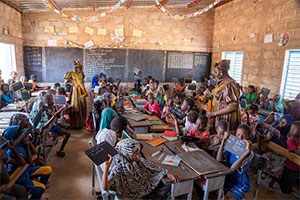 Two teachers work in a classroom in Forces Vives School in Dori, Burkina Faso. Credit: UNICEF/UNI978361
Safe and uninterrupted education is a fundamental right for all children. Education is paramount to global development, as it has been proven that investing in education – especially for girls and children – contributes significantly to economic growth and prosperity. Although more than 1 billion children go to school, many are subjected to conditions that are not conducive to a proper learning environment, including makeshift facilities, a lack of supplies, violence in classrooms, inadequate sanitation, untrained instructors, and widespread school closures. Since 2015, there have been immense gains in education with an increase of 109 million children in school. However, as of 2023, 272 million children are still out of school.
High poverty levels in developing countries also impede children’s access to a proper education. For example, from the early to mid 2000s, Sub-Saharan African nations witnessed a dramatic decline in trained teachers due to inadequate funding in the education sector. Furthermore, major cuts to United States international aid threaten an estimated 23 million additional children's access to education, as USAID‑funded school programmes across Africa and Asia face closure.
Various other factors contribute to the decline of education, notably hunger, which has increased as conflict and climate change interfere with global food production and dissemination. Meanwhile, certain social and cultural practices also impede children’s access to education, with gender inequality, discrimination, child labour, and child marriages preventing millions of children from attending school. Economic conditions such as the inaccessibility of higher education also affect disenfranchised communities across the world. In extreme situations, such as warfare where educational facilities are destroyed in their totality, notably in Gaza and Sudan, entire generations of children might grow up without access to education. Rebuilding educational infrastructure is a long and arduous process, especially when violence persists across generations, and this significantly stunts the development of societal prosperity and stability.
IPS is dedicated to telling the shocking truths about worldwide education through impassioned opinion pieces and comprehensive articles, highlighting global issues that impede worldwide education and the courses of action being taken by organizations such as UNICEF and Education Cannot Wait.

The Week with IPS

NEXT STOP - SDGs
Tracking global progress towards a sustainable world
Tracking global progress towards a sustainable world
