Languages
Sunday, October 18, 2026



News and Views from the Global South
Arts and Entertainment
BOOKS: Was Bush Doctrine Just a Little Bit of History Repeating?
Was the foreign policy of George W. Bush an aberration in U.S. history, a turn away from the traditional guiding principles of U.S. foreign policy towards messianic ambitions of permanent supremacy and universal democracy?
CULTURE-SWAZILAND: ‘We’re Artists Now, Not Just Souvenir Makers’
A developing national arts scene requires a developing national arts center, with luck one that is owned and operated by artists themselves. In Swaziland, the growth of indigenous talent has been complemented by the flowering of a venue popular with performers, audiences and critics.JAMAICA: Women Cheer Ban on Sexually Degrading Song Lyrics
It's the new dance craze here and many artists have hopped on the bandwagon. But when the latest "daggering" song hit the airwaves, government, broadcast regulators, civil society and others in Jamaica said enough is enough.
CULTURE: Filmmakers Probe Multiple Identities, Partitions
A German teacher of Visual Cultures and studying documentaries in India organises a film screening in Pakistan. A Pakistani produces an innovative short film series featuring work from India, Pakistan and Britain.EUROPE: Funnily, Bulgaria Is Not a Turkish Toilet
A work of art exhibited this week in Brussels has turned out to be an unusual test for whether some Europeans are able to laugh at themselves. Just as the artist intended.CHILE: Ex Political Prisoners in Therapeutic Theatre
A group of former political prisoners in Chile will become actors and actresses this month to heal the wounds left by the 1973-1990 dictatorship. They will be performing a cycle of plays written in torture camps and in exile.BOOKS-US: Wounded Veterans Treated as an Afterthought
"But the [George W.] Bush administration was never seriously interested in helping veterans. The sorry state of care for Iraq and Afghanistan war veterans is not an accident. It's on purpose."
BRAZIL: Afro-Brazilian Religions Battle New Threats
Millions of Brazilians usher in the new year by wading into the sea, dressed in white, scattering flowers on the water as an offering to the Afro-Brazilian deity Iemanjá, in return for her blessings for the year to come. But few of them realise that this tradition is rooted in a religion fighting for survival in the face of prejudice, racism and intolerance.MEXICO: Films on Indigenous People – But Who Will See Them?
Half a century of films about indigenous peoples have been removed from forgotten corners of store rooms, recorded on compact discs and launched on the Mexican market, in order to bring to light views and realities that are seldom shown on commercial television and in movies.CUBA: Racism – “Taboo, Complicated and Thorny” Issue
The persistence of racism in Cuba is disturbing to some of the island's thinkers, who are calling for a debate on the problem in this country, where equal rights have not guaranteed equal opportunities for all social groups.FILM: 1982 Massacre Rendered Through Dark, Distorted Lens
Recently opened in wide release in the United States, Ari Folman's new animated documentary detailing Israeli involvement in the Sabra and Shatila massacre sheds new light on the Israeli side of that conflict, as well as the one unfolding today.CHILE: Finding a Place for Memory
Chile’s socialist President Michelle Bachelet recently laid the foundation stone for the Museum of Memory and Human Rights, thus coming one step closer to carrying out one of the projects she has put a priority on, which has however given rise to criticism and reservations from both ends of the political spectrum.BRAZIL: Transformation Through Art and Music
They call it an orchestra, but this atypical all-percussion group is far from featuring the range of musicians found in a conventional ensemble. Which does not mean that the music they make is not rich and varied, as the young amateur musicians produce an amazing array of sounds.BOOKS-US: When Neocons Ruled Washington
In the first two pages of his book on the neoconservative movement, historian Stephen Sniegoski tells us that U.S. Mideast policy during the George W. Bush presidency has been "colossally erroneous" and "disastrous to U.S. interests", that the Iraq War is a "blunder of colossal proportions", and that an attack on Iran is a "highly likely" "disaster" unless the country "eschews all elements of the Middle East war policy".ARGENTINA: Bringing Films and Filmmaking to Indigenous Communities
With the assistance of experts from Bolivia, indigenous communities in the northeastern Argentine province of Chaco are learning how to make films, as a means of helping the rest of the world understand their way of life and the problems they face.
FILM-LIBERIA: The Women Who Ended a War
One night, in a country swept up in a long and harrowing armed conflict, Liberian social worker Leymah Gbowee dreamt that she gathered women together to pray for peace.BOOKS: An Outside Insider Probes the Iranian Psyche
While in New York this fall for the U.N. General Assembly, conservative Iranian President Mahmoud Ahmadinejad admitted to National Public Radio that he watches Western television: "Of course, I'm like the rest of the people. People like movies and shows."RELIGION-VENEZUELA: Santeria Scams?
In a ritual that includes sacrificing goats or fowl, a "babalawo" priest of the Yoruba religion in Venezuela can "mount a saint" (attract blessings from forces of nature) on an initiate willing to pay up to 10,000 dollars, and sometimes even more.CULTURE-CUBA: Rock n’ Roll Fanzine Fights Prejudice
For eight years, Michel and Alexander Sánchez have been publishing Scriptorium, a fanzine (fan magazine) dedicated to rock music produced within Cuba and abroad, in a society that resists accepting this genre and its fans as part of the national culture.Q&A: "I Don’t Believe a 12-Year-Old Was Born to Kill"
A group of around 20 people settle into their seats in a small conference room in a hotel in the Salvadoran capital. They are here to watch "La Vida Loca", a 90-minute documentary about the Pandilla 18 youth gang, directed and co-produced by French-Spanish filmmaker Christian Poveda.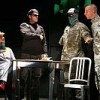
THEATRE-US: Undead GIs Pay a Visit to Bush
It might seem odd at first to compare them, but "Beast", a brutal, surreal black comedy about the Iraq war, has something in common with "The Files", a stunning, sardonic docudrama about the repression of cultural freedom by the Polish communist secret police.« Previous Page — Next Page »





The Week with IPS

NEXT STOP - SDGs
Tracking global progress towards a sustainable world
Tracking global progress towards a sustainable world
