Languages
Thursday, October 15, 2026



News and Views from the Global South
Science and Technology
CLIMATE CHANGE: ‘Copenhagen Accord Not Legal, Kyoto Protocol Is’
While the BASIC bloc countries - Brazil, South Africa, India and China - will submit their plans for voluntary mitigation actions by the Jan. 31 deadline stipulated by the Copenhagen Accord, they have taken care to emphasise that the agreement, reached at the end of the December climate change summit in the Danish capital, has no legal basis.ENVIRONMENT: Indian Glaciologist Fires Back at Climate Sceptics
"It is a fact that global warming is happening. If the Arctic Sea ice is melting, how can the Himalayan glaciers not be melting?" glaciologist Syed Iqbal Hasnain asked indignantly.CLIMATE CHANGE: After Copenhagen, Back to Basics for BASIC Bloc
As environment ministers from Brazil, South Africa, India and China (BASIC) prepared to meet in the Indian capital on Sunday to draw up a post-Copenhagen strategy, there were great expectations on the role they could play in pushing a consensus on how the world should go about dealing with climate change.INDIA/PAKISTAN: Reduced Himalayan Snowfall Could Spark Water War
The declining snow cover and receding glaciers in the Himalayan state of Jammu and Kashmir could trigger renewed hostilities between India and Pakistan, neighbouring states in the South Asian region that are at odds on a host of issues, experts warn.DEVELOPMENT: India Holds Public Meetings on GM Food Crop
As India's central government begins a series of public meetings across the country this month on the commercial release of genetically modified (GM) brinjal – or eggplant - in this country, activists and farmers’ groups are mobilising to oppose such a plan.
CLIMATE CHANGE: Watch the Birdies
Ornithologists say that climate change is having a profound effect on bird behaviour and suggest that this phenomenon can act as an early warning system to the dangers posed to Earth.SOUTH ASIA: ‘Harness Untapped Renewable Energy Sources’ — Experts
With its vast renewable energy potential, South Asia can lead the world in achieving energy security.
BIODIVERSITY: Invasive Species Multiply in U.S. Waterways
As 2010, the U.N.'s International Year of Biodiversity, gets underway, a fight against some of the most damaging invasive species in U.S. waterways is heating up.
ENVIRONMENT: Invasion of the Little Green Molecules
While the world's climate negotiators were getting ready for Copenhagen earlier this month, a meeting was taking place in Mumbai to discuss progress in green chemistry, a field that – like the reduction of greenhouse gas emissions – has the potential to greatly enhance the world's environmental health and sustainability.URUGUAY: ‘Dry Toilets’ Provide Ecological Solution in Slums
Marisabel's modest home had no plumbing, like the rest of the dwellings in this poor suburb on the outskirts of Montevideo, the capital of this small South American country.AGRICULTURE: Cattle ‘Black Death’ Banished to History
An animal 'black death' that has devastated livestock around the world for thousands of years, causing famine and untold human misery, is about to be permanently consigned to the history books.CLIMATE CHANGE: Ice Melting Faster Everywhere
From the Arctic sea ice to the Antarctic interior and the mountainous peaks of Peru, Alaska, and Tibet, ice is melting at an alarming rate. The accelerating loss of ice sheets, sea ice, and glaciers is one of the most powerful and striking indicators of a warming climate.
ENERGY-ICELAND: Osmotic, Tidal Power Show Promise
Iceland already gets over 72 percent of its energy from renewable, hydroelectric and geothermal sources, but Icelanders are ambitious when it comes to energy and scientists are now looking at osmotic and tidal power to meet future energy needs.EDUCATION-INDONESIA: Students Learn Science the Novel Way
Students in Indonesia are learning science the fun way via a monthly comic magazine that also prepares them for the highly debated national examination.RIGHTS-INDIA: Hi-Tech Beats Sex Selection Ban
When a magistrate in the western port city of Mumbai convicted two doctors in November for advertising sex selection services, it showed determination to enforce laws aimed at stopping gender determination tests linked to the mass abortion of female foetuses.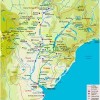
ENVIRONMENT: Rio de la Plata Fish and Fisherfolk Under Threat
A study by more than 30 experts from Argentina, Bolivia, Brazil and Paraguay warns of the threat menacing the survival of fish species and 50 riverside settlements in the Río de la Plata basin, which is the second largest river system in South America after the Amazon basin and contains a wealth of biodiversity.
CLIMATE CHANGE: History Was Not Made
There is no Copenhagen climate treaty. History was not made here and no deal was sealed.
CLIMATE CHANGE: Scientific Fact, Not Political Issue
"In a year's time, the Japanese archipelago will be completely under water." This official announcement was made following a violent eruption of Mt. Fuji, as a series of devastating earthquakes shook the country, forcing the world to face the challenge of taking in 110 million refugees within a very short time.
CLIMATE CHANGE: Getting Ready for Mexico
Before the outcome of COP 15 has even emerged, Latin American social organisations are already discussing their strategies for the next climate summit, to be held in a year's time in Mexico.
CLIMATE CHANGE: No Real Deal, and No Exit
The roof of our house is on fire but our leaders, our economic system and we ourselves are ignoring the alarms and continuing to add more fuel. There are no exit doors in our house; there is nowhere else to go.
DEVELOPMENT: South-South Cooperation at 30-Year High
As the United Nations commemorated its sixth annual 'U.N. Day for South-South Cooperation' Friday, Secretary-General Ban Ki-moon singled out the growing new ties among developing countries that go far beyond trade and investments: education, science, agriculture, medicine, health services and information technologies.« Previous Page — Next Page »





The Week with IPS

NEXT STOP - SDGs
Tracking global progress towards a sustainable world
Tracking global progress towards a sustainable world
