Languages
Thursday, October 22, 2026



News and Views from the Global South
COVID-19
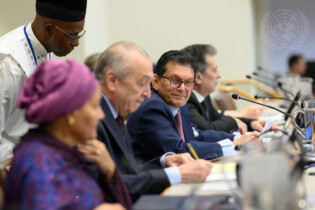
UNGA81: UN Leaders Calls for Faster Action on Pandemic Preparedness
The United Nations High-level Meeting on Pandemic Prevention, Preparedness and Response (PPPR) on September 25 called for faster and more sustained investment in pandemic preparedness. Speakers emphasized that future outbreaks will require coordinated action across governments, health systems, and communities.
To Sanctify Bigotry: The Case of Charlie Kirk
On September 11, Charlie Weimers, a Swedish Member of the European Parliament and active within the European Conservatives and Reformists Group, rose up during a Parliamentary session and asked for a minute of silence to honour the memory of Charlie Kirk, who the day before had been shot and killed during a political meeting at the Utah Valley University in the U.S.
Four Years Later, Still No Clarity: WHO Report Highlights Gaps in Global Cooperation
More than four years since Covid-19 upended the world, the question of how it began remains unanswered. Did SARS-CoV-2 originate from animals to humans naturally, or did it accidentally escape from a laboratory? The World Health Organization’s latest report offers little new clarity and raises serious concerns about international cooperation and scientific transparency.
Pandemic Agreement: Important Step but Big Decisions Deferred
When the next pandemic strikes, the world should be better prepared. At least, that’s the promise states made at the World Health Organization’s (WHO) World Health Assembly on 19 May when they adopted the first global pandemic treaty. This milestone in international health cooperation emerged from three years of difficult negotiations, informed by the harsh lessons learned from COVID-19’s devastating global impacts.
The Road to and from Wuhan: Is Trump a Threat to Global Health?
On his first day in office, President Donald Trump signed an executive order withdrawing the U.S. from the World Health Organization (WHO) – a move experts say makes the U.S. and other countries less safe from infectious diseases and other public-health threats. It might thus be opportune to return to the global COVID 19 pandemic. Has the threat really gone away? Can something similar not erupt again?
Expand choices for Women, Prevent New HIV Infections in Africa
In Uganda, women and girls are more affected by HIV. Out of 1.4 million people living with the disease, 860 000 are women and girls. According to UNAIDS, every week, 4,000 adolescent girls and young women aged 15–24 years became infected with HIV globally in 2023, with 3,100 of these infections occurring in sub-Saharan Africa.
US Fed- Induced World Stagnation Deepens Debt Distress
For some time, most multilateral financial institutions have urged developing countries to borrow commercially, but not from China. Now, borrowers are stuck in debt traps with little prospect of escape.
Pandemic’s ‘Silver Lining’ for Caribbean Was the Use of Technology
 Global South countries did get one benefit from the COVID-19 pandemic. A professor at St. George’s University in Grenada describes it as the pandemic’s “silver lining." He was referring to the widespread use of next-generation genomic sequencing technology to identify, track, and trace the numerous variants of the Sars Cov-2 virus. Researchers and scientists in the Caribbean, Africa, and elsewhere have been eagerly harnessing genomic sequencing technology to develop resilience and greater self-sufficiency in numerous fields, ranging from health surveillance to agriculture and beyond.

Kashmir Frontier Woman Leads the Way in Breaking Down Patriarchy
Smelling the toxic smoke coming from burned powder kegs and helplessly watching fields turn into smoke and ash is traumatic. Rushing to the government's safe houses and leaving your homes, belongings and cattle behind whenever the armies of India and Pakistan trade fire is inexplicable. Then came climate-change-induced weather unpredictability.
The World Bank Must Double Its Fund for the Poorest Nations like Mine to Tackle Hunger Crisis
After El Niño-induced floods and devastating drought, roughly two in five people in Malawi – a country of some 20 million people – are now facing the looming prospect of acute hunger by the end of the year.
Latin America and the Caribbean Hit with Record-Breaking Heat and Other Climate Effects in 2023
Every year for the last four years, a collaborative effort involving scientists and other experts has assessed the state of the climate in Latin America and the Caribbean. The findings have revealed increasingly alarming trends for the world’s second-most disaster-prone region.
Children’s Futures at a Crossroads
At the start of 2024, we stand at a critical juncture: Geopolitical tensions are escalating, economic integration is unravelling, and multilateral cooperation is faltering. This global fragmentation threatens to undermine decades of progress made for children worldwide.
North Ignores ‘Perfect Storm’ in Global South
A gathering ‘perfect storm’ – due to various developments, several quite deliberate – now threatens much devastation in the global South, likely to most hurt the poorest and most vulnerable.
Onerous Debt Making Poorest Poorer
Contractionary economic trends since 2008 and ‘geopolitical’ conflicts subverting international cooperation have worsened world conditions, especially in the poorest countries, mainly in Africa, leaving their poor worse off.
The Impact of Climate Migration on Developing Nations
As the world is still gearing up to welcome 2024, let us find a moment to reflect on some of the key trends of the past year and pursue now to embrace the path towards hope and promise for everyone, everywhere.
Technology Transfer Critical to Revolutionizing Africa’s Pharma Industry
An agreement signed between the Rwandan government and the Africa Pharmaceutical Technology Foundation (APTF) gives impetus to Africa’s domestic industry with the hope of helping the continent tackle vaccine inequity and fill the critical gap in vaccine manufacturing.
Rich Nations, IMF Deepen World Stagnation
With the US Fed raising interest rates, the world economy is slowing as debt distress spreads across the global South, increasing poverty worldwide to pre-pandemic levels, with the poorest countries faring worst.
Commonwealth Civil Society Offers Ministers Crucial Recommendations for Gender Equality Advancement
On August 22, 2023, Women's Affairs Ministers from the Commonwealth huddled in a room at the Atlantis Resort in the Bahamas. For the first time since the COVID-19 pandemic, they were meeting in person.
Deforestation, Encroachment Threaten West Africa’s One Health Plans
Thirty-three years ago, Bala Amerasekaran – a Sri Lankan by birth – visited Freetown, Sierra Leone. Since then, the West African nation has been his home, where Amerasekaran has dedicated his life to conserving the chimpanzee – Sierra Leone’s national animal.
COVID-19 Vaccine Hesitancy: Sharing ‘Real-Time’ Data, Consistent, Simple Messaging Helps
After months of warding off appeals from his employers to get vaccinated for the COVID-19 disease, Mohammad Yusuf, 24, working as a live-in domestic worker in Karachi’s Clifton area, finally relented and got his first shot.
New Zealand: Political Volatility under Cost-of-Living Crisis
It’s a rapid reversal for New Zealand’s Labour Party, in power for six years. At the last election in 2020 it won an outright majority, the first party to do so under the current voting system. But three years on, it’s finished a distant second in the election held on 14 October. The result speaks to a broader pattern seen amid economic strife in many countries – of intense political volatility and the rejection of incumbents.Next Page »





The Week with IPS

NEXT STOP - SDGs
Tracking global progress towards a sustainable world
Tracking global progress towards a sustainable world
