Thursday, September 10, 2026



News and Views from the Global South
HEALTH-MOZAMBIQUE: Stopping Death With a Net
Ruth Ansah Ayisi
- Each time she has been pregnant, 20-year-old Isaura Paulina has fallen sick with malaria. Malaria was probably the cause of her two miscarriages and the low birth weight and frailty of her baby Belinda. She only weighed two kilograms at birth and now also has malaria.
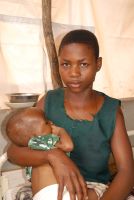
Isaura Paulina with her baby, Belinda. Credit: Ruth Ansah Ayisi
It is too early to say whether Belinda will be one of the child mortality statistics in Mozambique. An estimated 125 children die of malaria each day, which accounts for 35 percent of all hospital deaths of children under the age of five.
Malaria is the biggest child killer in Mozambique. It can kill an infant within 24 hours after the first fever developed.
Pregnant women are also particularly vulnerable. Malaria in a pregnant woman does not only exacerbate the risk of a miscarriage or babies being born with low birth weight. It can also cause life-threatening anaemia in the mother.
Such deaths contribute to the country’s high maternal mortality rate. For every 100,000 live births, an estimated 408 women die due to pregnancy-related complications. While this is almost half the average for sub-Saharan Africaùthe region with the highest level of maternal mortality in the worldùit is still more than the international average.
The government is currently increasing the free distribution of treated bed nets to all pregnant women who attend antenatal clinics. As well as stopping mosquitoes from biting the woman or baby under the net, the insecticide that the net has been doused with kills or repels the mosquito.
The net distribution has the added advantage of protecting a baby for the first two years of his or her life, as the baby traditionally sleeps with his or her mother while breastfeeding.
‘‘The distribution of treated bed nets is a relatively cheap way of fighting a disease that is taking a huge toll in Mozambique, one of the world’s poorest countries,” says Kate Brownlow, the country director of Malaria Consortium. This international organisation supports the government’s net distribution with funds from the British Department for International Development (DFID).
By the end of February 2007, the health centre where Paulina’s baby is being treated had distributed 6,050 nets throughout Rapale district. Unfortunately Paulina did not attend the antenatal clinic in time. ‘‘I only went to the health centre when I was sick with malaria,” she concedes.
Gradually women are becoming more aware of the distribution of free mosquito nets. ‘‘More pregnant women are now coming in the first term of pregnancy for antenatal examinations because they want a bed net,” says Minakumary Pratasinh, the nurse in charge of the programme in the Rapale health centre.
‘‘Some pregnant women walk 50 kilometres, crossing rivers, traversing hills and walking through the bush to get to the health centre during their first term because they know about the nets,” Pratasinh tells IPS.
To avoid women selling the nets, the nets are given to them with the package already open. ‘‘I do not get any indication that women are selling them,” says the nurse. ‘‘When I visit homes to monitor, I also always find the nets there.”
However, she adds, in a few cases women put the nets away, saying, ‘‘they are waiting to use it when the baby is born. We explain again that they must use it while pregnant as well”.
According to Brownlow, ‘‘the educative part of the programme has been central to its success”. Malaria Consortium supported the ministry of health with a training workshop for trainers in Nampula on how to effectively distribute the nets.
The participants in the workshop included a director of the health facility, a doctor or clinical nurse, and a nurse working in the pre-natal clinic. After being trained at the workshop, they carried out training with their staff at their respective health centres.
Vasconcelos Mario, the Malaria Consortium programme officer in Nampula, adds, ‘‘When we monitored the health centres, we found that all the staff were able to clearly explain the importance of the nets and how to use them.”
The government’s programme is gradually being scaled up nationally, with the ultimate aim being that each antenatal clinic in the country will have a constant supply of treated bed nets for pregnant women.
The free net distribution will be especially beneficial for women like Isaura Paulina who would find it difficult to buy a net. She is trying to support herself and Belinda with petty trading. ‘‘My husband finally left when Belinda also fell sick. He had brought a net for us a few years back but it is old and torn now and I cannot afford a new one.”
 Print
|
Print
|