
Wednesday, October 14, 2026



News and Views from the Global South
LEBANON: Violent Politics Play Out in Packed Refugee Camps
Mona Alami
- On the edge of Beirut’s suburbs lies Bourj al-Barajneh, a Palestinian enclave located at the heart of a Shiite neighbourhood, traditionally the domain of Iran-backed Hezbollah. Here, 17,000 Palestinian refugees are amassed on a minuscule swath of land, co-existing in a fragile truce among run-down buildings and muddy streets.
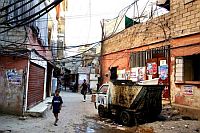
A young boy walks past a U.N. vehicle in Bourj al-Barajneh camp. Credit: UN Photo
On Nov. 16, exactly a week before the elections deadline – now postponed to Nov. 30 – screams filled the narrow alleys of Bourj al-Barajneh as shots fired by gunmen ripped the air, leaving three people injured.
On a recent Sunday morning, however, silence reigned over the camp, as fruit vendors, their carts filled with fresh produce, waited for clients, while a small nearby bakery churned out its aromatic evening batch.
What had ended in a Friday machine gun battle started out as an ordinary squabble between two families: the Bashirs, affiliated with the pro-Syrian movement Saika, and the Habets, from the Fatah movement.
“The clash actually erupted on Thursday evening as opposing youngsters from both clans were waiting for treatment at the Haifa Hospital, where they exchanged sharp words over right of passage,” a witness told IPS on condition of anonymity.
Ramez Mustafa, an official with the Popular Front for the Liberation of Palestine-General Command (PFLP-GC) in Bourj al Barajneh, said the argument morphed into a shoot-out involving automatic rifles in front of a mosque after the customary Friday noon prayers the next day.
“The Habets seemed to be holding a grudge against the Bashirs from the day before,” he told IPS. His version of the story was disputed, however, by other accounts that appeared to vary according to the interviewee’s political affiliation.
Close by the mosque, an unfinished block of gray concrete, a few days later, Fatah bodyguards congregated around a picture of Yasser Arafat hanging at the entrance of the party’s headquarters a few feet away from a large poster of the Aqsa mosque, which is revered by all Palestinians. Inside the white building, Khaled Aref, a senior Fatah official in Lebanon, confirmed one of his fighters was wounded and accused the PFLP-GC of attacking the Fatah office.
“We have organised patrols since then to avoid any possible dissension. We are aware that outside factions are trying to instrumentalise the Palestinian cause, something we reject entirely,” he told IPS.
Violence is a linchpin of every Palestinian refugee camp, generally known for their lawlessness, with rival groups constantly jockeying for higher positions. “In this country, the most trivial quarrel may end in a tribal war. It is a reflection of the camp’s dire reality, where refugees are either affiliated to a clan or a political faction,” said Ayman, a young man clad in black.
Torn between multiple political factions, the camps constitute a fertile ground for recruiting loyal gunmen in a land where unemployment rates are soaring. “To survive the camp’s difficult living conditions, young people have no other choice but to join militias. Hence, most of the camp’s youth is armed and, evidently, any argument might end in a bloodbath,” explained Bassam, while smoking a narguileh water pipe with his friends.
Tensions have been on the rise since Ahmad Jibril, head of the PFLP-GC, warned of a possible upheaval in Lebanon’s Palestinian camps. Lebanon’s Palestinians seem to have been listening closely, as a few days later, the Bourj al-Barajneh incident flared up, as did two other camp-related conflicts.
In Ain El Helweh, Lebanon’s most populous camp and home to numerous Islamist militias, clashes took place between Hamas and factions opposed to the group. Elsewhere, two deafening sound bombs broke the silence of night, terrorising passers-by in Rashidiyeh, a traditional Fatah stronghold. These incidents occurred – perhaps intentionally – during U.N. Secretary-General Ban Ki-moon’s Nov. 15-16 visit to Lebanon in a last-ditch effort to resolve the political deadlock ahead of the presidential elections.
A few kilometres away from Bourj al-Barajneh sits Chatila. The Palestinian enclave – a place reeking of desperation – is the infamous site of the 1982 slaughter of hundreds of Palestinians at the hands of Lebanese forces under Israel’s watchful eye. In the camp’s tortuous dark streets, young Palestinians told IPS they feared tensions and were traumatised by the recent Bourj al-Barajneh events.
“When news of an ominous clash circulated in the camp, Palestinians started leaving their homes en masse,” Ali Abou Jihad, a Palestinian refugee, told IPS. “Most people around here are terrorised and would like to avoid at any cost a repeat of the unfortunate Nahr el-Bared scenario.”
From May to September this year, the Nahr el-Bared refugee camp, located in northern Lebanon, was the scene of heavy fighting between Lebanese troops and al Qaeda-inspired Islamic militants. The battle left about 400 people dead and more than 30,000 Palestinians homeless.
“We have a feeling that history might repeat itself and a plan to eliminate the Palestinian presence in Lebanon has been put in place. In Nahr el-Bared, Fatah el Islam was introduced to us as a security apparatus responsible for the camp’s protection; look where it lead us,” stressed Mahmoud, a young hairdresser.
As rumors of Palestinian factions beefing up their arsenal sweep through the camps, the fragile camp system may be heading for collapse if a long-term power vacuum in Baabda, Lebanon’s presidential palace, occurs.
“In the eventuality of civil strife in Lebanon,” warned Fatah official Aref, “Palestinians will align their position according to those adopted towards them by Lebanese factions.”
 Print
|
Print
|




