
Saturday, October 24, 2026



News and Views from the Global South
Q&A: "Slash the Salaries of the President, Ministers and Members of Parliament"
Interview with Nazlin Umar
- The sole female presidential candidate in Kenya's Dec. 27 general elections will launch her party's manifesto on Sunday. Nazlin Umar, one of nine contenders, is running on the ticket of the Workers Congress Party under the slogan "President wa mtaa" ("Street President", in Swahili), as part of a campaign to convince voters that she is able to address everyday concerns.
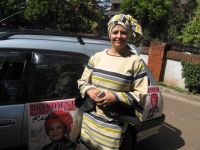
Nazlin Umar, presidential candidate of the Workers Congress Party. Credit: Kwamboka Oyaro
IPS East Africa correspondent Kwamboka Oyaro spoke to Umar to find out more about what she hopes to achieve if elected.
IPS: What will a Nazlin Umar presidency offer Kenyans?
Nazlin Umar (NU): A lot. My government will offer free primary health care for every Kenyan (and) free, quality primary and secondary education and access to university education by providing loans and building national universities in all regions.
People in the low income bracket, that is below 8,000 shillings (130 dollars) per month, will not be taxed, and I will reduce tax on basic commodities. I am also looking at devolving national financial resources to reach the common people. From the current government expenditure that means 60 billion shillings will be available annually to support the less privileged, including free daily feeding programmes for orphans and the poor. This money will also go to the youth and women fund to enable them to acquire economic growth.
My plan to provide clean water, sanitation and electricity to all Kenyans will reduce the rural-urban movement and enrich people in their communities. My government will avail affordable houses and upgrade slums.
I will give Kenyans a constitution within 60 days. This is possible because we already have a draft constitution in place which just needs a few amendments.
My priority is to slash the salaries of the president, ministers and members of parliament. It is obscene for leaders to earn so much money while most Kenyans are living in poverty.
IPS: Where will you get the money to achieve all these goals?
NU: By fighting corruption through a decentralised anti-corruption commission. I will get rid of the current…commission, which in my view has been inefficient, and put in place one that will deliver results. The commission will be nation-wide up to the grassroots levels. Kenya loses a lot of money through corruption, and if the embedded corruption culture is eradicated – what my presidency will do – then there will be a lot of money to do all this and a surplus to invest in other projects.
IPS: Would you, as president, raise issues of particular concern to women that might not receive as much – or any – attention from a male president?
NU: Yes. I have worked with women at the grassroots through various organisations I have initiated around the country (such as the National Muslim Council of Kenya, Oasis of Hope and Behind the Veil) and I know what is of concern to women. These I will put at the fore. Water, sanitation, free maternal health care, education, feeding of the poor and orphans are all issues that adversely affect women – and they are the issues at the core of my leadership.
Besides, my experience has exposed me to women's expectations of their leader. So within two weeks of my appointment, I will conduct regional meetings with the locals to listen to their desires with a view to coming up with eight – eight because five is too few and 10 too many, and also to give me room to include any urgent issue that may arise – key areas of concern which will inform my government in planning annual budgets. This means I will provide a need-driven leadership which the majority of Kenyans crave.
IPS: Initially you were one of the seven contenders for the presidential candidacy of the opposition Orange Democratic Movement-Kenya (ODM-K, viewed as running third in the electoral contest). What made you quit the party?
NU: There wasn't much room for me in ODM-K. I am one of the party founders, but…the party had become dictatorial and there was no space for democracy. It was suffocating. So I quit and joined the Workers Congress Party (WCP).
IPS: But, it appeared to take a while before you presented your papers to the Electoral Commission of Kenya on the ticket of the Workers Congress Party…Had you become undecided about running for the presidency at this point?
NU: Unfortunately between the time I left ODM-K and when I joined the WCP I fell sick for 40 days and it put me out of circulation for a while, but all along I knew I was going for the presidency and I never thought of shelving my plan.
IPS: Has the Workers Congress Party offered you more freedom, as a woman candidate, than you received from ODM-Kenya?
NU: A lot of support. I am the one who pulls the strings…I am the boss. You should meet the leaders of the parties that form the coalition (the Workers Congress Party comprises a number of small parties) – they all admire my resolve, and what I like most is that they don't see me as a woman but as a leader. That is how it should be.
IPS: Your name does not appear in the opinion polls and the media rarely mentions you, concentrating rather on the three presidential front-runners. What is your take on this?
NU: You know, media is really important in making you reach many people, but its unavailability to me will not deter my ascendancy to the top. I am doing what I can. Fortunately, word of mouth is very powerful and there are places I haven't even gone to, but people know about me. This is important support because the grassroots is where the majority of voters are.
IPS: Looking at matters from another perspective, does being the only woman presidential candidate give you mileage – if not in the media?
NU: Yes it does. As the only woman, I am the best option for some Kenyans who are tired of male leadership, and in terms of gender you can say I am privileged because my rivals are concentrating on fighting and mudslinging one another while I am working on the ground…People are noticing me wherever I go. About 39 church leaders have endorsed my presidency as they believe a woman's leadership in this country will be good for their followers.
It is only some sections of the media – especially print – that have given me a blackout, for reasons unknown to me. Radio and television have featured me severally and thus enabled me to reach my voters. I have just come from the KBC (the state-owned Kenya Broadcasting Corporation) where I recorded an interview for…'Good Morning Kenya' (a breakfast television show).
IPS: You were quoted recently as saying you had received death threats. Do you have any idea of why you are being threatened, or who is issuing these threats?
NU: I was threatened because people fear women's leadership and will try all means to suppress them from discovering their capabilities. From their homes, in schools and everywhere, people have seen women excelling in leadership and this is a threat to some people's superiority.
I know the people behind it, but it is not good to mention names. However, I will say that I am grateful to the police commissioner who has assigned me three police officers for security, 24 hours a day. With my security assured, I am now confident to reach places I could have feared to venture alone because of their insecurity notoriety.
IPS: Charity Ngilu contested the presidency in 1997, but despite her popularity she did not receive even a million votes. Are there lessons that current and future women presidential candidates can draw from her campaign with a view to winning more votes?
NU: Charity came out as a woman candidate and that I think was her undoing. When people see you first as a woman they view your capability as that of welcoming men to leadership, stepping down for them or dancing for them as they rule. I am coming out as a leader who happens to be a woman. That is the approach future women presidential candidates must use.
IPS: Certain reports are portraying the election as having boiled down to a contest between Luos and Kikuyus…Have you come up against issues of ethnicity in your own campaign – and if so, how have you dealt with them?
NU: Apart from discrimination from my former party and sections of the media, I have not faced any form of hostility from Kenyans…My ancestry encompasses many communities in the country: my mother's grandmother was Kalenjin, my father's grandmother was Kamba, and my children's origins are from Kajiado and Namanga. This is the true picture of Kenya. That is why Kenyans should vote for me: as I don't belong to just one tribe…I will not favour one tribe against others when I am elected president, but I will ensure equitable and representative appointments to my government.
 Print
|
Print
|




