Saturday, August 29, 2026



News and Views from the Global South
Q&A: ‘I Need the Support of the People To Get the Big Fish’
Interview with Abdul Tejan Cole, head of Sierra Leone’s Anti Corruption Commission (ACC)
- Since assuming office last September, Sierra Leone’s new president, Ernest Bai Koroma has publicly vowed to fight corruption. Koroma recently appointed Abdul Tejan Cole as the Anti Corruption Commissioner.
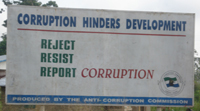
ACC Billboard in Bo Town Credit:
IPS: What forms does corruption typically take in Sierra Leone?
Abdul Tejan Cole: Generally people just tend to feel corruption is more about bribery. It is more than just bribery. It encompasses a whole range of others issues including conflict of interest, lack of governance, processes and procedure. It includes corrupt accusation of wealth, soliciting or accepting what is referred to as an advantage, influencing contracts, corrupting public officers, soliciting and accepting an advantage for a public officer, the misappropriation of public funds, misappropriation of donor funds and impeding foreign investment in Sierra Leone. These are broadly the forms of corruption that are stated in the anticorruption act 2000.
IPS: How rampant is corruption in Sierra Leone?
ATC: We do not have reliable statistics as such, but from all the indications we are getting from the relevant ministries it is said to be very very rampant and if you consider the perception of lots of people in Sierra Leone as reflected in the Transparency International corruption perception index it is very rampant in Sierra Leone.
IPS: What specific strategies have your commission put in place to fight corruption?
ATC: I think we are taking a three fronts approach. Prevention, Education, and Prosecution. Prevention, by putting in place systems and mechanisms, to be working with Government Ministries, Departments, and Agencies, to ensure that they have proper systems and practices in place. Also prevention includes declaration of assets for key public officials.
Education, I think the emphasis is really on educating the people of Sierra Leone, about the ills and vices of corruption. But also about working with integrity clubs in various schools, to ensure that the next generation of Sierra Leonean leaders live up to the right moral standards expected of them.
Prosecution as a means of setting up a deterrent to committing the act of corruption, and if possible to recover some of the proceeds of corruptions.
IPS: The public is often sceptical about the ACC because it always arrests the ordinary man and the big fish gets away?
ATC: ‘Big fishes’ have been arrested by the commission, but really I do not think it is for me to look at what happened in the past. I am looking forward and I can assure the public that if any of the so-called ‘Big fishes’ commit acts of corruption – and I have the evidence to prove it in the court of law – – action would definitely be taken against them… That is why I need the support of the people. We need to get people to report acts of corruption. We need to get people to be engaged with the commission to ensure that we are all in the fight against corruption. If I don’t have the necessary evidence and people do not come forward to give the necessary evidence then unfortunately these ‘Big Fishes’ will have to go scot-free. So the obligation really is also on the people of Sierra Leone, the government and the various key stakeholders to ensure that we have the necessary evidence to prosecute.
IPS: Did your predecessor fall victim to political interference?
ATC: I don’t know. That is my honest answer.
IPS: Is enough money being allocated to fighting corruption?
ATC: The answer is categorically, No!
IPS: A leading donor, the U.K.’s Department for International Development (DfID), stopped funding the ACC after a damning annual review last May found the commission had achieved little or no impact on reduction of real or perceived levels of corruption. What are the latest developments?
ATC: We are talking with DfID and hopefully we will be able to ensure that DfID can provide the necessary support it has been providing over the years to the commission so that the commission can discharge its functions. DfID support is absolutely necessary for us – we require it – the government of Sierra Leone on its own cannot fund the commission. We need the support not only of the DfID but other donors as well. My task really is to ensure that we give the donors the necessary confidence they require.
IPS: Many donors attach stringent reporting procedures to the aid they provide to developing nations. Why have these procedures not proved more effective with preventing corruption in Sierra Leone?
ATC: I cannot comment on the government as a whole, but in terms of the ACC, we have been meeting our reporting obligations. We have been publishing annual reports – albeit sometimes long after the period – but I think we have satisfied our reporting obligations.
IPS: Low salaries paid to officials in developing nations are said to be one of the main reasons for public sector corruption. Do you think levels of graft among Sierra Leonean civil servants can largely – even exclusively – be attributed to low pay?
ATC: I do not think it can exclusively be related to low salaries. I think low salaries can be one factor… there are so many causes of corruption that we can look at in Sierra Leone. I think if we just simply concentrate on low salaries we will not solve the problem of corruption. There are instances where salaries have been increased in certain institutions and where the corruption rate has still remained the same. So, in as much we address the issue of low salaries we need to look at other issues. The general attitudes of people need to change. The whole question of the economic decline, lack of governance structure within the system, the collapse of moral value within the country needs to be revised.
IPS: Do Sierra Leone’s laws facilitate effective investigation of graft cases? For instance, can investigators compel banks to reveal details about accounts that might have received suspicious transfers?
ATC: The ACC Act is quite clear in terms of what we can do. Yes, we can compel heads of banks and departments to produce statements. If the need arises we will do it. We have been doing it in the past and we will continue doing it.
IPS: What’s the level of collaboration between the ACC and the attorney general’s office?
ATC: We started off on good footing. We have held meetings, had discussions and hope it continues this way. I enjoy the confidence of the attorney general. He enjoys my confidence and I think really the future is bright.
 Print
|
Print
|