
Sunday, October 25, 2026



News and Views from the Global South
Q&A: “Mum, Were We Meant to Suffer All Our Lives?”
Interview with Nadifo Gababa, an Ethiopian refugee in Kenya
- The post-election violence here has turned nearly 500,000 Kenyans into internally displaced persons (IDPs). Caught up in this unrest are refugees from neighbouring countries – such as Sudan, Somalia, the Democratic Republic of Congo and Ethiopia – who sought refuge in Kenya but now find themselves destitute once again.
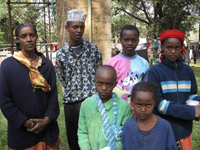
Nadifo Gababa with her five children at the refugee camp in Nairobi Credit:
Gababa was relieved when the truck she had been bundled into with her five children reached Huruma, an estate in Nairobi’s east-lands safely. Since she and her children speak Kiswahili it was not long before she was directed to the local Mosque.
With some money left over after her arrival, she rented a one-roomed shack, enrolled her children in local schools, and got herself a job at a nearby hotel. Life was manageable until violence broke out in the city soon after Mwai Kibaki was declared winner of the Dec. 27 presidential elections.
IPS correspondent Kwamboka Oyaro spoke to Gababa at the Jamhuri Show Ground refugee camp in Nairobi where 320 non-Kenyans are housed.
IPS: Why did you run away from Ethiopia?
Nadifo Gababa: It was politics. Again I am here because of politics. I left home on May 27, 2005. Five years earlier, the government of Ethiopia had arrested my husband accusing him of being a sympathizer of OLF. My husband was a driver of district commissioner. Before his arrest, we led a good life. We had public transport vehicles and a wholesale shop, which I managed. Since we lived at the Kenya-Ethiopia border, our children studied in Kenya.
When my husband was arrested things turned for the worse for my family. I was harassed by the police who picked me up twice and locked me in the police cells saying I was managing the network that funded the OLF cause – that I had continued my husband’s work.
This was a false accusation. Each time I was arrested, I spent quite some time in the cells this adversely affected my business. I was tortured and even raped… The last time I got out of the cells I resolved to run away for my safety and that of my children. The arrests had traumatized us – for five years I wasn’t allowed to see my husband.
So that morning as I prepared my children for school, I stuffed some few clothes into their school bags, whispered to my eldest child – then aged 13 – – about my intent and, about an hour later, I crossed the border as if I was going to buy something from the Kenyan side, that is how I escaped.
IPS: You ran to Kenya for safety, but you are on the run once again, what goes on in your mind about what is happening?
NG: At Huruma we were staying well. My neighbours although coming from different communities were friendly and we lived peacefully. Then on Dec. 29 there was tension in Huruma as people waited for the presidential results to be announced. My good neighbours – my house was between them – were not looking at each other any more.
I was scared, so I went with my children to spend the night at the mosque. When we came back the following day, our home was no more. The neighbours had set each other’s houses on fire and mine went up in flames along with theirs.
My hope is that there will be peace so that I go back to Huruma. What is happening now is however disheartening [gunshots could be heard in the distance].
When we came to the camp here, my son asked, “Mum, were we meant to suffer all our lives? Perhaps we should just go to Ethiopia and die.”
I want to be strong… to be there for my children. If it means breaking stones to make pebbles for sale, then I want to do that for my family’s upkeep. I want to live another day in peace. I want to believe this will happen very soon.
IPS: Are you safe here?
NG: So far – in the last three weeks we have been here – it has been okay. But there are always fears for the worst. In wartime, there is lawlessness and we can be adversely affected even within the camp. I want my children to be in my sight all the time. My son – now aged 15 – has been ensuring his siblings are safe. Rape and other crimes can happen in a camp. I fear the former and I want my children to be safe from such heinous crimes.
There is one evening when some youths from the Kikuyu community came with various crude weapons – sharp pangas, wood planks, metal bars – and forced us to join them in attacking Luo youths who were supposedly forcing their way into the camp to kill us. But there was nothing like that and when we came back to our sleeping places at the camp we found our clothes, utensils and other few possessions had been stolen.
We are 210 Ethiopians in this camp and we are generally safe and the International Red Cross and the National Alliance of Churches [a Nairobi- based NGO] are assisting us with food and other basic needs. Although thankful for this, sometimes the food is not enough, and it is served late when children are really hungry and sleepy. When you are in your own home, your territory, you know when and how much food to give to your children.
IPS: What next?
NG: The U.N. High Commission for Refugees (UNHCR) has told us that we are going to Kakuma [a refugee camp in northern Kenya] as soon as the roads are safe. I am apprehensive about Kakuma. I have heard bad things happen to people there. I don’t want my children or myself to risk rape. With HIV and AIDS now, rape spells doom.
IPS: Is there anything amid this situation you find positive?
NG: No. Nothing. Actually, yes, at least I am alive and I have all my children – – I haven’t lost any. The best thing is that my family is alive and intact. My son, although he misses school and his friends, says at least at the camp he doesn’t have to worry about being attacked or losing his books. He lost everything in the fire. Even the sound of gunshots [heard again in the near distance] does not startle us any more. We are used to the sound both day and night.
 Print
|
Print
|




