
Wednesday, October 7, 2026



News and Views from the Global South
PAKISTAN: Tax Payers Pay for Subsidised Fuel to Afghanistan
Ashfaq Yusufzai*
- Petrol pumps in Pakistan’s border regions do brisk business. Jerry cans of fuel are carried both clandestinely and openly across the porous frontier for sale in neighbouring Afghanistan.
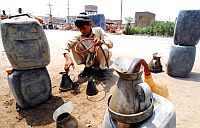
Small-time vendors in Peshawar fill jerry cans with petrol that will be taken across the border to Afghanistan. Credit: Ashfaq Yusufzai/IPS
Subsidised by the Pakistan government, diesel sells for 90 U.S. cents in Pakistan. For both traders and smugglers, the Afghanistan market where it fetches a much higher 1.4 dollars is naturally more lucrative.
The trade in part is legal – permitted under the government’s policy to permit licensed traders to deal in diesel. But that is causing a loss of "4.6 million dollars in foreign exchange every month" asserts Ilyas Ahmed Bilour a former president of the Federal Chamber of Commerce and Industry in Islamabad.
In an interview with IPS in Peshawar, Bilour who is a senator from the North West Frontier Province (NWFP), says filling stations here and in adjoining Balochistan province are brazenly exporting subsidised high speed diesel and superior kerosene oil to Afghanistan instead of selling it to local consumers.
The recent spurt in exports to Afghanistan was the result of a May 11 order issued by the Federal Board of Revenue (FBR) that permitted fuel trade in Pakistani rupees for permit holders.
According to senator Bilour, permits could be bought by bribing FBR and Petroleum Ministry officials who would also take a percentage of the cargo being trucked into Afghanistan.
"It is not only a violation of well-defined rules but also a big scandal to allow the import of subsidised products," he observes. "Subsidies are for the benefit of the people of Pakistan!"
Officials in the Petroleum Ministry are tight-lipped. One spoke with IPS only on the condition of anonymity saying that over just two weeks in August, around 2.3 million litres of high speed diesel and 0.5 million litres of kerosene oil were taken legally across the border to Afghanistan.
With Pakistan doling out precious foreign exchange for fuel imports, it is Pakistani taxpayers who are paying for these losses, according to the official. The situation has been exacerbated with the plummeting value of the rupee, the official adds.
Pakistan’s Finance Minister Naveed Qamar estimates the loss for Pakistan on account of subsidies on diesel to be worth 1.5 million dollars annually. This is a quarter of the total subsidies of 4.2 million dollars allocated by the government for the current fiscal year.
Subsidies – mainly for fuel, food, electricity and fertilisers – were cut by over a million dollars this year under sustained pressure from multilateral agencies. At a post-budget meeting, on Jul. 3, the finance minister said, "The decision has been taken in view of the budgetary deficit and the fact that the benefit of subsidies has never trickled down to the masses."
On Jul. 31, the Economic Coordination Council of the federal cabinet imposed a ban on the export of diesel to Afghanistan. Petroleum Ministry officials have leaked out to the media that an estimated 726,000 litres of subsidised diesel may have gone to North Atlantic Treaty Organisation (NATO) forces and private contractors in Afghanistan – a loss of 32.5 million rupees or 4.5 million dollars daily.
The ban was in response to a petition filed Jul. 25 by the Sarhad Chamber of Commerce and Industry (SCCI) in NWFP, whose president, Ghulam Sarwar Mohmand, described the export of subsidised fuel in rupees as "illogical".
The SCCI had stopped the issue of a crucial document necessary for exporters to Afghanistan – the letter of origin. Meant exclusively for trade in items that are produced or manufactured in Pakistan, it was being issued for fuel exports to Afghanistan.
In mid-September, the government announced the imposition of a regulatory duty on fuel export to Afghanistan – to discourage imports into the neighbouring country of subsidised Pakistani fuel. The new duty – roughly 35 percent – is not applicable on fuel supplies to International Security Assistance Force (ISAF) in Afghanistan.
Over the last year, Pakistan’s oil import bill has shown a sharp hike. The Federal Bureau of Statistics says the oil bill for the year up to Jun. 30 reached an all time high of 11.38 billion dollars, up by 55 percent over the previous year. Consequently, Pakistan’s current account deficit jumped by more than half, from 6.8 billion dollars to 14 billion dollars.
Officials at Pakistan State Oil (PSO) say the state-owned company supplied 2,435 barrels of diesel in July to North Waziristan compared to 99 barrels in July 2007. Its director, M Abdul Haleem, issued a warning letter to the Petroleum Ministry that the spike in demand was entirely due to the high subsidy of 37.07 rupees (50 U.S. cents) per litre of diesel.
The president of Pakistan Petroleum Dealers Association, Abdul Sami Khan, told IPS that the government should take action against those involved in smuggling of diesel. "We cannot stop smuggling but the government can through stricter vigilance on the border."
(*This is the first of a 2-part series that explores the politics of fuel subsidies in Pakistan and tracks the diesel to Afghanistan.)
 Print
|
Print
|



Pictures for this story
This story includes downloadable print-quality images -- Copyright IPS, to be used exclusively with this story.


