
Friday, October 23, 2026



News and Views from the Global South
POLITICS: Iranians Hope for Temperate President at the U.N.
Omid Memarian
- When Iran’s President Mahmoud Ahmadinejad attends the 63rd session of the General Assembly next week in New York, many Iranian academics and political activists hope he will avoid the kinds of controversial statements that have hurt Iran’s international image since he was elected to the office in 2005.
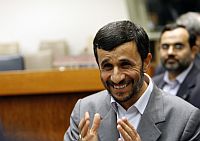
Iranian President Mahmoud Ahmadinejad after giving a speech at the 2007 U.N. General Assembly. Credit: UN Photo/Mark Garten
Ahmadinejad’s controversial remarks about Israel and description of the Holocaust by Nazi Germany as a “myth” have provoked a tremendous backlash by the international community during the past three years.
Asked what Iranians expect their president to say, and not to say, at the United Nations, Sadegh Zibakalam, a political science professor at the University of Tehran, told IPS in a telephone interview that he should avoid discussion of the Arab-Israeli conflict and especially the Holocaust.
“He mustn’t discuss the Holocaust issue. He must refrain from discussing Israel’s annihilation and its leaders’ demise,” Zibakalam said.
“He should not discuss Iran’s eventual victory over the United States and its attempts to teach humanity a lesson – he must seriously stay away from this type of rhetoric,” said Zibakalam.
“He must move towards language through which he can demonstrate the Iranian people’s respect for Americans and their elected leaders, respecting whomever will be the elected president of the U.S., whether Democrat or Republican, demonstrating [Iran’s] willingness to seriously negotiate about Iran’s regional and nuclear issues with the next president,” he added.
Pres. Ahmadinejad has repeatedly said that he is willing to talk to the United States and other nations. However, his aggressive tone and Iran’s dismissal of a series of U.N. Security Council resolutions against its nuclear programme, coupled with Washington’s repeated accusations of meddling in Iraq, have sent a somewhat different message.
“He has announced on numerous occasions his desire to negotiate or to reach a resolution through negotiations,” Ali Mazroui, a former member of Iran’s Parliament, told IPS. “His rhetoric and his actions, however, have fallen short of providing assurances [to those countries], enlisting their response.”
“There is a kind of contradiction between Mr. Ahmadinejad’s verbal and actual policies. I have no hope for any kind of change regarding new avenues for Iran during this trip,” added Mazroui.
Regarding plans by human rights and Jewish groups to stage news conferences to protest the situation of human rights in Iran and Ahmadinejad’s speeches against Israel, Dr. Elaheh Koulaee, also a former parliamentarian and now a professor at the University of Tehran, told IPS that the determining factor in international politics has always been the consensus among powerful countries of the world.
“Street protests and civil society activities have not been terribly influential in Iran-U.S. relations,” she said. “Therefore if Iran and the U.S. use opportunities available to them to discuss their needs within the framework of their interests, I doubt these types of protests will affect those dialogues.”
Last month, Esfandiar Rahim Mashaie, Iran’s vice president, said that Iran is “friends of all people in the world – even Israelis.” His remarks were widely denounced by Iran’s hardliner establishment. Mashaie later claimed that his comments were misrepresented and clarified that that no one inside Iran recognises the Zionist regime. Surprisingly, the president has resisted intense pressure from the Parliament and some of the hardliner Ayatollahs and has not yet commented on the controversy.
The Islamic Republic has never recognised the state of Israel, and it remains unclear whether Mashaie’s remarks and Ahmadinejad’s silence denote a policy shift, or whether it was simply a gaffe.
“[Ahmadinejad] has said things in international circles which have led those countries to assume a negative position vis-a-vis Iran, as opposed to improving our relations with them. For example, what he said about Israel and Holocaust and the tensions he created on international and regional political levels,” said Mazroui. “I think none of these discussions can help Iran.”
Hooshang Amirahmadi, president of the American Iranian Council and a professor at Rutgers University, told IPS that the Iranian people are wary of war and have been badly hurt by years of sanctions.
“They want nothing more than peace and are yearning for prosperity. U.S.-Iran relations have been their key concern for years and at present over 90 percent of Iranians, including those in the government, want the relations normalised and quickly.”
Amirahmadi, who is going to meet the Iranian delegation during their time in New York, has traveled to Iran several times during the past six months and has visited with President Ahmadinejad. He believes that the majority of the Iranian people want their president use the opportunity of his presence on U.S. soil to build goodwill with the U.S. people and government.
“This means that they do not want Pres. Ahmadinejad to use words and terminologies that will be annoying to his host,” said Amirahmadi. “More importantly, they want the president speak of the Americans very highly and with utmost respect.”
“I think Mr. Ahmadinejad should also use the opportunity to mend relations with a key player in U.S.-Iran relations, namely Israel,” he added. “Here is an opportunity for him to reinforce the view expressed by one of his VPs that Iran is a friend of the Israeli people and that Iran consider the Jewish people as friends of Iran, though there are those in that community who are inimical toward the Islamic Republic.”
However, it appears unlikely that this will come to pass. At a press conference in Tehran this week, Ahmadinejad repeated his assertion that the Holocaust was a “fake” and said the Jewish state would not survive in any form.
 Print
|
Print
|




