
Tuesday, August 25, 2026



News and Views from the Global South
SÃO TOMe AND PRINCIPE: A Retro Approach to Politics?
Ramusel Graça
- It is lonely at the top – especially when you are one of only two women among 53 men at the National Assembly.
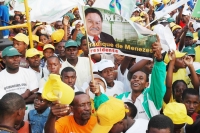
Politics is a manly affair in Sao Tome. Credit: Lourenço Silva/IPS
“This is an anachronism,” says Albertino Bragança, a Member of Parliament. “The cultural machismo prevailing in our society – that women must care for the children and the home – is the problem.”
Bragança is president of the Party for Democratic Convergence (PDC, in Portuguese), part of a ruling coalition with the Movement for the Liberation of São Tomé and Príncipe-Social Democratic Party (MLSTP-PSD, in Portuguese) and the Force for Change Democratic Movement (MDFM).
At the last Parliamentary elections in March 2006, the coalition won 43 of the total 55 seats, including the only two women in the Assembly. Another two are deputy MPs.
The opposition Independent Democratic Action (ADI) and the New Way Movement (NR) hold the remaining seats but have no women MPs.
“This is one of our worst Parliaments in terms of women representation,” says Cristina Dias, an MP with the ruling coalition, who was Minister of Agriculture, Rural Development and Fisheries until recently.
The previous Parliament had five women. So Dias is pushing for a mandatory quota for women in party lists and Bragança supports her. He says PDC is considering a voluntary 30 per cent quota for the municipal elections in 2008 and parliamentary elections in 2010.
Bragança deplores that some parties do not have any women candidates and others put them at the bottom of the lists, reducing their chances of being elected.
The situation is better in cabinet, with four women holding the portfolios of Planning and Finance; Defence; Work, Solidarity and Family, and Social Communication, Youth and Sport, among a total of 14 ministers.
Politics in São Tomé follow the pattern described in a 2008 study by the Geneva-based Inter Parliamentary Union: political parties operate as “closed entities” and old boys’ networks that make it hard for women to gain entry.
“We have seen again and again that political parties do not take into account women’s participation,” says Manuela Ferreira, a deputy MP with the MDFM/PDC. “Thus we have little opportunity to improve our electoral system.”
Ferreira, 45, is a medical doctor. At age 12, she joined the youth wing of the liberation struggle, studied in the former Soviet Union, and has combined politics, medicine and family life ever since.
Uninterested men
They may be few, but São Tomé’s women MPs make their presence felt.
Maria das Neves Sousa has been in politics for a long time. An economist, with two university-age daughters, she was prime minister between 2002-2004 and led the government through the country’s most serious recent crisis, a failed coup in 2003 by a group of Saotomense soldiers, former members of apartheid’s South Africa’s mercenary Buffalo Battalion.
Later, Neves was sacked over unproven charges of squandering Japanese aid, which she claims were a “political conspiracy” against her.
She rebounded into Parliament, where she presides over the committee on human rights, citizenship and gender issues.
Worldwide, women MPs have led efforts to pass laws on violence against women, says the IPU study.
São Tomé is no exception. For many years, Neves campaigned at the Assembly to change the criminal code, which did not consider physical violence against women as a crime. She succeeded in September.
Her lobbying effort is captured in the IPU study: “I started campaigning in Parliament to tell men that if it [this law] is not passed, that means that they are not part of the solution but part of the problem.”
The new law punishes crimes of physical violence with 8 to 16 years of prison.
“Now that we have the law, we need the media and civil society to join the fight against this scourge, rooted in alcohol, jealousy and most of all, poverty,” she says.
Neves told IPS that she may try again for the Prime Minister post. The Prime Minister is chosen by the National Assembly and confirmed by the President.
Her experience at party, legislative and executive levels have taught her a hard truth. “When it comes to women’s issues, the men are not very interested. It is the women who take the initiative and who ask men for support,” she says in the IPU study.
Were Neves to become Prime Minister again, expect more measures to promote gender equality.
 Print
|
Print
|


Pictures for this story
This story includes downloadable print-quality images -- Copyright IPS, to be used exclusively with this story.


