Languages
Wednesday, July 22, 2026



News and Views from the Global South
COP-22: Developing Nations Seek Acceleration of Climate Action
Speaking on behalf of the Group of 77 and China, Manasvi Srisodapol, Special Representative of the chair of the Group of 77, told the joint closing plenary of the 22nd session of the Conference of Parties (COP-22) in Marrakech that the needs of the developing countries should be given the highest priority for two reasons: they bear the brunt of the increasing adverse effects of climate change, and they are also the least equipped to cope with this problem on their own.
“Bonn Has Become an Insider Tip on the International Stage”
With around 320,000 inhabitants on 141 square kilometres, no other relatively small city has played such a historically critical role like the City of Bonn.
“Dead Men Don’t Vote” in Gambia
“Dead men don’t vote,” said a Gambian political activist known as Mama Africa. She spoke during an event on the side-lines of the 59th Session of the African Commission on Human and Peoples Rights (ACHPR) held in Gambia’s capital Banjul last month. The focus was the crackdown on freedom of expression and assembly ahead of the 2016 presidential elections.
Green Mobility
On April 23, 2016, Pakistan became a signatory to the Paris Agreement on Climate Change, joining 174 other countries in a pledge to combat climate change. The surprise victory of Donald Trump in the US has cast doubts on this agreement. The prospects of American commitment to the agreement are slim — the president-elect has said that climate change is something the Chinese came up with to “make US manufacturing non-competitive”.Take Middle Path on Foreign Policy
The Government received a reality check last week in Geneva when the Attorney General (AG) and the chief of National Intelligence (CNI) got a rude shock at a UN committee monitoring torture when they were cross-examined to the point that they had to beat a hasty retreat from the floor.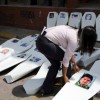
Journalism in Honduras Trapped in Violence
It was in the wee hours of the morning on October 19 when journalist Ricardo Matute, from Corporación Televicentro’s morning newscast, was out on the beat in San Pedro Sula, one of the most violent cities in Honduras.
Selling Their Bodies for Fish and a Handful of Shillings
It's Saturday morning and Hafsa Juma* is seated on a traditional mat known locally as a mkeka under the scorching sun outside her homestead, located near Gasi Beach on the Kenyan coast.
UN Security Council Seats Taken by Arms Exporters
Nine of the world’s top ten arms exporters will sit on the UN Security Council between mid-2016 and mid-2018.
The Cuban Revolution Has Lost Its Founder and Leader
Fidel Castro, who survived more than 600 assassination attempts and remained in power longer than any other leader in the history of Cuba, died Friday night at the age of 90.
25th November – International Day for the Elimination of Violence against Women
Each year on November 25, the International Day for the Elimination of Violence against Women is commemorated. A commemoration in essence is an opportunity to reflect on the challenges, prove that progress can be made and celebrate victories. It is also a reminder of the obligations and the responsibility we all must own at both the private and the public level to ensure that every woman, every girl, in all corners of the world lives in a world free of violence and fear. They must be enabled to enjoy their most fundamental right to physical integrity and security.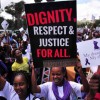
Let’s Unite to End Violence Against Women in Kenya
Consider this. According to the 2014 Kenya Demographic and Health Survey of Kenya, 4 out of every 10 Kenyan women undergo some form of violence, whether physical or sexual. This figure is staggering and should compel us to pause and reflect.
Ensuring Shared Progress for Sustainable Development and Peace
International inequality has grown over recent centuries, especially the last two. Before the Industrial Revolution, between-country inequalities were small, while within-country inequalities accounted for most of overall global income inequality. Now, inter-country income inequalities account for about two-thirds of world inequality with intra-country inequality accounting for a third.
Violence Against Black Women in Brazil on the Rise, Despite Better Laws
Four months in hospital and a number of operations saved the life of Maria da Penha Fernandes of Brazil, but the rifle shot left her paraplegic at the age of 37. When she returned home, her husband tried to electrocute her in the bathroom.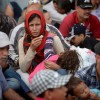
For Women and Girls Who Flee Conflict: Protection & Opportunity
Over the past 18 months, 1.3 million migrants and refugees crossed into Europe. For women and girls particularly, that journey is one of violence and trauma.
Initial Global Effects of Trump Even Before Taking Office
Even before taking office, President-Elect Donald Trump and the policies he promised during his campaign are already having a worldwide impact in at least three areas -- global finance, trade and climate change.
Australian Activists, Dissenters and Whistleblowers Feeling the Heat
For Australian activist Samantha Castro, it was her association with the non-profit publishing organisation Wikileaks that brought her to the attention of the Australian Federal Police (AFP).
Refugees Slipping in, Getting Help
Wearing a burqa, Rashida Khatun was waiting in front of Lambabil fish market along the Cox's Bazar-Teknaf highway yesterday afternoon.
The Potential Cost of U.S. Climate Inaction
Although U.S. President-elect Donald Trump has hinted he may be softening his stance on climate change, many are still uncertain of what lies ahead concerning climate action within and beyond the United States.
Jamaica’s Culture of Fear Allows Police to Get Away With Murder
The morning her brother was shot dead in January 2014, Shackelia Jackson had slept through her alarm. She woke up to the sound of his name and instantly knew something was wrong. When she ran down to the modest restaurant he operated in downtown Kingston, she noticed the spoon in the rice pot, the flour where the chicken was being fried. Then one of his slippers, and blood marks.
Battle of the Desert (and III): UNCCD ‘s Louise Baker on The Silk Road
Marking this year's World Day to Combat Desertification last June, the United Nations announced the launch of a China-United Nations Convention to Combat Desertification (UNCCD) Belt and Road Joint Action initiative to curb Desertification along the Silk Road.G77 Congratulates UNIDO on Its 50th Anniversary
In a congratulatory message on its 50th anniversary, Ambassador Virachai Plasai, Permanent Representative of Thailand to the United Nations and chair of the Group of 77, singled out the achievements of the UN Industrial Development Organization (UNIDO).« Previous Page — Next Page »


The Week with IPS

NEXT STOP - SDGs
Tracking global progress towards a sustainable world
Tracking global progress towards a sustainable world
