
Thursday, October 22, 2026



News and Views from the Global South
Opinion
How Am I Going To Die?

Non-communicable diseases such as heart disease and cancer account for nearly three-quarters of all deaths worldwide. Credit: Shutterstock
- With death being an inevitable outcome, a fundamental question that crosses the minds of practically everyone is: “How am I going to die?”
A simple response is that you will likely die from one of the top causes of mortality. A more precise answer is that “it depends” to a large extent on your personal circumstances.
For example, if you are under the age of 45, the most likely cause of death statistically in many countries is unintentional injuries or accidents. If you are a young adult aged 18 to 29, in addition to motor vehicle accidents, other major causes of death include suicide and homicide. If you are an older adult over the age of 65, you are most likely going to die from the major causes of death for that age group, which are heart disease and cancer.
Various important personal circumstances contribute to your eventual demise, including age, sex, genetics, country of residence, medical condition, family status, occupation, income, healthcare access, and lifestyle choices. These lifestyle choices may involve smoking, alcohol consumption, drug use, diet, and exercise.
Before delving into personal circumstances and the leading causes of death globally and in various countries that ultimately end human lives, it is important to recognize the positive news regarding survival rates and the increase in human life expectancy.
In recent years, the average length of human lives has significantly increased. More people across the globe are surviving to older ages than ever before.
Marked increases in human survival rates have occurred at virtually every age, resulting in more people living longer lives. Additionally, a wide range of diseases, ailments, and conditions have either been eliminated or significantly reduced.
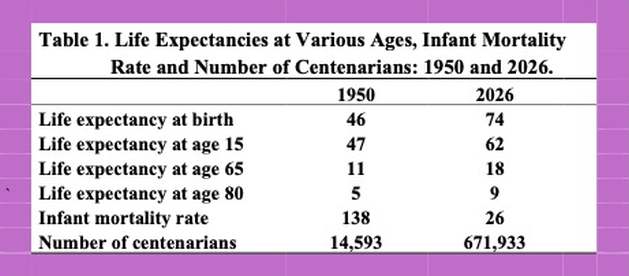
Life expectancies at various ages have shown significant increases worldwide. For example, the global life expectancy at birth has risen from 46 years in 1950 to 74 years today and at age 65, life expectancy has increased from 11 years in 1950 to 18 years today (Table 1).
Source: United Nations.
Additionally, infant and childhood death rates have significantly decreased with more children surviving to adulthood. For instance, the world’s infant mortality rate has dropped from 138 deaths per 1,000 births in 1950 to today’s 26 deaths per 1,000 births.
Moreover, remarkable medical advancements have been made in extending the lives of older men and women since 1950. For example, the number of centenarians worldwide has increased from nearly 15,000 in 1950 to about 672,000 in 2026.
Returning to the question posed at the beginning, “How am I going to die?”, the major causes of death for the world’s population of 8 billion provide some general background.
Globally, the main causes of death are non-communicable diseases (NCDs), which are illnesses that are not contagious. These NCDs account for about three-quarters of all deaths worldwide.
However, infectious diseases, such as pneumonia, influenza, diarrheal diseases, tuberculosis, HIV/AIDS, COVID, and malaria, still exist and are responsible for approximately 14% of all deaths.
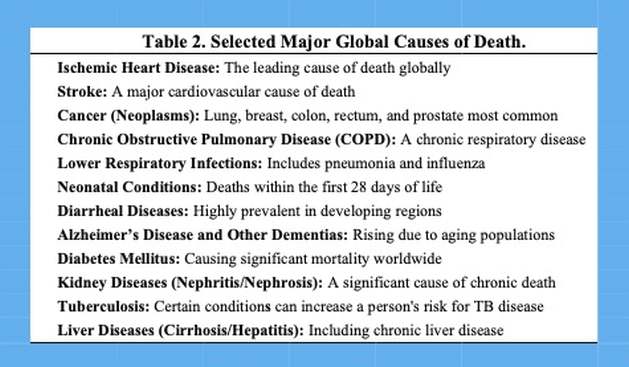
According to recent trends by the World Health Organization (WHO) the leading cause of death globally is ischemic heart disease. It is followed by stroke, cancer, chronic obstructive pulmonary disease (COPD), lower respiratory, and neonatal conditions (Table 2).
Source: World Health Organization (WHO).
In 2021, COVID-19 was a leading cause of death, ranking after ischemic heart disease and preceding stroke. By 2025, COVID-19 had dropped significantly in ranking, yet it still remains a significant contributor to respiratory mortality.
Analyzing the major causes of death among various age groups in different countries provides additional valuable insights. These data offer a glimpse into potential answers to the question of how I am going to die, based on specific age groups within different countries.
For individuals aged 15 to 34, the primary causes of death in many countries, especially more developed ones, are suicide, accidents, and cancer.
Similarly in the United States, the causes of death vary significantly by age. For young adults (ages 15 to 24), the main causes of death are unintentional injuries such as motor vehicle crashes and drug overdoses, followed by suicide and homicide. Among the elderly, the primary causes of death are heart disease, cancer, stroke, and chronic lower respiratory diseases.
In many more developed countries, such as Canada, France, Germany, Great Britain, Italy, and South Korea, the leading causes of death for those aged 15 to 34 are suicide, road accidents, and cancer. Among adults aged 65 and older, like in the United States, heart disease, cancer, stroke, and chronic lower respiratory diseases are the main causes of death.
Turning to less developed countries, the leading cause of death in China is cardiovascular disease, accounting for over 44% of deaths in 2024. Among children and adolescents, the leading causes of death are suicide, road traffic accidents, and drowning while among older persons aged 60 and above, cancer and cardiovascular diseases are major factors. Unintentional falls are also a significant and growing cause of injury related deaths in this older age group.
Similarly, ischemic heart disease is the leading cause of death in India, accounting for nearly one-third of all deaths. Among those aged 15 to 24, suicide is the leading cause of death, followed by road traffic injuries. For children, infectious diseases such as diarrheal diseases and intestinal infections are major factors contributing to death.
In contrast to China and India, the leading causes of death in Africa are dominated by communicable diseases. The major causes of death, particularly in sub-Saharan Africa, include lower respiratory infections, malaria, diarrheal diseases, and HIV/AIDS. Neonatal conditions and maternal mortality also significantly contribute to premature death.
In Nigeria, for example, the leading causes of death are dominated by malaria, lower respiratory infections, diarrheal diseases, and tuberculosis. Heart disease, stroke, and HIV/AIDS are also among the important causes of death. However similar to China, India, and many other countries worldwide, road traffic accidents are among the top causes of death among young adults.
Among the countries of South America, cardiovascular disease is the leading cause of death, followed by cancer and respiratory diseases. Together these three account for over two-thirds of deaths in this major region.
Suicide is the leading cause of death among young people in several South American countries, including Chile, Ecuador, Guyana, and Suriname. Additionally, in many countries in South America, such as Argentina, Brazil, Colombia, and Mexico, homicide and road traffic accidents are the major causes of death among individuals aged 15 to 24.
A particularly troubling global trend development in mortality is the fact that suicide ranks as the third leading cause of death among individuals aged 15 to 29. More than 720,000 people die by suicide every year. This number, coupled with the alarming increasing trend, has elevated suicide to a major public health concern in many countries.
In conclusion, while virtually everyone acknowledges the inevitability of death, many occasionally wonder “How am I going to die?” Providing a precise answer to this question is challenging and depends on various personal circumstances, including age, sex, genetics, income, medical conditions, country of residence, and lifestyle choices.
Some of these circumstances, such as age and genetics, are unchangeable. However, lifestyle choices that impact the cause of death, such as smoking, alcohol and drug consumption, diet, and exercise, can be modified or improved. Making positive changes in these areas can often lead to a longer and healthier life.
Joseph Chamie is a consulting demographer, a former director of the United Nations Population Division, and author of many publications on population issues.
 Print
|
Print
|




