
Thursday, October 22, 2026



News and Views from the Global South
Freedom of Expression
100 Days, No Outcry – The Cost of Speaking Out
One hundred days after their arrest, lawyers Imaan Mazari and Hadi Ali Chatha remain behind bars. For many of Pakistan’s most vulnerable, their absence has left a growing legal and moral vacuum.
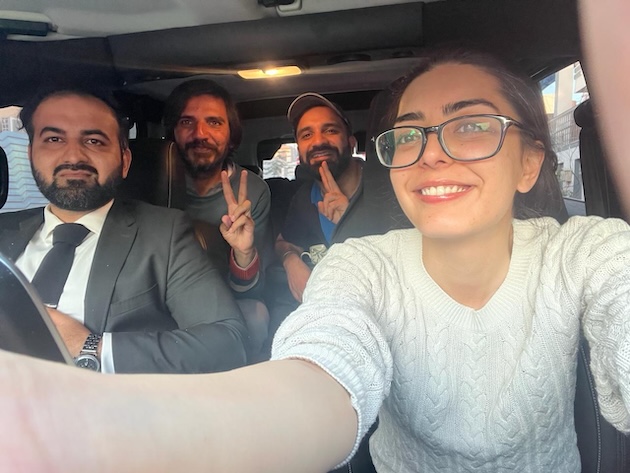
Hadi Ali Chatha (left) and Imaan Hazir Mazari (right) in the front seat, taking Asad Toor (at the back on the left) home after his release from Rawalpindi’s Adiala Jail, on March 17, 2024. Credit: Asad Toor
- “We’ve abandoned this couple completely; we have not done even 1% of what they did for us all these years!” said journalist Asad Ali Toor.
Arrested on January 23, 2026, two lawyers, also husband and wife – Imaan Mazari and Hadi Ali Chatha – were sentenced the next day to 17 years under the Prevention of Electronic Crimes Act (PECA), 2016 (amended in 2025) – a law Mazari had described as even more ‘draconian’ than its original version. Fines of Rs36 million (USD129,261) each were also imposed on the two under Sections 9 (glorification of an offence), 10 (cyber terrorism), and 26-A (false and fake information) under the same law.
“They have not violated PECA, and in my opinion the prosecution failed to prove any of the ingredients of any offence under the law,” said human rights activist and lawyer Jibran Nasir. He added that “the military elite and the new chief justice in the Islamabad High Court have taken a personal dislike to Imaan and Hadi. He noted that “The laws may be inherently flawed, even draconian, but more dangerous is their malicious application by the state.”
The amendments on PECA were pushed through parliament within a week, without debate, and signed into law by President Asif Ali Zardari. The move triggered nationwide protests by journalists and rights groups, who warned that the law lacked safeguards. The government, however, defended it as necessary to regulate social media, arguing that similar frameworks exist globally.
Charges, Judgment and Allegations
The judgment stated that Mazari was accused of “disseminating and propagating narratives that align with hostile terrorist groups and proscribed organisations”, while Chatha was charged with reposting her content. The police report also alleged her social media content portrayed the armed forces as ineffective against groups such as the Balochistan Liberation Army (BLA) and Tehreek-i-Taliban Pakistan.
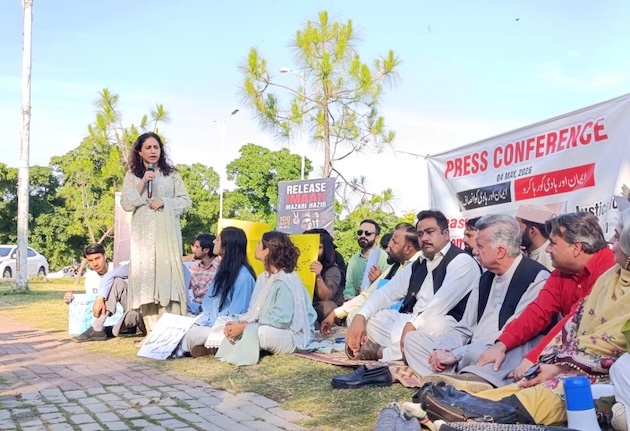
Protestors gather outside the Islamabad Press Club to mark 100 days of the two lawyers’ continued detention. Credit: Rana Shahbaz
For Toor, who runs the YouTube channel Asad Toor Uncensored, the case is deeply personal. In 2024, he spent 20 days in Federal Investigation Agency custody and 12 in solitary confinement at Rawalpindi’s Adiala Jail, the same prison where the couple is now held.
Arrested on February 26, 2024, on “digital terrorism” charges linked to his coverage, among other things, of a Supreme Court ruling stripping the Pakistan Tehreek-e-Insaf of its election symbol, he was granted bail on March 17, 2024.
He credits Mazari and Chatha with securing his release. “They argued that journalists should not face criminal charges for “honest criticism” of court judgments, citing then Chief Justice of Pakistan Qazi Faez Isa and Attorney General for Pakistan Mansoor Usman Awan.”
But journalists like Toor are not alone in feeling what he describes as “a certain vacuum.”
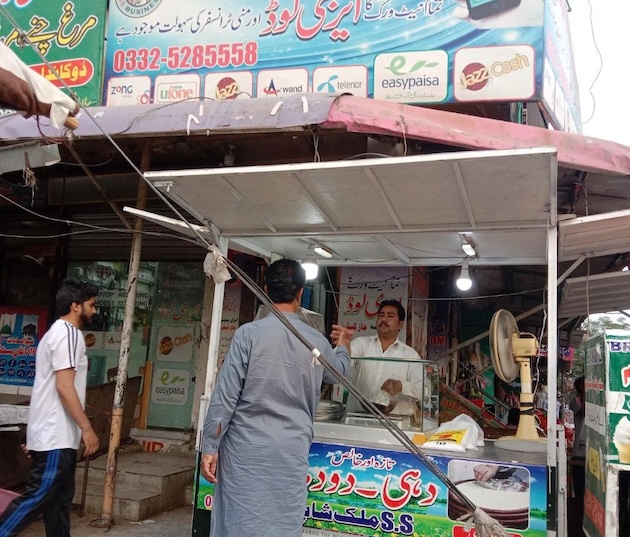
Rana Shahbaz’s milk stall was demolished by the city administration. Credit: Rana Shahbaz
‘It Feels Like I’ve Lost My Right Arm’
The two lawyers had built a reputation for taking on cases few lawyers would touch.
“Imaan and Hadi have always taken up cases most lawyers shy away from due to their controversial or dangerous nature — including blasphemy accusations, enforced disappearances, and press freedom cases — often representing the most marginalised people, without charging anything,” said rights activist Usama Khilji, director of Bolo Bhi, an advocacy forum for digital rights.
“It feels like I’ve lost my right arm,” said a woman, who requested anonymity, as she struggles to secure the release of her brother and more than 400 others accused of blasphemy, languishing in jail across Pakistan.
“In the past three years, I have met countless lawyers and even judges, but no one fought like Imaan. She missed nothing – every detail mattered; she was relentless,” said the woman, talking to IPS.
Leading the campaign, she said most of the accused came from poor backgrounds. “She didn’t even charge for the photocopying of documents submitted to the court – she paid out of her own pocket.”
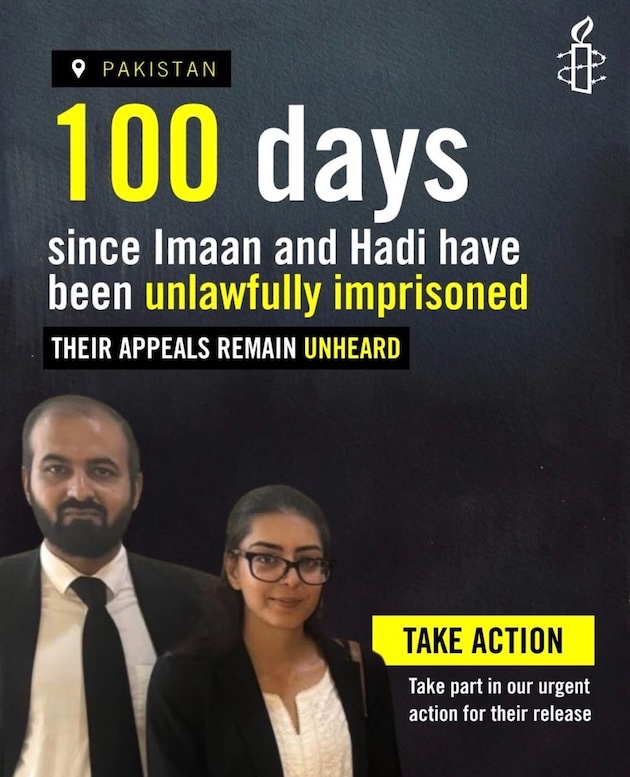
An Amnesty International poster protesting the 100 days since Hadi Ali Chatha and Imaan Hazir Mazari were jailed. Credit: Amnesty International
The sense of loss extends well beyond individual cases.
Rahat Mehmood, mother of missing poet and writer Mudassir Naru, who disappeared in 2018 described the couple’s arrest as devastating.
“It’s like my support system has collapsed,” she said over the phone from Faisalabad. “Not just for me—these two were a ray of hope, an anchor for hundreds of mothers, especially Baloch mothers.”
Mazari’s work, she said, was not limited to legal representation.
Her grandson, Sachal, was just six months old when his father was taken and later lost his mother in 2021. Court hearings, Mehmood recalled, became rare moments of relief. “They played hide-and-seek, raced around, and she would bring him toys and candy. Tell me—who does that?”
Although her son’s case has not been heard in over a year, Mehmood said that, with Mazari by their side, they had always had hope. “But now,” she added, “it’s all darkness.”
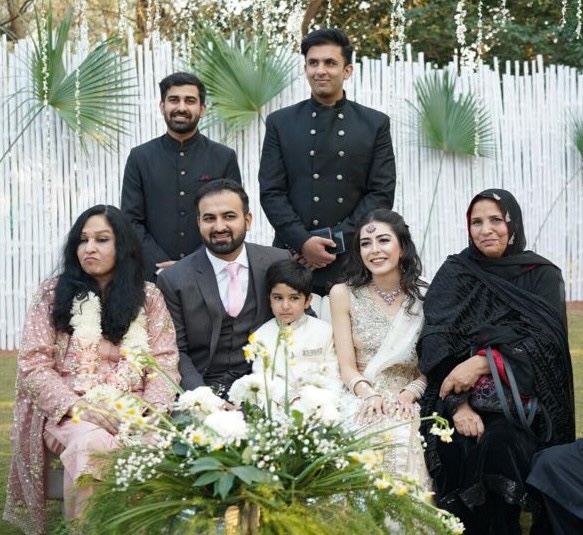
At the wedding of Imaan Mazari and Hadi Ali Chatha, Sachal (son of Mudassir Naru) sits between the two, on the far right; in black, Rahat Mehmood, Naru’s mother, sits. Credit: Rahat Mehmood
Mazari’s advocacy extended beyond the courtroom. She appeared in two of the three press conferences held by families of the blasphemy accused, which drew “huge crowds and media attention”. Today, more than 120 people are out on bail. “It’s because of the efforts of these two,” said the sister of the accused.
Their absence is being felt acutely among many others with the least protection.
A week after the lawyers’ arrest, Rana Shahbaz, a street vendor, went to visit Mazari in jail but was turned away. “I was told by jail authorities no one was allowed to meet her.” He had brought dry fruits, juices and clothes, which authorities refused to accept.
Shahbaz, president of the Anjuman Rehri Baan, Islamabad (association of street vendors), which represents over 20,000 street vendors, said Mazari had been instrumental in securing relief for them. Despite holding licences from the Metropolitan Corporation Islamabad, they routinely face raids and eviction by city administrations.
“Last year because of Madam Imaan, the Islamabad High Court stopped authorities from removing our stalls. She presented video evidence showing stalls being dismantled despite having permits,” Shahbaz said.
Since their arrest, he added, the pressure has returned.
“The day they were arrested, an official told us, ‘Call your lawyers now — I’ll see who stops me.’ She was right — only Madam Imaan had the courage to stand up for us,” said Shahbaz, whose stall has been destroyed thrice in the past two years.
“It costs Rs150,000 (USD 538) to set up these makeshift stalls – financed through a bank loan with a monthly instalment of Rs7,000 ($25). Each time authorities dismantle them, repairs cost up to Rs40,000 (US$144), making it impossible to keep up with repayments and pushing me toward default,” he said. Last week, despite having a valid licence, his lassi (yoghurt drink) and fresh milk stall were demolished.
The pretext for crackdowns can be anything—from late-night vending to fines for not displaying price lists or even refusing to offer “freebies” to the police. “Madam Imaan knew well that vendors are exempt from the curfew time for regular shops or that we can only display the price list once it comes from the city authorities and it doesn’t until midday,” he pointed out.
Like many others, Shahbaz said, the two lawyers worked for vendors for free. “We didn’t even know what the basic legal processes cost,” he said.
Muted Response
Despite the breadth of their work, support beyond affected communities has been limited.
“I hold both the journalist and legal fraternities responsible for doing virtually nothing,” said Toor. “Individual voices may struggle, but unions and bar councils have the power to pressure the government.”
Toor’s assessment is shared by lawyer Nasir. He acknowledged that the legal fraternity, with “many lawyers, like judges, appear to be motivated by self-preservation as opposed to the preservation of the constitutional and fundamental freedoms” and which has “blunted its effectiveness” and left it “equally vulnerable” in the long run.
Yet, even as this institutional weakness is laid bare, others frame the duo’s actions less as miscalculation and more as conscious defiance. Media development expert Adnan Rehmat argued that while some may see them as having paid a heavy price for their stance, the two have a long history of public-interest resistance. “They consciously chose to risk themselves to highlight state abuses, and their courage should be lauded—and we must continue raising our voices in their favour.”
As a result, sporadic protests have failed to shift the situation. With public pressure waning, the battle has moved to the courts.
An Uncertain Path
But even there, justice has remained elusive.
The Islamabad High Court refused interim relief. “Everyone knows the 17-year sentence is the product of a sham trial. No superior court in any modern judicial system would uphold it,” said senior advocate Faisal Siddiqi, the lawyer representing them.
Undeterred, the defence has moved the Supreme Court of Pakistan after the IHC failed to fix an early hearing for nearly two months – a delay which Siddiqui called “unheard of” and a ploy to “deny Imaan and Hadi their deserved liberty”.
The bail petition has since been accepted by the Supreme Court, offering a glimmer of hope. “It is our only and last hope,” said Siddiqi.
One hundred days on, that hope remains uncertain.
What is clearer, however, is the void left behind – felt in courtrooms, in protest spaces, and in the lives of those who had come to rely on the two lawyers willing to take risks few others would.
For many, it is not just their absence that is being measured in days but also the growing silence it has left behind.
“I cannot fathom why people like Imaan and Hadi are being punished—and for what,” said Mehmood. “They deserve to be saluted, not jailed!”
IPS UN Bureau Report


 Print
|
Print
|




