
Sunday, September 27, 2026



News and Views from the Global South
Opinion
Tea’s Future Depends on Its Farmers
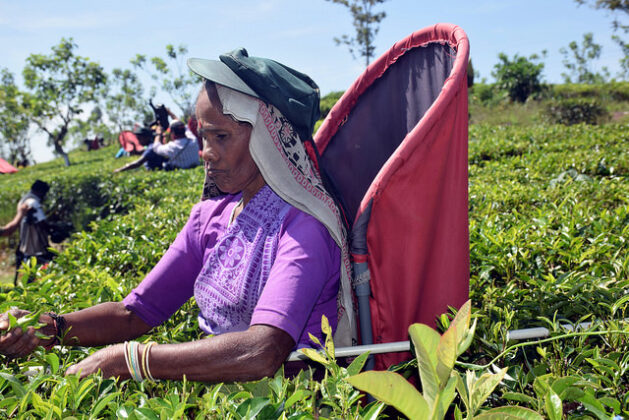
A tea picker in the Bearwell tea estate of Sri Lanka. Credit: Stella Paul/IPS
- The tea in your cup this morning began its journey in someone else’s hands. Hands whose work most of us never think about. Almost certainly, those hands belonged to a smallholder farmer tending a small plot of land, plucking leaves by hand beneath long mornings of mist and rain.
Two leaves and a bud. Two leaves and a bud. Thousands of times. Smallholders account for about 60 percent of global tea supply. The industry built on their labor is worth US$19.5 billion a year and supports the economies of some of the world’s poorest countries. Yet the conditions that sustain that work – ecological, economic and climatic – are under growing pressure.
Yet the millions of smallholder farming families driving that growth in China, India, Kenya, Sri Lanka, Uganda, Malawi, Rwanda and beyond need stronger support if the sector’s momentum is to endure.
The geography of tea production is also a geography of economic necessity, linked to patterns of economic dependence and rural livelihoods. Kenya is the world’s largest tea exporter.
Sri Lanka, Uganda, Malawi and Rwanda rank among the global top ten. In these economies, revenues from tea exports help finance food imports and sustain rural livelihoods across entire regions. The sector remains a major source of employment and income for millions of poor families worldwide.
That income is more fragile than the industry’s headline numbers suggest. International tea prices, adjusted for inflation, have been declining for four decades.
The sector’s nominal value has expanded, while the real purchasing power of many producers has stagnated. FAO has documented what this means at the household level: when farmgate prices fall, smallholder families reduce spending on food, education and health care.
Smallholder producers also face limited market access, inadequate extension services, weak access to credit and technology, and persistent asymmetries in how value is distributed across the supply chain.
As production costs rise and price increases transmit unevenly through markets, many farming families struggle to generate sufficient returns to reinvest in farm renewal, climate adaptation or productivity improvements. These pressures heighten income volatility and make long-term planning increasingly difficult.
Tea production and processing are major sources of employment and income for women across East Africa and South Asia. When smallholder tea farming families prosper, women’s economic participation will determine whether that prosperity and stability hold.
Programmes that support women directly through training, market access and financial resources consistently produce stronger outcomes for both households and communities. In many tea-growing regions, women sustain not only household economies, but also the continuity of the knowledge and labor on which the crop depends.
Tea cultivation relies on highly specific agro-ecological conditions: altitude, rainfall patterns and temperatures shaped gradually over centuries in the regions where production became concentrated.
These conditions are becoming harder to predict and increasingly difficult to sustain. More erratic rainfall, fluctuating temperatures, and extreme weather events are already impacting both yields and quality.
For a smallholder farmer without savings or insurance, a lost harvest is not a temporary setback. It immediately affects household spending on food, medicine and schooling.
The unevenness of that burden is a central challenge. Larger operations often possess greater capacity to adapt through irrigation, diversification, upgrading and financial reserves.
Smaller producers, by contrast, frequently get trapped between increasing climate risks and limited investment capacity. Investment needs to be calibrated to the realities of smallholder tea farming rather than assumptions drawn from larger commercial operations.
What is at stake extends beyond a commodity market. Several tea-growing landscapes have been formally recognized by FAO as Globally Important Agricultural Heritage Systems. These landscapes were shaped over generations through accumulated farming knowledge and long relationships between land, crop and community.
Tea cultivation depends on delicate balances of shade, slope, rainfall, soil health, and inherited knowledge built gradually over generations. Climate-related stress threatens these landscapes alongside the livelihoods and agricultural continuity they sustain.
More efficient, inclusive and sustainable value chains, including greater local value addition and stronger producer participation in markets, are essential if the benefits of the growing tea economy are to reach both the people and the environments that sustain it. Per capita tea consumption in many producing countries remains relatively low, meaning the sector’s growth potential is still substantial.
Ensuring the sector’s viability, however, requires more than rising consumption levels. Smallholder producers need better access to finance, markets, technology, and climate adaptation support calibrated to their realities.
More transparent and balanced value chains, targeted investment that reaches women directly, and stronger incentives for reinvestment at farm level will determine whether the industry’s future growth will remain economically and socially sustainable.
The farmer who grew your tea will get up again tomorrow morning before sunrise. The future of the sector depends on ensuring this remains a viable livelihood option.
You want to see a bright tea future? Join us in celebrating International Tea Day on 21 May!
Boubaker Ben-Belhassen is Director of the Markets and Trade Division at the Food and Agriculture Organization of the United Nations (FAO)
 Print
|
Print
|




