
Monday, October 5, 2026



News and Views from the Global South
CUBA: Raul Shares His Seat with Fidel
Dalia Acosta
- Raúl Castro, one of the leaders of the Cuban revolution and a lifelong communist, is Cuba’s new president as of Sunday. But he said he would listen to the views of Fidel, who he described as “not substitutable,” as long as his older brother is around.
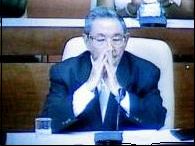
Raúl Castro Credit:
The proposal was immediately and unanimously approved by the 597 members of the National Assembly who met Sunday, less than a week after the 81-year-old Fidel Castro announced that he was permanently stepping down after nearly half a century in power.
“There is only one commander-in-chief of the Cuban revolution. Fidel is Fidel, and we all know that. Fidel is not substitutable, and the people will continue his work when he is no longer with us physically,” said the new president, who reiterated his certainty that only the Communist Party can be “the worthy heir of the confidence that the people have deposited in their leader.”
Fidel Castro “is the same as he always has been, with a clear mind and a more than intact, in fact strengthened, capacity for analysis and making forecasts,” said Raúl Castro.
In a gesture that was described as “rational” and “dignified” by a large part of the Cuban population and analysts both within and outside of Cuba, Fidel Castro, who remains the head of the governing Communist Party, said it would amount to a betrayal of his conscience to hold onto responsibilities that he was not in a position to fulfil, for health reasons.
Fidel Castro, who temporarily ceded power to Raúl on Jul. 31, 2006 as a result of emergency intestinal surgery, said that for months he had been trying to prepare the Cuban population for the inevitable, by sending out realistic messages that did not attempt to generate a sense of optimism and that gradually paved the way for the decision that he announced in a message published on Tuesday.
“My only wish is to fight as a soldier in the battlefield of ideas. I will continue writing under the heading ‘Reflections from Comrade Fidel’. It will be just another weapon in the arsenal that you can count on. Perhaps my voice will be heard,” he said in the statement.
His voice will be heard, as made clear by the first decision adopted by the members of the legislature who were elected on Jan. 20.
“We will not work without him, we will always work with him and with his teachings. He keeps an eye on us, and gives us advice and recommendations. Wherever he is, he will always be the commander-in-chief,” Dr. Pura Concepción Avilés, a lawmaker representing the province of Holguín who was elected to the legislature for the fourth time, told IPS.
Ricardo Alarcón, 70, was reelected as president of the National Assembly on Sunday, and José Ramón Machado, for years the “organiser” of the Communist Party, was elected as first vice president of the Council of State and Council of Ministers.
The election of Machado, a 77-year-old doctor who is identified with the most orthodox faction within the Cuban leadership, laid to rest widespread speculation that vice president Carlos Lage would be reelected to that position. However, Lage will remain one of the five vice presidents of the Council of State.
The 56-year-old Lage, who represents a younger generation of leaders, emerged from the ranks of the Young Communist League, was involved in the process of economic reforms adopted in Cuba in the 1990s, and on more than one occasion headed the Cuban delegation in meetings of heads of state and government.
The 76-year-old Raúl Castro announced that the creation of the new Council of Ministers would be decided after a careful analysis of the current system.
“Every decision and resolution that is adopted begins to age the very next day. Everything must be renewed and renovated, and at every moment, it is necessary to do what that moment requires,” Jaime Crombet, who was confirmed in his post as vice president of the National Assembly, told IPS.
For his part, Eliades Acosta, head of the cultural department of the Communist Party Central Committee, said that since Marxists believe that the economic base determines the superstructure, the top priority of the new government must be the economy.
“Vigorous action will be taken. What the people expect from the revolution is precisely that: that it will solve a series of pending problems,” he told IPS.
Although he did not specify the changes that lie ahead, President Raúl Castro said the dual currency system is being studied. But, he warned, any decision to that respect must avoid “traumatic effects and incongruencies” and must take into account the current wage system, retail prices, free services and subsidised products and services.
“Moving forward in a coherent, sound, well-thought-out manner until wages recover their role is a strategic objective today,” he said.
He also said that the excess of prohibitions and regulations that were heavily questioned by Cubans in the open debates held since Raúl Castro, in a Jul. 26, 2007 speech, urged the public to openly voice their criticisms of Cuban society, were being evaluated.
After urging Cubans “to never believe that what we have done is perfect,” the new president said that some of the prohibitions would begin to be eliminated as soon as possible, because in some cases their only objective was to prevent the emergence of social inequalities.
However, the “total suppression of other regulations will take longer,” because they will require comprehensive assessments and changes in Cuban legislation. In addition, he said, measures taken against Havana by its long-time foe, the U.S. government, play a role in some of the bans and restrictions.
Raúl Castro reiterated several ideas that he has expressed for years: that “improvisation” that can bring “considerable negative consequences” must be avoided, and that it is necessary to “plan well” in order to avoid “spending more” than the government has and to work “with order and discipline.”
“We must not fear discrepancies in a society like ours, in which, by its very essence, there are no antagonistic contradictions,” said the new president. The “right to express oneself” should be guaranteed by law,” he added. “We will not stop listening,” he promised.
 Print
|
Print
|




