
Sunday, October 11, 2026



News and Views from the Global South
Q&A: "I Don't Consider Myself a Loser in Any Way"
Interview with Pamela Mburia
- In the run-up to Kenya's Dec. 27 general elections, IPS touched base with legislative candidate Pamela Mburia on several occasions to discuss the challenges she was facing in her campaign. Ultimately, Mburia did not win the Eastern Province seat of Nithi that she contested, so this week we decided to join her again to look back on lessons learned.
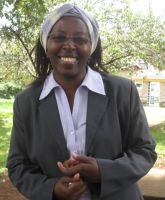
Pamela Mburia, set to continue pushing for change in her community. Credit: Kwamboka Oyaro/IPS
Those lobbying for gender balance among lawmakers would find it difficult to fix the public's attention at present, however. As IPS correspondent Kwamboka Oyaro was interviewing Mburia, President Mwai Kibaki and prime minister-designate Raila Odinga were locked in a standoff over the formation of a coalition government.
Kibaki's Party of National Unity and the Orange Democratic Movement, led by Odinga, agreed to a government of national unity in February to end weeks of violence sparked by allegations that Kibaki was returned to office through a rigged presidential poll. But, disagreements over the sharing of key cabinet positions, and of high-ranking posts in the civil service and parastatals have put a brake on proceedings.
IPS: When we last reached you, ahead of the Dec. 27 polls, you were upbeat about your prospects – but struggling to continue financing your campaign. Looking back now, what could you have done differently with raising money for your parliamentary bid?
Pamela Mburia (PM): I really don't know what I could have done differently. Experts gave me tips about raising money, which made it look really easy. But, the reality is different. They tell you to start with your friends. I drew up a list of my friends, but you know, some friends don't see things the way you do – and others don't have the financial strength to make a political impact. I started with the expert, a friend, to put a little money into my kitty; but that was the last time I saw or heard from her.
Despite not having money to finance my campaign I was optimistic about winning elections because there were such positive responses on the ground. The people told me that it was time for change…and when I penetrated areas politicians had never visited, the voters swore to support me. I learnt so much about the disparities on the ground. But money is the bottom line of success.
IPS: Last year, you alleged that a number of your political opponents were bribing voters. How do you think legislation can be tightened up to prevent this happening again, in future polls? And perhaps more importantly, how do you think Kenyans themselves can get to the point where taking bribes is as unacceptable as offering them?
PM: Members of parliament can pass a law that makes voter buying criminal, and those caught doing it slapped with a serious punishment such as being disqualified from contesting.
For voters, I insist that civic education can change this. One day, I talked to youths who were demanding money from me for a drink about the futility of depending on handouts, instead of asking for more durable things such as water wells or health clinics…When I was done with my speech, they didn't ask for the money for local brew.
More such messages, I believe, might make taking bribes unacceptable. The mentality that someone has to give you money before you vote for them could be vanquished if leaders went back to the community and started development projects to help reduce poverty…If they (voters) understood that they could actually use their vote to bring real change, then they would vote for a candidate whose qualities would meet their expectations, and reject bribes.
IPS: Let's suppose for a moment that your party gave you carte blanche to improve the way it deals with its women candidates in elections…What would you advise the party to do?
PM: Money is the greatest impediment to women's political progress, and starting a kitty for them would help. I would also advise the party to go around the country to villages and identify strong women at the grassroots as party candidates. This should be done long before the election year to give the party and its contestants ample time to identify pitfalls and deal with them early.
In the election year, the party should bring all women candidates from around the country together. Apart from exchanging ideas and experiences, these women could plan to visit one another and campaign in the constituencies. I realised that you appeal more to voters when guests accompany you to rallies.
The party gave me some cash just two days before elections, which helped me pay agents – which was good, but I would advise that such financial help should come much earlier to enable the candidate to plan the campaign better.
Also, the party must strive to popularise itself and make an impact among voters. The party leaders should also go to the ground to boost the candidate's chances by showing voters that the party supports the candidate.
IPS: What do you make of the fact that only 15 women were elected to parliament in December?
PM: This is an improvement, but we could have done better. With six more women nominated to parliament by their parties, we now have 21 women in parliament, but this is still paltry against the total number of 222 members. Yet, women are a majority in this country.
What I realised, unfortunately, is that many women are not registered voters – and even some of those registered don't actually vote. When women play their part by registering as voters and actually voting, then we will see this number going up. Women's participation makes a difference, but when there is apathy, realising adequate numbers will take time.
IPS: Has your loss at the polls permanently disillusioned you, or do you see yourself contesting another parliamentary election, perhaps during the next round of polls in 2012?
PM: I don't consider myself a loser in any way. I consider having gone through the whole journey a plus for me. Not going to parliament is not what disillusioned me, but (rather) the practices associated with campaigns and elections.
I am not sure I will try it again. Unless there are laws in place to discourage corruption during campaigns where voters are blatantly bribed in full view of everyone, I won't be party to the process again. Those who offer bribes and the recipients must be dealt with severely to deter others from doing the same. This will provide a level playing ground for everyone.
Also, my people lack civic education. I know of constituencies where voters received bribes but still voted for the candidates of their choice. When my people are enlightened the same way, only then will I rethink my position.
IPS: What are your plans for the future?
PM: From my experience in the last elections, I realise I have a bigger calling: I must take civic education to the villagers. I would ask them during the campaign, "If you receive 200 shillings (just over three dollars) to vote for someone, how much is that per year…per month and per day?" When they realised it boiled down to cents, they bowed their heads in shame. This is the message I want to keep repeating throughout the constituency until the people grasp it and change their attitude.
Besides, I still have my activities I have been doing on the ground to promote education among the Nithi people. At the end of this month we are having a fundraising meeting for school fees for students in secondary schools from poor families. My campaign platform was education, because I know without education even civic education could be irrelevant. It is education that has made me who I am and I want others to have a chance.
I want to remain relevant in the community, so I will still participate fully in any activity there that calls for my attention. Politics is every day, you can't walk away from it; it doesn't end with one's not going to parliament. My presence in the constituency is going to be felt for a long time.
 Print
|
Print
|




