
Monday, October 12, 2026



News and Views from the Global South
POLITICS-US: E-Voting Worries Focus on Swing States
Ali Gharib
- A common criticism of technology is that the more complex it gets, the more likely it is to break down; more moving parts means more potential problems.
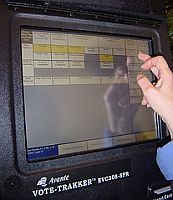
The Avante Vote-Trakker touch screen system used in Hartford County, Connecticut. Credit: Aaron Gustafson
Electronic voting technology, known as e-voting, ranges from punch cards to optical scan voting systems and special voting kiosks. It can also involve transmission of ballots and votes via telephones, private computer networks, or the Internet. About 50 million U.S. citizens will use the new systems on Nov. 4.
Critics of e-voting say that some of the 24 states with at least some counties using e-voting systems are not doing enough to ensure that all votes will be properly recorded and counted.
“It is simply dangerous to rely on today’s electronic voting machines to deliver a fair and accurate election,” Avi Ruben, a computer science professor at Johns Hopkins University, said last week in a press release accompanying a report released by Fortify Software listing voting methods in order of what should be most desirable to voters.
The concerns are especially acute considering that so many potential problems exist in swing states – electoral battlegrounds that don’t consistently vote for one party and will likely decide the election.
U.S. presidents are chosen by the Electoral College system, where the states hold individual elections which then throw their entire number of delegates – a figure allotted according to the state’s size – to the candidate with the most votes. A candidate wins the national election by amassing at least 270 out of 538 electors.
In the 2004 election, a widely predicted worst-case scenario of massive e-voting errors and problems never occurred, but there were discrepancies that lend credence to some criticisms of e-voting as potentially calling elections into question.
In that year, computers in North Carolina failed to log some 4,500 votes, others in Florida inexplicably started counting backward, and voters in several states complained that when they tried to cast a ballot for Democratic challenger Senator John Kerry, it was recorded as a vote for the incumbent, President George W. Bush.
North Carolina, while not up for grabs in 2004, is considered a hotly contested battleground in this year’s election cycle. In an era where, in 2000, Bush won the crucial state of Florida by about 500 votes, North Carolina’s 4,500 missing votes could easily make a marked difference on the electoral map.
A joint report released last week by the Brennan Centre for Justice at New York University, the Verified Voting Foundation, and Common Cause gave poor grades to several swing states over a handful of categories.
Two hot battleground states this year, Colorado and Virginia, said the report, were among the 10 states that received the poorest ranking in three out of four categories.
“It’s the small scale troubles that I’m more concerned with,” Lawrence Norden, the director of the Voting Technology Project at the Brennan Centre, told IPS. “If you’re not doing good checking after the election, it’s easy to lose 100 or 200 votes here and there.”
“All these problems are always more serious when the election is close. If you have close races in Virginia and Colorado, the problems could potentially be very big,” said Norden.
“On Nov. 4, 2008 voting systems will fail somewhere in the United States in one or more jurisdictions in the country,” said the report, titled “Is America Ready to Vote?”
“Unfortunately, we don’t know where. For this reason, it is imperative that every state prepare for system failures,” it continued.
Because of inherent problems with e-voting – susceptibility to hacking and viruses and potential non-malevolent technical issues – the Brennan Centre report calls for measures to be taken so that all those who wish to vote can have their voices counted.
The report used four categories to judge preparedness to deal with e-voting issues: contingency plans for downed voting machines; “ballot accounting and vote reconciliation” to identify inconsistencies; “voter verifiable paper records”; and using that paper record for a post-election audit.
“Unfortunately, there is still much work to be done to ensure that every voter will get to vote and every vote will be counted if something goes wrong with voting systems on Election Day,” said Norden in a release from the Institute for Public Accuracy Wednesday.
Some problems can occur before voting begins. For instance, when voting machines go down, said the report, polling places should have paper ballots on hand so that people don’t need to wait in long lines for machines to go back up.
But even after votes have been cast, computers can be tampered with, or just skew results because of programming or hardware errors. Double checking one’s vote against a paper record, and comparing results tabulated on a paper print-out to results spit out by a computer when voting is done are both considered ways to ensure that even if things go wrong with the machines, the votes will count, said the Brennan Centre report.
Another contributing factor to potential problems could be the extraordinary numbers of new and first-time voters who have registered leading up to November’s election.
“All indications are that there could be a dramatic surge in turnout for the General Election on Nov. 4, 2008, resulting in a much higher turnout than in years past,” said a separate report from the Advancement Project, a group for racial justice formed by veteran civil rights lawyers in 1998.
“However,” continued the report, “if election officials are not adequately prepared, what could be the greatest collective exercise in democratic participation in our Nation’s history will likely be stained by systematic failures to equitably accommodate all those who turn out to vote.”
The report recommends that election officials, when possible, get more machines, re-allocate underused ones to locations expected to have heavy turnout, add poll workers, and encourage and use absentee ballots and early voting.
Many critics of electronic voting methods and potential problems that can end up disenfranchising voters cite the turnout and the expected explosion of voting among urban populations and people of colour.
 Print
|
Print
|




