Languages
Monday, November 9, 2026



News and Views from the Global South
Opinion

A Pivotal Moment for Biofortification
This year’s World Food Prize pays tribute to biofortification, an intervention that strengthens efforts to address one of the world’s most insidious and pervasive public health challenges—hidden hunger. That is good news for the majority of the two billion people globally who suffer from hidden hunger, and likewise for those fighting to end the epidemic.
Time to Get Serious about Civilian Protection for Darfur
With the future of the United Nations peacekeeping operation in Darfur now in jeopardy, the safety and security of the Sudanese region’s most vulnerable communities hangs in the balance.
You must be the change you wish to see in the world – Mahatma Gandhi
2016 has been a dramatic year for the world, and for the media. Political dysfunction appears to be on the rise, putting social media under increasing critical scrutiny even as prestigious global commercial news brands capable of acting as the fourth estate are downsizing.
More of the Same: World Bank Doing Business Report Continues to Mislead
The World Bank’s Doing Business Report 2017, subtitled ‘Equal Opportunity for All’, continues to mislead despite the many criticisms, including from within, levelled against the Bank’s most widely read publication, and Bank management promises of reform for many years.
Women Human Rights Defenders: Targeted for Identity and Activism
AWID’s 5th online tribute to Women Human Rights Defenders (WHRDs) who have died in recent years, commemorates sixty feminists and activists. Thirty eight of these defenders died violently, and were murdered as a result of who they were, their identities, and the rights they defended.
Why Achieving Sdg Goal 8 on Decent Work and Economic Growth Is Critical for Kenya
In Kenya the Gini coefficient of inequality is at around 0.45%. Therefore, the economic growth statistics present an unequivocal picture of a highly unequal society, whose development strategy is largely leading to accumulation of wealth by a few and worsening the poverty of the majority.
Fiscal Austerity Has Been Blocking Economic Recovery
Instead of concerted and sustained efforts for a strong, sustained economic recovery to overcome protracted stagnation, the near policy consensus on fiscal austerity in the G7 and the G20 OECD countries, except for the US and Japan, has dragged down economic recovery in developing countries.
Resilient People & Institutions: Ecuador’s Post-Earthquake Challenge
No one is really prepared for an emergency until they’ve had to live through one. And the 16 April earthquake in Ecuador put us to the test.
The End of a Cycle ?
Is the demise of Renzi really a local affair? There is no doubt that a referendum on a constitutional change can be a matter of confidence in him, having personalized the issue to a point that it became basically a vote on the young Prime Minister. But if you look at the sociology of the vote, you find that the No vote was again coming from the poorest parts of Italy. A case study is Milan. Voters living in the centre voted Yes, and those in the periphery voted No. Is this not similar to what has happened in Brexit and in the US elections? And Renzi fell into the same trap like Cameron, calling for a referendum on a very complex issue and putting at stake his own credibility and prestige, to be swept away by an unexpected tide of resentment. Lamented Renzi: "I had no idea I was so hated”.
Rethinking trade policy and protectionism in the Trump era
What kind of trade policy will the United States have under President Donald Trump? This is a hot issue, as Trump has made unorthodox pronouncements on trade issues during and after the election campaign. If he acts on even some of the positions he took, it will create a sea change in trade policy in the US and possibly the world.
The United Nations Volunteer: From Global To Local
Today 05 December is International Volunteer Day, and every year we recognize the invaluable contributions of volunteers to peace and development.
Unleashing Africa Full Potential
Africa, the cradle of mankind and home to the youngest population in the world, has a historic opportunity to realise its full potential, in sharing our potential prosperity, by enhancing economic growth, promoting and entrenching democratic ideals. That is why I am so passionate to be running for the coveted African Union Commission (AUC) Chairperson.
ISDS Corporate Rule of Law
Investor-state dispute settlement (ISDS) provisions in ostensible free trade agreements (FTAs) and bilateral investment treaties (BITs) have effectively created a powerful, privileged system of protections for foreign investors that undermine national law and institutions. ISDS allows foreign corporations to sue governments for causing them losses due to legal or regulatory changes.
Looking into the Eyes of Central American Refugees in a Time of Hate and Fear
Ten years ago I arrived in Mexico for the first time. A heavy backpack strapped around my waist, I toddled over a large, concrete bridge that divides Mexico and Guatemala.
“Dead Men Don’t Vote” in Gambia
“Dead men don’t vote,” said a Gambian political activist known as Mama Africa. She spoke during an event on the side-lines of the 59th Session of the African Commission on Human and Peoples Rights (ACHPR) held in Gambia’s capital Banjul last month. The focus was the crackdown on freedom of expression and assembly ahead of the 2016 presidential elections.
25th November – International Day for the Elimination of Violence against Women
Each year on November 25, the International Day for the Elimination of Violence against Women is commemorated. A commemoration in essence is an opportunity to reflect on the challenges, prove that progress can be made and celebrate victories. It is also a reminder of the obligations and the responsibility we all must own at both the private and the public level to ensure that every woman, every girl, in all corners of the world lives in a world free of violence and fear. They must be enabled to enjoy their most fundamental right to physical integrity and security.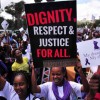
Let’s Unite to End Violence Against Women in Kenya
Consider this. According to the 2014 Kenya Demographic and Health Survey of Kenya, 4 out of every 10 Kenyan women undergo some form of violence, whether physical or sexual. This figure is staggering and should compel us to pause and reflect.
Ensuring Shared Progress for Sustainable Development and Peace
International inequality has grown over recent centuries, especially the last two. Before the Industrial Revolution, between-country inequalities were small, while within-country inequalities accounted for most of overall global income inequality. Now, inter-country income inequalities account for about two-thirds of world inequality with intra-country inequality accounting for a third.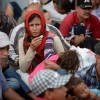
For Women and Girls Who Flee Conflict: Protection & Opportunity
Over the past 18 months, 1.3 million migrants and refugees crossed into Europe. For women and girls particularly, that journey is one of violence and trauma.
Initial Global Effects of Trump Even Before Taking Office
Even before taking office, President-Elect Donald Trump and the policies he promised during his campaign are already having a worldwide impact in at least three areas -- global finance, trade and climate change.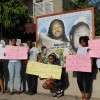
Jamaica’s Culture of Fear Allows Police to Get Away With Murder
The morning her brother was shot dead in January 2014, Shackelia Jackson had slept through her alarm. She woke up to the sound of his name and instantly knew something was wrong. When she ran down to the modest restaurant he operated in downtown Kingston, she noticed the spoon in the rice pot, the flour where the chicken was being fried. Then one of his slippers, and blood marks.« Previous Page — Next Page »





The views expressed in these articles are those of the authors and do not necessarily represent the views of, and should not be attributed to, IPS-Inter Press Service

The Week with IPS

NEXT STOP - SDGs
Tracking global progress towards a sustainable world
Tracking global progress towards a sustainable world
