Languages
Tuesday, November 10, 2026



News and Views from the Global South
Active Citizens
EDUCATION-SIERRA LEONE: Government Ignores Demands for Additional Teachers
Ismail Conteh has been teaching for the past year-and-a-half at a primary school in Sierra Leone’s capital Freetown – without receiving a single cent. He is one of hundreds of teachers recruited by schools to match the ever-growing number of pupils.
RIGHTS-MALAWI: Country Not Safe for Homosexuals
Malawi is quickly becoming unsafe for homosexuals as the country’s police service recently launched a campaign to hunt down and arrest prominent people who are suspected of being gay.
INTERNATIONAL WOMEN’S DAY: ‘We Will Demonstrate, As They Celebrate’
‘Equal rights; equal opportunities’ may be the theme for this year’s International Women’s Day, but while women around the world celebrate, a group of Ugandan women are protesting against the suppression of their rights.
UGANDA: Pressure Mounts to Make Public Oil Agreements
Uganda’s members of parliament (MPs) are pressurising government to make public details of oil production-sharing agreements it signed with various international oil companies.MALAWI: Extra Money Allocated for Drought Relief
Maize farmer Anita Yunus has lived near the Mulanje Mountain in southern Malawi for over 30 years. And she does not remember there ever being a drought in the area.GHANA: Constitution Under the Knife
After 18 years of successful multi-party democracy, Ghanaians are bracing themselves to review the Fourth Republican Constitution.
ETHIOPIA: Dam Critics Won’t Go Away
Ethiopia is building a 240-metre high dam on the Omo River that is intended to end the country's electricity shortage and supply power to neighbouring countries. Not everyone's happy.POLITICS-SUDAN: Security Essential to Ensure Peaceful Elections
Peace in Sudan remains an uncertainty ahead of the country’s first general elections in 24 years, according to the African Union Commission chief.
RIGHTS-UGANDA: Fugitives in Their Own Country
Every morning Pepe Julian Onziema wakes up not knowing if she will live to see another rising sun. Onziema is transgender and she lives in fear for her life because of a national campaign against gay people.
POLITICS-UGANDA: Sharing the National Cake
Their caricatures show great wealth and status, being driven in flashy four-wheel drives surrounded by bodyguards, and receiving benefits including mansions, cars, medical care and travel and sitting allowances. They are treated as Very Important Persons.
SOUTH SUDAN: Changing of the Guard
An old rite is long overdue in Paul Yugusak Tombe’s home village, in Central Equatoria State, south Sudan.ZAMBIA: Scarcely Room for Women in Male-dominated Politics
Charity Mwansa, a former minister and member of parliament, knows just exactly what being one of the very few female politicians in Zambia means. When she left politics it had nothing to with not being able to do the work and instead had everything to do with the mad world of male-dominated politics.
SOUTH SUDAN: Tension Builds as Peace Agreement Marks Anniversary
Sudan is at a crossroads. Its future looks grim. "Only a miracle can save it from disintegrating. The signs are already on the wall," says Khamis Lako, a petty trader in Juba, the capital of South Sudan.
MALAWI: Love That Dares To Speak Its Name
The traditional engagement ceremony of two men on Dec. 26, 2009 has created controversy in conservative Malawi. Tiwonge Chimbalanga and Steven Monjeza were arrested two days after their engagement and remain in police custody, facing long jail terms.
ZAMBIA: Police Breaking the Law to Prevent Crime
Juniper Mwale was attending a funeral in another town when her husband jumped bail and fled the country. Despite not being aware of her husband's escape, police tracked her down and detained her illegally in an effort to force her spouse home.
SIERRA LEONE: Mining Bill Queried
Sierra Leone’s parliament has come under serious scrutiny by opposition legislators, civil society and members of the public for ‘breaching procedures’ and ‘undermining the constitution’.
SOUTH SUDAN: A More Gender Representative Leadership
As the general elections scheduled for April 2010 draw nearer in Africa’s largest country ravaged by a long drawn war, the scramble for political positions is rife as women struggle to make their presence felt.UGANDA-CORRUPTION: Where ‘Kitu Kidogo’ is Cheaper than Facing the Law
You are driving through the streets of the Ugandan capital and suddenly a traffic police officer waves you down. He immediately notices that the side-mirror on the passenger’s side is missing. He threatens to give you a penalty ticket that costs 50,000 shillings (25 dollars).ZAMBIA: Telecommunications Sale ‘Lacks Transparency’
The impending privatisation of the Zambia Telecommunications Company (Zamtel) is being opposed by civil society organisations and opposition political parties, who accuse the government of lacking transparency in selling one of the last remaining state-utility firms.
ZAMBIA: Let our Chiefs Govern
The Litunga of Barotseland, King of the Lozi, has no judicial or legislative authority. No supervisory control over government projects, and worst of all he cannot stand for elected office. Yet successive Zambian presidents have deferred to him.UGANDA: Political Parties Fail to Declare Funding
The Electoral Commission of Uganda says if they tightened the noose around parties which fail to declare election funding, all of them would probably be deregistered.« Previous Page — Next Page »





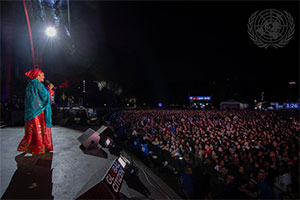 Global Citizen Festival in New York. Credit: UN Photo/Eskinder Debebe
Active citizens are committed to social change because they know that it is achievable. However, major political challenges face active citizens across the world. For example, in authoritarian regimes in Latin America where the hegemonic party has been in power for decades on end, protestors and human rights activists face enormous repression and struggle to materialize their advocacy into concrete results. The same can be said for Africans, where a shift towards elected government in recent decades has yet to translate into an effective voice in decision-making. Now, the Strengthening Citizen Demand for Good Governance, which uses evidence-based approaches – funded by DFID's Governance and Transparency Fund – seeks to raise their voices.
In 2025, the CIVICUS Monitor’s People Power Under Attack report revealed that civic freedoms are severely limited in 122 of 198 countries and territories, and only 7.2% of the global population now lives in countries where civic space is open. Through partnership with the Overseas Development Institute (ODI) and CIVICUS, IPS reporters across the continent will seek to define the extent and limits of state capability, government accountability and the responsiveness of leaders to the needs of citizens.

The Week with IPS

NEXT STOP - SDGs
Tracking global progress towards a sustainable world
Tracking global progress towards a sustainable world
