Languages
Monday, October 26, 2026



News and Views from the Global South
Active Citizens

Georgia’s LGBT+ Law Could Lead to Violent Repression, Rights Group Warns
“If this legislation passes, LGBT+ people simply aren’t going to be able to live here.” The warning from Tamar Jakeli, an LGBT+ activist and Director of Tbilisi Pride in Tbilisi, Georgia, is stark, but others in the country’s LGBT+ community agree, accurate.
Peoples’ Climate Vote Shows Global Support for Stronger Climate Action
The global public opinion research on climate change reveals that 80 percent, or four out of five, of people globally want their governments to take stronger action to tackle the climate crisis.
Conflict Deprives Children of Education in Northern Syrian IDP Camps
Twelve-year-old Walid Al-Hussein, displaced from the city of Kafranbel to a camp for internally displaced people (IDP) in northern Idlib on the border with Turkey, has given up his dream of becoming a lawyer. "The distance of schools from our home (in the camp) made me leave education and give up my dream and my mother's dream of becoming a lawyer who defends the rights of the oppressed," Al-Hussein told IPS.
Maggot Farming Creates Entrepreneurs, Saves Farming Costs in Zimbabwe
Three years ago, 43-year-old Benard Munondo was an "ordinary" Zimbabwean teacher at a local primary school, but now he has turned maggots into gold. Thanks to maggot farming, Munondo, who has never owned a home nor driven a car, now has both. In 2020, a week’s training on maggot farming changed his world.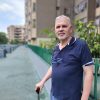
Explainer: Why Is It Important for Venezuela to Adopt Escazú Agreement in the Coming Year?
Venezuela is one of the few countries outside the Escazú Agreement, a treaty in Latin America and the Caribbean ratified by 16 member countries that guarantees access to environmental information, public participation in environmental decisions, and environmental justice.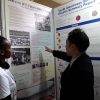
Lessons From Youth-Focused ‘Future Action Festival’ Ahead of UN Summit of the Future
The world has crossed the halfway point to the end of the Sustainable Development Goals (SDGs) era amid multiple, unprecedented, and significantly destructive global shocks. Two of the most pressing global challenges are the climate crisis and the threat of nuclear armament. Of serious concern is a severe lack of youth engagement on issues of critical global importance. Speaking to IPS during the 2024 UN Civil Society Conference, the outcome of which will inform high-level discussions when the UN hosts hundreds of world leaders, policymakers, experts, and advocates in September at the Summit of the Future in New York, Tadashi Nagai stressed the importance of coalition and movement building and youth engagement to escalate progress towards attainment of the SDGs.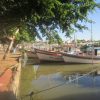
Women Organize to Fight Coastal Erosion in Southeastern Brazil
Coastal erosion has been aggravated by climate change and has already destroyed more than 500 houses in the town of Atafona in southeastern Brazil. Movements led largely by women are working to combat the advance of the sea and generate economic alternatives.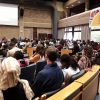
Inclusivity, Impact, and Innovation Needed to Meet SDGs, UN Civil Society Conference Hears
The world is neither on track to meet the Sustainable Development Goals (SDGs) nor is it leveraging emerging opportunities to effectively address global concerns such as extreme hunger, poverty, conflict, and climate change. Global concerns have outpaced existing structures for international cooperation and coping.
We Should Aim to be at Peace with Nature, Says David Cooper of UN Convention on Biological Diversity
In a world faced with habitat loss and species extinction, climate change, and pollution, it’s crucial that countries develop their national action plans and create a society that lives in harmony with nature, says David Cooper, Acting Executive Secretary of the UN Convention on Biological Diversity (CBD), in an exclusive interview with IPS.
Another Climate Victory in Europe… and Counting
A group of senior Swiss women recently won a powerful victory offering renewed hope for tackling climate change. Earlier this month, the European Court of Human Rights ruled that the government of Switzerland is violating human rights because it isn’t doing enough to cut greenhouse gas emissions.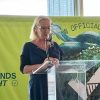
UN Live’s CEO Katja Iversen Talks About the Power of Popular Culture and ‘Sounds Right’
UN Live’s CEO, Katja Iversen, says the way to engage people in the environment is through popular culture—film, music, gaming, sports, food, and fashion. She is excited about the Sounds Right project, which puts the sounds of nature—bird songs, waves, wind, and rainfall—at the center of a campaign to support those involved in climate action.
‘Toasting the World’s Most Natural Talent’: UN Museum Campaign Recognizes NATURE’s Contributions to Music
Spearheaded by the Museum for the United Nations, a new campaign brings together music and ecology to spark people's interest and engagement in environmental conservation through consciously listening to music.
Solar Power and Biogas Empower Women Farmers in Brazil
A bakery, fruit pulp processing and water pumped from springs are empowering women farmers in Goiás, a central-eastern state of Brazil. New renewable energy sources are driving the process.
Rural Entrepreneurs Thriving Against All Odds in Zimbabwe
With heavy sweat drenching his face and his shirt soaked in the sweat, 39-year-old Proud Ndukulani wrestled with a homemade knife, which he dipped in some used oil, before turning the glistening knife upon a rather tough and dusty tyre obtained from what he said was a forklift. His assistant stood by his side as he (Ndukulani) cut some tough rubber from the giant tyre lying outside an open shade roofed with aging asbestos sheets at Juru Growth Point, located 52 km east of Harare in Zimbabwe’s Goromonzi district in the country’s Mashonaland East province.
Can Preserving Goa’s Khazans Address Climate Threats?
Growing up in a khazan ecosystem, the traditional agricultural practice followed in the south-western Indian state of Goa, Elsa Fernandes would love sitting in a koddo, a woven bamboo structure for storing paddy. Her family members would pour paddy around her and with the growing pile, she would rise to the top and then jump down with joy.
Why Farmers in India and Pakistan Are Shifting to Natural or Regenerative Farming
Nine years ago, farmer Sultan Ahmed Bhatti gave up tilling the soil and using most fertilizers and pesticides on his farm in Doober Bhattian, Pakistan. His brothers at first derided him. But soon, his first experiment with growing wheat on raised beds was a runaway success. “We produced more wheat than what we grew on ploughed, flat land,” he said.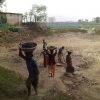
Revival of Hope: How a Remote Indian Village Overcame Water Scarcity
The people of Patqapara Village, a hamlet in India's West Bengal State, were until recently reeling under absolute distress due to water scarcity. The lack of irrigation facilities in this far-flung and inaccessible hamlet had resulted in a steady decline in agricultural activities. With a population of around 7,000, as per government estimates, the village primarily depends on agriculture for its livelihood. However, in recent years, drastic changes in weather patterns, including unseasonal rainfall, delayed monsoons, and soaring temperatures above normal levels, led to the drying up of irrigation canals and wells in the village. This left the local population in chaos, as their cultivable fields were bereft of any irrigation facilities.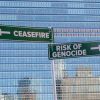
Global Governance: Time for Reform
At last the UN Security Council has passed a resolution calling for an immediate ceasefire in Gaza. While stopping short of demanding a permanent end to the violence, it goes further than the world’s peak peace and security body had so far managed since the start of the current brutal phase of conflict in October. But the time it’s taken to get to this point signals an ongoing failure of global institutions to uphold human rights.
Abandoned Children Growing Problem in Northern Syria
Wael Al-Hassan was returning from work in the Syrian city of Harim when he heard the sound of a baby crying. He was returning from work on December 10, 2023. He stopped momentarily, turned on his mobile phone flashlight to investigate, and spotted a baby girl, around one month old, wrapped in a white blanket, lying by the roadside.
Building Resilience and Mental Health Capacity of Youth
Sri Lankan lawmaker Hector Appuhamy, in conversation with IPS ahead of a two-day conference aimed at educating and involving university students in mental health issues, said parliamentarians were concerned about gaps in the programmes and financing for youth mental health. They were looking beyond the country's health budget for support in ensuring that youth were able to access mental health facilities in a supportive environment.
Women’s Land Rights in Farming Need Further Recognition
In the developing world, land rights for women remain tenuous in the agricultural sector. But if women farmers are recognized as landowners in their own right, it can lead to greater economic empowerment and be a positive step towards eradicating poverty. This formed part of the wider discussions that are being hosted during the 68th session of the Commission for the Status of Women (CSW68) in New York. The leading theme of CSW68 and its side events is the effort to accelerate gender equality by addressing poverty and strengthening institutions.« Previous Page — Next Page »





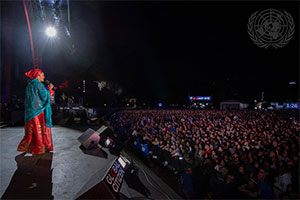 Global Citizen Festival in New York. Credit: UN Photo/Eskinder Debebe
Active citizens are committed to social change because they know that it is achievable. However, major political challenges face active citizens across the world. For example, in authoritarian regimes in Latin America where the hegemonic party has been in power for decades on end, protestors and human rights activists face enormous repression and struggle to materialize their advocacy into concrete results. The same can be said for Africans, where a shift towards elected government in recent decades has yet to translate into an effective voice in decision-making. Now, the Strengthening Citizen Demand for Good Governance, which uses evidence-based approaches – funded by DFID's Governance and Transparency Fund – seeks to raise their voices.
In 2025, the CIVICUS Monitor’s People Power Under Attack report revealed that civic freedoms are severely limited in 122 of 198 countries and territories, and only 7.2% of the global population now lives in countries where civic space is open. Through partnership with the Overseas Development Institute (ODI) and CIVICUS, IPS reporters across the continent will seek to define the extent and limits of state capability, government accountability and the responsiveness of leaders to the needs of citizens.

The Week with IPS

NEXT STOP - SDGs
Tracking global progress towards a sustainable world
Tracking global progress towards a sustainable world
