Languages
Saturday, November 14, 2026



News and Views from the Global South
Civil Society

‘A Turtle is Worth More Alive Than Dead’
On the north-eastern shores of Trinidad and Tobago, on the shoreline of Matura, more than 10,000 leatherback turtles climb the beaches to nest each year. But there the local community is keenly area of one thing: ‘a turtle alive is worth more than a turtle dead.”
Amidst Rising Hunger, BCFN Forum to Promote Food Sustainability
As 2018 nears its end, the world faces a new wave of food insecurity with the level of hunger being on the rise globally. A record 821 million people are facing chronic food deprivation – a sharp rise from 804 million figure in 2016 - said a report published by the UNFAO earlier this year. Along with rising hunger, food security has declined across Africa and South America while undernourishment is on the rise again in Asia, said the report which attributed the changing scenario to climate-related changes, adverse economic conditions and conflict. With this alarming picture as the backdrop, the 9th Barilla Center for Food and Nutrition (BCFN) International Forum on Food and Nutrition in Milan is all set to take off on November 27.Airways Aviation Academy teams up with ‘Football for Peace’ in sponsoring the launch of the #FootballSavesLives campaign
Airways Aviation Academy has teamed up with sports charity ‘Football for Peace’ (FfP) Founders British Footballer Kashif Siddiqi and Chilean FIFA Legend Elia Figueroa, to support #FootballSavesLives campaign, aimed at training the next generation of young leaders in how to harness a shared passion for football to bring together their local communities.
Solar Energy Drives Social Development in Brazil’s Favelas
"We can't work just to pay the electric bill," complained José Hilario dos Santos, president of the Residents Association of Morro de Santa Marta, a favela or shantytown embedded in Botafogo, a traditional middle-class neighborhood in Rio de Janeiro.‘Low-batt’ APEC summit back to search for coherence
For the first time in 29 years, the 21 countries in the Asia Pacific Economic Cooperation (APEC) forum this week could not agree on a declaration to mark the 2018 meeting of leaders in Port Moresby, Papua New Guinea.
Cuba’s Only Semiarid Region Reinvents Agriculture to Survive
At a brisk pace, Marciano Calamato and Mireya Noa walk along the dry, yellow soil of their farm, where they even manage to grow onions in Cuba's unique semi-arid eastern region.
2018 World Tolerance Day: Executive Director of the Geneva Centre appeals to decision-makers to sign and endorse 2018 World Conference outcome declaration
On the occasion of the 2018 World Tolerance Day, the Geneva Centre’s Executive Director Ambassador Idriss Jazairy has called upon decision-makers worldwide to sign and endorse the declaration “Moving towards greater spiritual convergence worldwide in support of equal citizenship rights.”
Women Make the Voice of Indigenous People Heard in Argentina
The seed was planted more than 20 years ago by a group of indigenous women who began to gather to try to recover memories from their people. Today, women are also the main protagonists of La Voz Indígena (The Indigenous Voice), a unique radio station in northern Argentina that broadcasts every day in seven languages.
Trump’s Anti-Media Rhetoric Resonates Worldwide
A former French president once remarked: Never pick a fight with a little kid or the press. The kid will throw the last stone at you and the press will have the last word. But that obviously does not apply to a teflon-coated Donald Trump because nothing apparently sticks on him – even as he survives a barrage of criticisms from the mainstream media while he continues to utter falsehoods and mouth blatant lies.
Climate of Repression a Dark Cloud over Upcoming Elections in Fiji
Powdery white beaches. Crystal clear turquoise water. Palm trees swaying in the breeze. This is the postcard picture of paradise that comes to mind when tourists think of Fiji. But for many citizens of the South Pacific’s largest island nation, and its media, the reality is anything but blissful.
Empowering Women in Post-Conflict Africa
While its conflict ended in 2007, Northern Uganda struggles with its legacy as one of the most aid-dependent regions in the world.
Rainwater Harvesting Eases Daily Struggle in Argentina’s Chaco Region
"I've been used to hauling water since I was eight years old. Today, at 63, I still do it," says Antolín Soraire, a tall peasant farmer with a face ravaged by the sun who lives in Los Blancos, a town of a few dozen houses and wide dirt roads in the province of Salta, in northern Argentina.
A “Crisis Point” for Human Rights Defenders
Globally, the people working to defend our human rights are increasingly under attack, reaching a “crisis point.”
Women’s Climate Leadership More Vital Than Ever In Light Of Climate Change Report
The latest Intergovernmental Panel on Climate Change (IPCC) report, which arrived thunderously in October, concludes that we have only 12 years remaining to transform our energy systems and ways of living to limit the worst effects of climate change.
Youth in Latin America Learn About Paths to Clean Energy
Young Peruvians plan to take advantage of the knowledge acquired in Brazil's semi-arid Northeast to bring water to segments of the population who suffer from shortages, after sharing experiences in that ecoregion on the multiple uses of renewable energies in communities affected by climatic phenomena.
African Union Makes Moves to Neutralise Africa’s Main Human Rights Body
For many African activists based on the continent, getting to a major human rights summit just underway in The Gambia is likely to have been a challenging exercise. The journey by air from many African countries to the capital, Banjul, for the 63rd Session of the African Commission on Human and People’s Rights (ACHPR), could have been prohibitively expensive, involved transiting through multiple cities and taken days.
An Ounce of Democracy
As the old adage goes: “An ounce of prevention is worth a pound of cure”. Nowhere is this more appropriate than when it comes to conflict. Violent conflict causes not only human suffering and destruction but robs entire societies of development and growth.
Honduran Migrant Caravan Moves Northwards, Defying all Obstacles
A long chain of people is winding its way along the highways of Chiapas, the southernmost Mexican state. It is moving fast, despite the fact that one-third of its ranks are made up of children, and it has managed to avoid the multiple obstacles that the governments of Honduras, Guatemala and now Mexico, under pressure from the United States, have thrown up in a vain effort to stop it.
UAE Raising Awareness About the Impact of Climate Change
The Middle East, due to its geographical location, is particularly prone to the impacts of climate change. Longer droughts, more frequent and intense heatwaves, and higher temperatures in the summer are expected to to become increasingly prevalent throughout the Middle East - from Sana’a to Jeddah to Dubai to Tehran.
Women as Liberia’s Guardians of Peace
Not long ago, images of child soldiers and the nation of Liberia were wedded in the minds of the international community. The country was struggling to end a horrific civil war, but military efforts were going nowhere.
Latin American Rural Women Call for Recognition and Policies
Rural women in Latin America play a key role with respect to attaining goals such as sustainable development in the countryside, food security and the reduction of hunger in the region. But they remain invisible and vulnerable and require recognition and public policies to overcome this neglect.« Previous Page — Next Page »


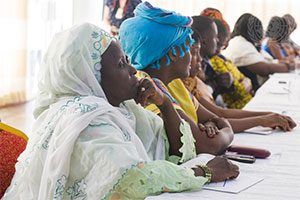 Representatives of Civil Society, Sierra Leone. Credit: UN Photo/Eskinder Debebe
Civil society faces mounting threats worldwide, even as it remains essential for democratic accountability, especially in countries struggling with economic instability and social inequality. However, at the same time, nations with weak democratic governance structures also systemically suppress the power of civil society. Human rights activists across the Global South frequently challenge issues such as political persecution and gender oppression, but in return face state-sanctioned punishment for their advocacy. Imprisonment and exile are common mechanisms of punishment that seek to erode the strength of civil society. The 2026 World Press Freedom Index has reached its lowest level in 25 years, with more than half of the world’s countries now falling into the "difficult" or “very serious” category for press freedom. IPS seeks to highlight the work of civil society across the Global South as well as the challenges that they face.
Updated by Yilan Batista and Shuli Wong August 2026

The Week with IPS

NEXT STOP - SDGs
Tracking global progress towards a sustainable world
Tracking global progress towards a sustainable world
