Languages
Tuesday, September 22, 2026



News and Views from the Global South
Civil Society

Ocean Action Boosted in Africa as Biodiversity Leaders Call for Urgent Synergy, Funding Reform
As the curtains draw on the UN Ocean Conference, a flurry of voluntary commitments and political declarations has injected fresh impetus into global efforts to conserve marine biodiversity. With the world’s oceans facing unprecedented threats, high-level biodiversity officials and negotiators are sounding the alarm and calling for renewed momentum—and funding—to deliver on long-standing promises.
‘Truth and Justice Have No Statute of Limitations; The State Must Assume Its Responsibility’
CIVICUS discusses struggles for historical justice with Graciela Montes de Oca, a member of Mothers and Relatives of Detained and Disappeared Uruguayans, a Uruguayan civil society organisation that seeks truth, justice and prevention of future crimes like those committed under dictatorship.

Atoll Nation of Tuvalu Faces Climate Existential Crisis, Frustration With Slow Funding
Prime Minister of Tuvalu, Feleti Teo, describes himself as an optimist—despite the existential crisis his atoll nation faces with climate change-induced sea level rise and frustration with existing international financial mechanisms to fund adaptation and mitigation.
‘A Wake-Up Call from the Womb’—Indigenous People Rally for a Binding Plastics Treaty
As the sun peeked through the French Riviera clouds and a dozen reporters sipped orange juice aboard the WWF Panda Boat docked at Port Lympia, Frankie Orona, a Native American rights advocate from the Society of Native Nations in San Antonio, Texas, stunned the room into a moment of absolute stillness.
Pandemic Agreement: Important Step but Big Decisions Deferred
When the next pandemic strikes, the world should be better prepared. At least, that’s the promise states made at the World Health Organization’s (WHO) World Health Assembly on 19 May when they adopted the first global pandemic treaty. This milestone in international health cooperation emerged from three years of difficult negotiations, informed by the harsh lessons learned from COVID-19’s devastating global impacts.
Waves of Change: From the Glittering Shores of Nice to Struggling Seaweed Farmers in Zanzibar
The late afternoon sun sparkles on the waters of the French Riviera as yachts dock at the Port of Nice with mechanical grace. A tram glides past palm-lined boulevards, where joggers, drenched in sweat, huff past leisurely strollers and sunbathers. Just beside the promenade, a crowd gathers around a young girl. With braided hair bouncing in rhythm, she belts out Beyoncé’s Halo with stunning precision. Her bare feet dance on the cobblestones, her voice echoing against the pastel façades.
‘Ocean Health Is Inseparable From Human Health, Climate Stability’—UN Chief Urges Swift Action, Partnership for Ocean Conference
“When we poison the ocean, we poison ourselves,” UN Secretary-General António Guterres told reporters on the second day of the UN Ocean Conference (UNOC3).
‘The Regime Seeks to Consolidate Absolute Control by Eliminating All External Oversight’
CIVICUS discusses Nicaragua’s withdrawal from the United Nations Educational, Scientific and Cultural Organization (UNESCO) and other international organisations with Wisthon Noguera, an activist, student and deputy coordinator of the National Youth Platform of Nicaragua.

Oceans at Risk: Report Warns Global Fossil Fuel Expansion Threatens Marine Biodiversity
A newly released report by Earth Insight in collaboration with 16 environmental organizations has sounded a global alarm on the unchecked expansion of offshore oil and gas projects into some of the most biologically rich and ecologically sensitive marine environments on the planet.
UN Ocean Decade vs. Coastal Reality: ‘They Took Our Sea,’ Say Vizhinjam Fishworkers
As the UN Ocean Conference (UNOC) approaches, bringing renewed attention to SDG 14 (Life Below Water) and the rights of ocean-dependent communities, India’s Vizhinjam coast highlights the environmental injustice and human cost of unchecked coastal development.
Solar Energy Brings Water to Iconic Salvadoran Village of El Mozote
The worst massacre of civilians in Latin America occurred in the Salvadoran village of El Mozote, where environmental projects are beginning to emerge, slowly fostering awareness about protecting the natural resources of this deeply symbolic site, embedded in the country's historical memory.
Girls in Kenya Are Repurposing the Invasive Mathenge Tree Into Furniture
Char Tito is hammering nails into wood at Kakuma Arid Zone Secondary School in Turkana County, northern Kenya. The 16-year-old is making a traditional chair under the scorching sun outside one of the classroom blocks.
CIVICUS’ New Leader Speaks on Global Declines in Civic Freedom
On June 1, CIVICUS Global Alliance, announced the appointment of Mandeep Tiwana as its new Secretary-General. With his tenure underway, Tiwana sat down with an IPS correspondent to discuss CIVICUS’s work in promoting civic freedom and solidarity in an increasingly autonomy-restrictive world.
Portugal: No Longer an Exception to Europe’s Far-right Rise
For decades, Portugal stood as a beacon of democratic stability in an increasingly unsettled Europe. While neighbours grappled with political fragmentation and the rise of far-right movements, Portugal maintained its two-party system, a testament to the enduring legacy of the 1974 Carnation Revolution that peacefully transitioned the country from dictatorship to democracy. It was long believed that Portugal’s extensive pre-revolution experience of repressive right-wing rule had effectively inoculated it against far-right politics, but that assumption is now demonstrable outdated. An era of exceptionalism ended on 18 May, when the far-right Chega party secured 22.8 per cent of the vote and 60 parliamentary seats, becoming the country’s main opposition force.
Rethinking Digital Platform Design: A Systems Approach
A better internet that supports democracy rather than undermines it is possible. In 2025, we stand at a crossroads in the digital era. Our platforms have become the new public squares, but rather than fostering democracy and dignity, many are optimized for manipulation, division, and profit. The Council on Technology and Social Cohesion's "Blueprint on Prosocial Tech Design Governance" offers a systems-level response to this crisis.

Noor Mukadam Got Justice, But Why Does Pakistan’s Legal System Fail Its Women?
“It’s brought me some closure,” said Shafaq Zaidi, a school friend of Noor Mukadam, reacting to the Supreme Court’s May 20 verdict upholding both the life sentence and death penalty for Noor’s killer, Zahir Jaffer.
The Africa Our Youth and Women Want
History rarely remembers those who waited quietly. In Africa, it is those who dare to act, to resist, to lead, and to dream aloud who have shaped the continent’s most defining moments.
‘Despite Deep-rooted Prejudice Against Dalits, Encouraging Shifts Are Emerging among Young Urban People’
CIVICUS discusses the challenges facing Nepal’s Dalit community with Rup Sunar, chairperson of the Dignity Initiative, a Kathmandu-based research and advocacy organisation working to dismantle caste-based discrimination.

Climate Justice Starts with a Bus Ride: A Lifeline for Delhi’s Waste Pickers
Every day, Delhi’s waste pickers walk three to four kilometers under the blazing sun, collecting and sorting the garbage that keeps India’s capital functioning. Their work is essential—yet largely invisible.
Africa in Control of Its Digital Future: Mobilising Domestic Resources & Strategic Partnerships
As political, financial and social leaders met on 27 May 2025 in Abidjan, Republic of Côte d’Ivoire, for the Annual Meetings of the African Development Bank (AfDB), the continent stands at a crucial turning point. Digitalisation can be the engine of inclusive and resilient development, but only if approached with local leadership and strategic vision.
‘We Are Witnessing Ecocide in West Papua, One of the World’s Richest Biodiversity Centres’
CIVICUS discusses the devastating impact of palm oil extraction in West Papua with Tigor Hutapea, legal representative of Pusaka Bentala Rakyat, an organisation campaigning for Indigenous Papuan people’s rights to manage their customary lands and forests.« Previous Page — Next Page »


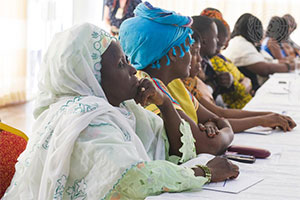 Representatives of Civil Society, Sierra Leone. Credit: UN Photo/Eskinder Debebe
Civil society faces mounting threats worldwide, even as it remains essential for democratic accountability, especially in countries struggling with economic instability and social inequality. However, at the same time, nations with weak democratic governance structures also systemically suppress the power of civil society. Human rights activists across the Global South frequently challenge issues such as political persecution and gender oppression, but in return face state-sanctioned punishment for their advocacy. Imprisonment and exile are common mechanisms of punishment that seek to erode the strength of civil society. The 2026 World Press Freedom Index has reached its lowest level in 25 years, with more than half of the world’s countries now falling into the "difficult" or “very serious” category for press freedom. IPS seeks to highlight the work of civil society across the Global South as well as the challenges that they face.
Updated by Yilan Batista and Shuli Wong August 2026

The Week with IPS

NEXT STOP - SDGs
Tracking global progress towards a sustainable world
Tracking global progress towards a sustainable world
