Languages
Sunday, November 29, 2026



News and Views from the Global South
Civil Society
RIGHTS: Argentina’s Jewish ‘Desaparecidos’
The leaders of Argentina’s Jewish community - the largest in Latin America - published in book form a report on Jewish victims of forced disappearance in the 1976-1983 dictatorship, who faced especial brutality because of their ethnic origin.
COMMONWEALTH: "Get Rid of Your Agricultural Subsidies" – McKinnon
The political crisis in Pakistan and global trade negotiations are amongst issues set to dominate the Commonwealth Heads of Government Meeting (CHOGM) that starts Friday in the Ugandan capital, Kampala.
PAKISTAN: Media Under Siege
From being the liberal President under whom Pakistan’s independent electronic media was born and flourished, Pervez Musharraf is now seen as the military general who imposed emergency rule on Nov 3 and suspended the Constitution and the independent judiciary.DEATH PENALTY-CHINA: Going Easy on Executions Ahead of Olympics
Conscious of the need to burnish its international image ahead of the 2008 Beijing Olympic Games, China has been more sparing in applying the death penalty this year - but the country is far from abolishing capital punishment.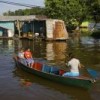
VENEZUELA: Wretchedly Poor on the Banks of Lake Maracaibo
"My father was a fisherman, and so was my grandfather. I fished for as long as I could. We live here because it is very beautiful, but we suffer great hardship," said 72-year-old Antonio Navarro, sitting in his six-by-eight-metre house on stilts in the Venezuelan village of Congo Mirador.
ENERGY-BRAZIL: Pray, Cheer, and Do the Rain Dance to Stave Off Crisis
An energy crisis will hit Brazil in 2009 or 2010, and not even the discovery of vast undersea oil and gas reserves with "enormous potential yields," as announced by the government, can stave it off, warn experts.KYRGYZSTAN: Opposition Talks Unity Ahead of Polls
A month after the Kyrgyz parliament was dissolved and elections announced in December, President Kurmanbek Bakiev’s decision to introduce a party system in the poll process has caught his country unprepared.
HEALTH: Talking About a Toilet Revolution
The rhythmic beat at the inaugural conference of the World Toilet Association seemed to roll away cultural taboos surrounding the act of defecation.ENVIRONMENT-PERU: A (Toxic) River Runs Through It
The Mantaro river basin, one of the main water sources in Peru’s central Andes mountains, is a dump for toxic substances, according to an independent scientific study. Lead levels, for instance, are 180 times higher than those accepted by the World Health Organisation (WHO).
Q&A: 'Out-of-the-Box Solutions Needed to Solve World's Sanitation Problems'
Born in a lavatory, South Korean legislator Sim Jae-Duck prefers to be addressed as ‘Mr. Toilet’ and hopes to die in one too. He moved into a home shaped like a giant toilet bowl in time for the launch, in Seoul, of the World Toilet Association (WTA) general assembly from Nov. 21-25.GUATEMALA: Activists Call for Reparations for Victims of Conflicts
Human rights groups from Guatemala, Mexico, Uruguay, Colombia, Western Sahara and Sweden called for reparations for victims of armed conflicts and crimes against humanity, and punishment for those responsible.COLOMBIA: Quarries in Slums Seen as Health Risk
Local residents of shantytowns on the outskirts of the Colombian capital complain that sand, gravel and limestone quarries operating in the area pose serious risks to their health as well as the danger of landslides. But they are afraid to speak out.POLITICS: ASEAN Family Gets ‘Protective’ About Burma
South-east Asian leaders closed ranks this week behind a view that places a higher premium on protecting the life of the region’s governments, no matter how oppressive they are, than on being accountable to their respective peoples.KOSOVO: Thaci Promises Independence Before Year-end
Exit polls reveal that the elections held in Kosovo this weekend have produced a major win for the party led by the former Kosovo Liberation Army (KLA, UÇK Alb) leader, Hashim Thaçi.SOUTH KOREA: Youth Apathetic to Reunification With North
One month after the historic South-North Korean summit and less than a month before presidential elections in South Korea, students, activists, and academics are lamenting a trend towards conservatism and political apathy among the youth.RIGHTS-EU: Minorities Want Acceptance, Not ‘Tolerance’
"Tolerance? No. I want to talk about acceptance. I don't want to be ‘tolerated’, I want to be accepted as a disabled lesbian woman," said Lydia La Rivière-Zijdel, to a lengthy ovation at the event concluding the 2007 European Year of Equal Opportunities for All, in the Portuguese capital Tuesday.
Q&A: "The Presence of Women in Local Councils Is in Itself a Revolution"
As local elections in Benin draw closer, activists are pushing ahead with efforts to have more women voted into local government. Just 45 of the 1,189 councilors currently in office are women.CUBA: Sails of Popular Education Catch Winds of Socialist Change
The growing role of popular education in local experiences of social change is spurring debate about the need for more active participation by the people of Cuba in the social transformations that are inevitable if it is to remain a socialist country.MIGRATION: 35 Countries Agree to Regulate Flows Across Mediterranean
Everyone agrees: migration flows from the developing South to the industrialised North must be regulated to curb the appalling trafficking of human beings across the Mediterranean sea.POLITICS-PAKISTAN: Towards Democracy Musharraf-Style
As President Gen. Pervez Musharraf congratulated the outgoing national assembly for being the first ever in Pakistan’s 60-year history to complete its term (on Nov 15) and swore in a new 24-member caretaker government to supervise general elections in January, the flaws in these ostensibly positive moves towards democracy were glaring.CUBA: Popular Education Transforms Women’s Lives
"I have the spirit of a 15-year-old girl, and the wisdom of a 66-year-old woman," says Felicia Pérez, who recovered her joie de vivre after attending a handicrafts course, and became a promoter of urban values and the creator of a crafts workshop in her own neighbourhood.« Previous Page — Next Page »


 Representatives of Civil Society, Sierra Leone. Credit: UN Photo/Eskinder Debebe
Civil society faces mounting threats worldwide, even as it remains essential for democratic accountability, especially in countries struggling with economic instability and social inequality. However, at the same time, nations with weak democratic governance structures also systemically suppress the power of civil society. Human rights activists across the Global South frequently challenge issues such as political persecution and gender oppression, but in return face state-sanctioned punishment for their advocacy. Imprisonment and exile are common mechanisms of punishment that seek to erode the strength of civil society. The 2026 World Press Freedom Index has reached its lowest level in 25 years, with more than half of the world’s countries now falling into the "difficult" or “very serious” category for press freedom. IPS seeks to highlight the work of civil society across the Global South as well as the challenges that they face.
Updated by Yilan Batista and Shuli Wong August 2026

The Week with IPS

NEXT STOP - SDGs
Tracking global progress towards a sustainable world
