Languages
Monday, November 2, 2026



News and Views from the Global South
Civil Society

Monster Monsoon: “Pakistan and Its People Are Paying the Costs of What They Are Not Responsible For.”
Pakistan has been going through the worst time of its recent history due to unprecedented colossal monsoon rains and devastating floods. The current floods would have been expected less than once a century, but climate experts claim that what we are seeing today is just a trailer of what’s in store for us if we don’t pay heed to climate change. More than 112 districts are currently afffected and around 30 million people; their property and land are totally devastated. Across the country, where hundreds of thousands of cattle died due to the Lumpy Skin Disease, now more than 727,000 have perished due to floods and rains. The number is increasing rapidly.
There’s no Stopping Renewable Power in Chile, but Community Energy Is Not Taking Off
Renewable energies, especially solar and wind power, are growing inexorably in Chile, driven by large companies. But community generation of alternative energy is not taking off, despite a law promoting it.
Kofi Time: The Podcast

About the Podcast
Regarded as one of the modern world’s icons of diplomacy, what is Kofi Annan’s legacy today? What can we learn from him, and how can we prepare for tomorrow, based on his vision for a better world? In this exclusive 10-part podcast, Ahmad Fawzi, one of Kofi Annan’s former spokespersons and communication Advisor, will examine how Kofi Annan tackled a specific crisis and its relevance to today’s world and challenges. Apple Podcasts, Spotify and SoundCloud Brought to you by the Kofi Annan Foundation and the United Nations Information Service.Kofi Time: The Official Trailer
Join us as we take a journey of discovery about Kofi Annan’s leadership style and what makes it so relevant and important today.Multilateralism: Then & Now | Kofi Time with Lord Mark Malloch-Brown | Episode 1
In this episode, Lord Malloch Brown shares insights with podcast host Ahmad Fawzi on how Kofi Annan strengthened the United Nations through careful diplomacy and bold reforms, and how significant advances were made during his tenure as Secretary-General. He comments on the state of multilateralism today, as the organization is buffeted by the crisis in Ukraine and the paralysis of the Security Council.Making Peace: Then & Now | Kofi Time with Christiane Amanpour | Episode 2
In this episode of Kofi Time, host Ahmad Fawzi interviews renowned journalist Christiane Amanpour. Together, they discuss a world in turmoil, and what would Kofi Annan – who did so much for peace – do today? Christiane shares her thoughts on the ‘Kofi Annan way’, the difficult job mediators and peacebuilders face, and the courage they must show. With Ahmad, they deliberate whether there is a type of ‘calling’ for those who work in this field.Health Crises: Then & Now | Kofi Time with Dr Peter Piot | Episode 3
In this episode of Kofi Time, our special guest is Dr Peter Piot. Dr Piot discusses how he and Kofi Annan worked together to reverse the HIV/AIDs tide that swept through Africa in the 1990s, through patient but bold diplomacy, innovative partnerships and an inclusive approach that brought to the table previously marginalized communities. Dr Piot and podcast host Ahmad Fawzi discuss whether this approach be replicated today as the world enters the third year of the COVID-19 pandemic and must prepare for future heath emergencies.Fighting Hunger: Then & Now | Kofi Time with Catherine Bertini | Episode 4
In episode 4 of Kofi Time, our special guest is Catherine Bertini. Ms. Bertini discusses how she worked with Kofi Annan to fight hunger and malnutrition around the world. Not only is access to food far from universal, but it is also severely impacted by conflicts and climate change. As food prices increase and access becomes even more challenging, how can we replicate Kofi Annan’s approach to improving food systems to make sure no one gets lefts behind on the path to food security globally?Leadership: Then & Now | Kofi Time with Michael Møller | Episode 5
In episode 5 of Kofi Time, host Ahmad Fawzi interviews diplomat Michael Møller on Kofi Annan’s special kind of leadership. A respected leader among his peers and the public, Kofi Annan served the people of the world with courage, vision and empathy. Embodying moral steadfastness and an acute political acumen, his leadership was one of a kind. What drove him, and how can we emulate his leadership style to face today’s global challenges?Human Rights: Then & Now | Kofi Time with Zeid Raad Al Hussein | Episode 6
In episode 6 of Kofi Time, our special guest is Zeid Raad Al Hussein. Zeid discusses his friendship with Kofi Annan and how they worked together to protect human dignity and promote human rights. Through the creation of the Human Rights Council and International Criminal Court, Kofi Annan played a critical role in establishing the mechanisms that we have today to protect human rights and fight impunity. How can we uphold Kofi Annan’s legacy and ensure that respect for human rights is not just an abstract concept but a reality?Podcast Host & Guests
Ahmad Fawzi Kofi
Time Podcast Host Mr Fawzi is the former head of News and Media at the United Nations. He worked closely with Kofi Annan both during his time as Secretary-General and afterwards, on crises including Iraq and Syria. Before joining the United Nations, he worked for many years in broadcast journalism, as a news editor, reporter and regional news operations manager. From 1991 to 1992, he was the News Operations Manager for the Americas for Visnews -- now Reuters Television. Also with Reuters Television, Mr Fawzi served as Regional News Manager for Eastern Europe, based in Prague, from 1989 to 1991 -- a time of tumultuous political change in that region. Concurrently with his assignment in Prague, he coordinated coverage of the Gulf war, managing the war desk in Riyadh, as well as the production centre in Dahran, Saudi Arabia. In 1989, Mr Fawzi was Reuters Television Bureau Chief for the Middle East, based in Cairo. Prior to that, he worked in London as News and Assignments Editor for Reuters Television. Previously, he was Editor and Anchor for the nightly news on Egyptian Television.Lord Mark Malloch-Brown
Episode 1 Guest Mark Malloch‐Brown is the president of the Open Society Foundations. He has worked in various senior positions in government and international organizations for more than four decades to advance development, human rights and justice. He was UN Deputy Secretary‐General and chief of staff under Kofi Annan. He previously Co-Chaired the UN Foundation Board. Malloch-Brown has worked to advance human rights and justice through working in international affairs for more than four decades. He was UN deputy secretary‐general and chief of staff under Kofi Annan. Before this, he was administrator of the UNDP, where he led global development efforts. He covered Africa and Asia as minister of state in the United Kingdom’s Foreign Office. Other positions have included World Bank vice president, lead international partner in a political consulting firm, vice-chair of the World Economic Forum, and senior advisor at Eurasia Group. He began his career as a journalist at the Economist and as an international refugee worker. He was knighted for his contribution to international affairs and is currently on leave from the British House of Lords. Malloch-Brown is a Distinguished Practitioner at Oxford University’s Blavatnik School of Government, an adjunct fellow at Chatham House’s Queen Elizabeth Program, and has been a visiting distinguished fellow at the Yale Center for the Study of Globalization.Christiane Amanpour
Episode 2 Guest Christiane Amanpour is a renowned journalist, whose illustrious career has taken her from CNN where she was Chief international correspondent for many years, to ABC as a Global Affairs Anchor, PBS and back to CNN International for the global affairs interview program named after her. She has received countless prestigious awards, including four Peabody Awards, for her international reporting and her achievements in broadcast journalism. She served as a member of the board of directors of the Committee to Protect Journalists and a UNESCO Goodwill Ambassador for Freedom of Expression and Journalist Safety. She is also an honorary citizen of Sarajevo and was made a Commander of the British Empire in 2007 by Her Majesty Queen Elizabeth.Dr Peter Piot
Episode 3 Guest Dr Peter Piot co-discovered the Ebola virus in Zaire in 1976. He has led research on HIV/AIDS, sexually transmitted diseases, and women's health, mostly in sub-Saharan Africa. Peter Piot was the founding Executive Director of UNAIDS and Under-Secretary-General of the United Nations from 1995 until 2008. Under his leadership, UNAIDS has become the chief advocate for worldwide action against AIDS. It has brought together ten organizations of the United Nations system around a common agenda on AIDS, spearheading UN reform Peter Piot was the Director of the Institute for Global Health at Imperial College; London and he held the 2009/2010 "Knowledge against poverty" Chair at the College de France in Paris. He is a Fellow of the Academy of Medical Sciences and was elected a foreign member of the National Academy of Medicine of the US National Academy of Sciences.Catherine Bertini
Episode 4 Guest An accomplished leader in food security, international organization reform and a powerful advocate for women and girls, Catherine Bertini has had a distinguished career improving the efficiency and operations of organizations serving poor and hungry people in the United States and around the world. She has highlighted and supported the roles of women and girls in influencing change. She was named the 2003 World Food Prize Laureate for her transformational leadership at the World Food Programme (WFP), which she led for ten years, and for the positive impact she had on the lives of women. While in the US government, she expanded the electronic benefit transfer options for food stamp beneficiaries, created the food package for breastfeeding mothers, presented the first effort to picture healthy diets, and expanded education and training opportunities for poor women. As a United Nations Under-Secretary-General, and at the head of the World Food Programme for ten years (1992 to 2002), she led UN humanitarian missions to the Horn of Africa and to Gaza, the West Bank, and Israel. During her time serving with WFP, Catherine Bertini was responsible for the leadership and management of emergency, refugee, and development food aid operations, reaching people in great need in over 100 countries, as well as advocacy campaigns to end hunger and to raise financial resources. With her World Food Prize, she created the Catherine Bertini Trust Fund for Girls’ Education to support programs to increase opportunities for girls and women to attend school. At the Maxwell School of Citizenship and Public Affairs at Syracuse University, where she is now professor emeritus, she taught graduate courses in humanitarian action, post-conflict reconstruction, girls’ education, UN management, food security, international organizations, and leadership. She served as a senior fellow at the Bill and Melinda Gates Foundation early in its new agricultural development program. Bertini is now the chair of the board of the Global Alliance for Improved Nutrition (GAIN). Concurrently, she is a Distinguished Fellow at the Chicago Council on Global Affairs. She has been named a Champion of the 2021 United Nations Food Systems Summit. She is a professor emeritus at Syracuse University.Michael Møller
Episode 5 Guest Mr Møller has over 40 years of experience as an international civil servant in the United Nations. He began his career in 1979 with the United Nations High Commissioner for Refugees and worked for the United Nations in different capacities in New York, Mexico, Iran, Haiti, Cyprus and Geneva. He worked very closely with Kofi Annan as Director for Political, Peacekeeping and Humanitarian Affairs in the Office of the Secretary-General between 2001 and 2006, while serving concurrently as Deputy Chef de Cabinet of the Secretary-General for the last two years of that period. Mr Møller also served as the Secretary-General’s Special Representative for Cyprus from 2006 to 2008 and was the Executive Director of the Kofi Annan Foundation from 2008 to 2011. From 2013 to 2019, Mr Møller served as Director-General of the United Nations Office at Geneva as well as Personal Representative of the United Nations Secretary-General to the Conference of Disarmament. He currently is Chairman of the Diplomacy Forum of Geneva Science and Diplomacy Anticipator. A Danish citizen, Mr Møller earned a Master’s degree in International Relations from Johns Hopkins University, and a Bachelor’s degree in International Relations from the University of Sussex, in the United Kingdom.Zeid Raad Al Hussein
Episode 6 Guest Zeid Ra’ad Al Hussein is IPI’s President and Chief Executive Officer. Previously, Zeid served as the UN’s High Commissioner for Human Rights from 2014 to 2018 after a long career as a Jordanian diplomat, including as his country’s Permanent Representative to the UN (2000-2007 & 2010-2014) and Ambassador to the United States (2007-2010). He served on the UN Security Council, was a configuration chair for the UN Peace-Building Commission, and began his career as a UN Peacekeeper in the former Yugoslavia. Zeid has also represented his country twice before the International Court of Justice, served as the President of the Assembly of State Parties to the Rome Statute of the International Criminal Court from 2002-2005, and in 2005, authored the first comprehensive strategy for the elimination of Sexual Exploitation and Abuse in UN Peacekeeping Operations while serving as an advisor to Secretary-General Kofi Annan. Zeid is also a member of The Elders, an independent group of global leaders working together for peace, justice and human rights, founded by Nelson Mandela. Zeid holds a PhD from Cambridge University and is currently a Professor of Practice at the University of Pennsylvania.
Gender Equality & Women’s Rights Wiped out Under the Taliban
In the year that has passed since the Taliban’s takeover in Afghanistan we have seen daily and continuous deterioration in the situation of Afghan women and girls. This has spanned every aspect of their human rights, from living standards to social and political status.
ECW Interviews Three Inspiring #Youth4EiE Advocates on International Youth Day
On this International Youth Day, ECW interviewed three inspiring #Youth4EiE Advocates – Nataly Rivas, Angela Abizera, and Jean-Paul Saif. Nataly, Angela, and Jean-Paul are three Global Youth for Education in Emergencies panel members.
‘Aid Organizations Must Include the Youth Voice’ August 12, 2022—International Youth Day
Today marks International Youth Day, a global celebration of the transformative power of young people. Introduced by the United Nations General Assembly in 1999, the event was inaugurated not only to observe the power of the youth voice, but to serve as a promise from those in power to activate the power of youth across the development sector.
Colombia’s New President May Need U.S. Blessing to Realize his Domestic Agenda
For the first time in its contemporary history, Colombia has a left-wing government. The presidency of Gustavo Petro, who took the reins August 8, marks a significant break from the political status quo. He also represents a stiff test for U.S. influence in Latin America.
The Price of Bukele’s State of Emergency in El Salvador
The body of Walter Sandoval shows a number of dark bruises on his arms and knees, as well as lacerations on his left eye and on his head - signs that he suffered some kind of violence before dying in a Salvadoran prison, accused of being a gang member.
What Makes a Human Rights Success? PODCAST
The largest ever settlement in Canadian legal history, 40 billion Canadian dollars, occurred in 2022, but it didn’t come from a court – it followed a decision by the Canadian Human Rights Tribunal. In 2016 the Tribunal affirmed a complaint that the Government of Canada’s child welfare system discriminated against First Nations children. (First Nations are one of three groups of Indigenous people in Canada). 
The Politics of the Hangman’s Noose: Judge, Jury & Executioner
A spike in state-sanctioned executions worldwide – including in Iran, Singapore, Saudi Arabia, and more recently Myanmar – has triggered strong condemnations from the United Nations and several civil rights and human rights organizations.
Unprecedented Threats Against “Right to Protest” on the Rise World-wide
The French writer and philosopher Voltaire (1694-1778), once famously remarked: "I disagree with what you have to say, but I will defend unto death, your right to utter them.” But that political axiom hardly applies to multiple governments in Asia, Africa, Europe and Latin America—including Greece, UK, Thailand, Hong Kong, India, Myanmar, Chile, France, Democratic Republic of Congo and Cyprus – where the right to protest, along with freedom of speech, are increasingly in jeopardy.
U.S.-Latin America Immigration Agreement Raises more Questions than Answers
The immigration agreement reached in Los Angeles, California at the end of the Summit of the Americas, hosted by U.S. President Joe Biden, raises more questions than answers and the likelihood that once again there will be more noise than actual benefits for migrants, especially Central Americans.
Sri Lanka: Why a Feudal Culture & Absence of Meritocracy Bankrupted a Nation
Sri Lanka is officially bankrupt and a failed state in all but name. How did a country of 22 million people with a level of literacy on par with most of the developed world end up in such a dire position where the state coffers did not have the measly sum of 20 million dollars to purchase fuel to keep the country functioning beyond the next working day?
Drones To Help Fishers Avoid Border Conflicts on Lake Victoria
It is exactly two years since George Omuodo’s brutal confrontation with fishers from Uganda, an encounter that left him hospitalized with a broken arm and bruised ribs. After listening to his ordeal, one wonders where he gets the courage to go back to the lake every day.
Migrant Workers from Mexico, Caught Up in Trafficking, Forced Labor and Exploitation
Eduardo Reyes, originally from Puebla in central Mexico, was offered a 40-hour workweek contract by his recruiter and his employer in the United States, but ended up performing hundreds of hours of unpaid work that was not authorized because his visa had expired, unbeknownst to him.
Indigenous Peoples Must Continue To Challenge Human Rights Violations: PODCAST
Today we are starting a new series focused on human rights. For people working to create a more sustainable and just world – as we are – a human rights based approach makes sense as it starts from the premise that only by recognizing and protecting the dignity inherent in all people can we attain those goals. 
Sri Lankan Beggar’s Opera
When Ceylon- now Sri Lanka- gained independence from Britain in 1948 after almost 450 years of colonial rule under three western powers, it was one Asia’s most stable and prosperous democracies.
Mobilizing Against Hunger in Brazil, Where It Affects 33.1 Million People
A campaign against hunger, a problem that affects 15.5 percent of the Brazilian population, seeks to mobilize society once again in search of urgent solutions, inspired by a mass movement that took off in the country in 1993.
Why We Need a Digital Safe Space for LGBTQ Youth – Thoughts from Asian Teens
Recently, I watched a documentary titled Why We Can’t See Disabled People [in Korea].
Smelter Finally Closes Due to Extreme Pollution in Chilean Bay
A health crisis that in 20 days left 500 children poisoned in the adjacent municipalities of Quintero and Puchuncaví triggered the decision to close the Ventanas Smelter, in a first concrete step towards putting an end to a so-called "sacrifice zone" in Chile.
The World Is Melting Down and the Cause is Corruption- The G20 Needs to Take Action
The G20 is meeting again next week in Indonesia for the second time this year- at a moment when the world is facing the most difficult economic, political and social challenges for decades.« Previous Page — Next Page »





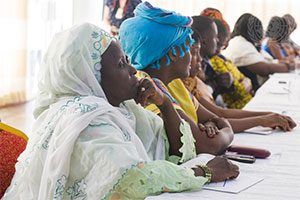 Representatives of Civil Society, Sierra Leone. Credit: UN Photo/Eskinder Debebe
Civil society faces mounting threats worldwide, even as it remains essential for democratic accountability, especially in countries struggling with economic instability and social inequality. However, at the same time, nations with weak democratic governance structures also systemically suppress the power of civil society. Human rights activists across the Global South frequently challenge issues such as political persecution and gender oppression, but in return face state-sanctioned punishment for their advocacy. Imprisonment and exile are common mechanisms of punishment that seek to erode the strength of civil society. The 2026 World Press Freedom Index has reached its lowest level in 25 years, with more than half of the world’s countries now falling into the "difficult" or “very serious” category for press freedom. IPS seeks to highlight the work of civil society across the Global South as well as the challenges that they face.
Updated by Yilan Batista and Shuli Wong August 2026

The Week with IPS

NEXT STOP - SDGs
Tracking global progress towards a sustainable world
Tracking global progress towards a sustainable world
