Languages
Sunday, November 1, 2026



News and Views from the Global South
Civil Society

How Digital Can Drive a Green Recovery
As much of the world was starting to glimpse recovery from the COVID-19 pandemic, it now finds itself amid a cost-of-living crisis brought on by disruptions in global energy and food markets that are the result of conflict and climate change.
Doubts about Chile’s Green Hydrogen Boom
In Magallanes, Chile's southernmost region, doubts and questions are being raised about the environmental impact of turning this area into the world's leading producer of green hydrogen.
UN Censures 42 Nations for Retaliating Against Human Rights Activists & Journalists
The United Nations has singled out 42 countries (out of 193 member states) for condemnation-- virtually blacklisting them-- for retaliating against human rights activists and journalists
Caribbean-American Artist Depicts ‘Chosen Family’
For two months over the summer, Caribbean-American artist Delvin Lugo presented his first solo show in New York City, exhibiting large, vibrant canvases at High Line Nine Galleries on Manhattan’s West Side and featuring queer communities in his homeland, the Dominican Republic.
Small Farmers in Peru Combat ‘Machismo’ to Live Better Lives
"My father was very ‘machista’, he used to beat my mother... It was a very sad life," said Dionisio Ticuña, a resident of the rural community of Canincunca, on the outskirts of the town of Huaro, in the southern Peruvian highlands region of Cuzco more than 3,000 meters above sea level.
Women in Argentine Slum Confront Violence Together
The Padre Carlos Mugica neighborhood looks like another city within the Argentine capital, which most people usually see from up above as they drive past on the freeway but have never visited. It is a shantytown in the heart of Buenos Aires, of enormous vitality and where women are organizing to confront the various forms of violence that affect them.
Journalists, Under Threat, Need Safe Refuge Through Special Emergency Visas
“This woman sitting next to me, Maria Ressa, is a Nobel laureate and a convicted criminal,” said barrister Amal Clooney, who co-leads the international legal team representing Ressa. The founder of news website Rappler, Ressa has been targeted with a barrage of legal charges intended to stop her journalism in the Philippines.
Uyghur Violations a Litmus Test for Global Governance & Rules-based International Order
This week is a momentous one for the world’s premier human rights body. At stake is a resolution to decide whether the UN Human Rights Council in Geneva can hold a debate on a recently released UN report.
Korean Slums: The Shadows of Society, or the New Light for the Future?
Have you watched Parasite? In 2021, everyone seemed to be watching it. But I wonder how many of them paid attention to the old man who found a little shelter in a hidden basement behind the kitchen of a mansion. However hidden it was, that's where he could meet his basic needs. That was his little slum.
Reasonable Left, Irresponsible Right: & the Future of Social Democracy
With no shortage of catastrophes in the past 15 years worldwide — the democratic left is stepping up to provide stability amid the storm. Throughout the history of mankind, there have been catastrophes. In modern times, there have also been media representations of catastrophe, including worked-up or even imagined catastrophes.
Deadly Smoke: Feeding Children Kills Cafeteria Staff
During my summer break this year, I read a news article about five school cafeteria workers who had died of lung cancer. Due to these incidents, a union of cafeteria workers, wearing their aprons and holding their lunch trays, held a protest in front of the President’s office on a scorching summer day. And it made us think about the devastating working conditions for the school lunch employees. Isn’t it so disheartening that we eat our school lunch at the expense of their health?
From Indonesia to India: Is There Hope for Anti-Corruption Efforts Within the G20?
As global crises mount, the G20 is proving unable to find solutions. Political disagreements within the bloc- including most prominently with Russia over the ongoing war in Ukraine- have hamstrung collective efforts.
We Need Urgent Commitment, Resources & Action to Tackle Hunger Crisis
Last week, as world leaders gathered in New York for the 77th United Nations General Assembly, one topic came up more than most: looming famine. That’s because despite a global commitment to make famine a relic of the past, it is once again knocking at our door.
Civil Disobedience – How to Make Enemies and Influence People
Blocking metros and highways in rush-hour traffic to stop commuters getting to work. Vandalizing petrol pumps to put them out of use. Halting sporting events such as the French Open and the British Grand Prix. Disrupting bemused art lovers by gluing oneself to priceless masterpieces.
Guatemalans Fight Extractive Industries
The majority of the Guatemalan population continues to oppose mining and other extractive projects, in the midst of a scenario of socio-environmental conflict that pits communities defending their natural resources against the interests of multinational corporations.
Multi-Faith Team Urges Repeal of Blasphemy Laws– in the Name of Religious Freedom
In nations lacking certain religious freedoms, the bold multi-faith membership of the International Religious Freedom Roundtable’s Campaign to Eliminate Apostasy and Blasphemy Laws, would be forbidden.
Peruvian Trans Women Fight for Their Right to Identity
"Without recognition of your identity by the State and society, there is no exercise of citizenship or rights," said Leyla Huerta, director of Féminas Perú, an organization that has been working since 2015 to empower transgender women in the face of the highly vulnerable situation they find themselves in.
A Plea for the Creation of a UN Youth Assembly
There are many ways the UN can have a sizeable role in promoting the engagement and participation of youth and helping them becoming a central pillar of a new way of doing policy-making.
Racism Hurts People and Democracy in Peru
Banning the use of the same bathroom, insults and calling people animals are just a few of the daily forms of racism experienced by people in Peru, a multicultural, multiethnic and multilingual country where various forms of discrimination are intertwined.
Monster Monsoon: “Pakistan and Its People Are Paying the Costs of What They Are Not Responsible For.”
Pakistan has been going through the worst time of its recent history due to unprecedented colossal monsoon rains and devastating floods. The current floods would have been expected less than once a century, but climate experts claim that what we are seeing today is just a trailer of what’s in store for us if we don’t pay heed to climate change. More than 112 districts are currently afffected and around 30 million people; their property and land are totally devastated. Across the country, where hundreds of thousands of cattle died due to the Lumpy Skin Disease, now more than 727,000 have perished due to floods and rains. The number is increasing rapidly.
There’s no Stopping Renewable Power in Chile, but Community Energy Is Not Taking Off
Renewable energies, especially solar and wind power, are growing inexorably in Chile, driven by large companies. But community generation of alternative energy is not taking off, despite a law promoting it.« Previous Page — Next Page »





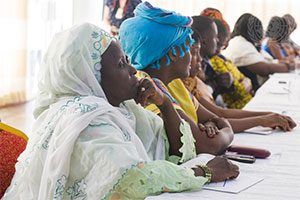 Representatives of Civil Society, Sierra Leone. Credit: UN Photo/Eskinder Debebe
Civil society faces mounting threats worldwide, even as it remains essential for democratic accountability, especially in countries struggling with economic instability and social inequality. However, at the same time, nations with weak democratic governance structures also systemically suppress the power of civil society. Human rights activists across the Global South frequently challenge issues such as political persecution and gender oppression, but in return face state-sanctioned punishment for their advocacy. Imprisonment and exile are common mechanisms of punishment that seek to erode the strength of civil society. The 2026 World Press Freedom Index has reached its lowest level in 25 years, with more than half of the world’s countries now falling into the "difficult" or “very serious” category for press freedom. IPS seeks to highlight the work of civil society across the Global South as well as the challenges that they face.
Updated by Yilan Batista and Shuli Wong August 2026

The Week with IPS

NEXT STOP - SDGs
Tracking global progress towards a sustainable world
Tracking global progress towards a sustainable world
