Languages
Thursday, October 22, 2026



News and Views from the Global South
Aid

Governments Slow to Respond to Elder Abuse
Although instances of elder abuse are widespread around the world, many government responses have been inadequate.
Climate-Proofing Agriculture Must Take Centre Stage in African Policy
After over a year of extreme weather changes across the world, causing destruction to homes and lives, 2015-16 El Niño has now come to an end.
Seeds for Supper as Drought Intensifies in South Madagascar
Havasoa Philomene did not have any maize when the harvesting season kicked off at the end of May since like many in the Greater South of Madagascar, she had already boiled and eaten all her seeds due to the ongoing drought.
AIDS Meeting Was Bold but Disappointing, Organisations Say
Though the High Level Meeting on Ending AIDS ended with the adoption of bold and life saving targets, many organisations have expressed their disappointment in its outcomes.
Gender & Disability
Women with disabilities face triple discrimination the world over on the basis of disability, gender and poverty. They are the most marginalised of all population groups including men with disabilities. The negative stereotyping of women with disabilities puts them at greater physical risk as they are exposed to neglect, emotional abuse, domestic violence and rape.
Antibiotic Resistance Requires Global Response Similar to AIDS, Climate Change
Addressing antibiotic resistance will require a global political response similar to the way the world has reacted to climate change or HIV / AIDS, Sweden’s Minister of Public Health Gabriel Wikstrom, told IPS recently.
Youth Leaders Push for More Progressive Action to End HIV AIDS
Young people are disproportionately affected by HIV, yet their concerns about sexual education, and discrimination of key populations were ignored at the UN General Assembly High Level Meeting on ending AIDS.
A Triple Threat in the Fight Against AIDS
The exclusion of key regions, contexts and actors must be addressed in order to successfully and significantly reduce HIV and AIDS by 2020, many have noted during the High Level Meeting on Ending AIDS this week.
‘What Can We Do for You?’ Aid Projects Pour Into Myanmar
International aid agencies, big and small, are beating a path to Myanmar, relishing the prospect of launching projects in a nation of 51 million people tentatively emerging from more than five decades of military rule.
Thousands of Minor Refugees Stranded Alone in Greece
Closure of the Western Balkans route has trapped tens of thousands of refugees heading to Central and Northern Europe in Greece, including many unaccompanied minors who either escaped from war zones after having lost their relatives, or were sent ahead in hopes of helping their families follow afterwards.
Golden Rice: The Malnutrition Fighting Crop
Over the past two decades, Bangladesh has remarkably managed to feed an increasing population better - the UN's Food and Agricultural Organization estimates that in 1993, the average Bangladeshi had access to just 2,000 calories per day, whereas today that number has increased to 2,450 calories per day. To a large extent, this success comes on the back of ever-higher rice production - rice makes up 70 percent of the average daily calorie intake.
Mega Dams Remain Controversial Source of Energy
Although mega dams can have devastating impacts on ecosystems and indigenous communities, many of the world’s poorest countries still see them as a way to fill gaping holes in their energy supplies.
What Lies Ahead for Oceans, Seas and Marine Resources
In September 2015, the international community adopted 17 Sustainable Development Goals, including Goal 14: Conserve and sustainably use the oceans, seas and marine resources for sustainable development.
UN Planning Airdrops for Besieged Syrians but Prefers Land Convoys
The UN has begun plans to deliver aid to besieged Syrian towns by air but says there are a number of obstacles in the way and that delivery by land remains its preferred choice.
Battered by Storms, Sri Lanka Rethinks Food Security
The picture could be straight out of a tourist postcard – a sleepy green mountain with misty clouds floating above the canopy – if not for one fatal flaw: the ugly gash running right through the middle.
Young African Women More Vulnerable to HIV
When Lebogang Brenda Motsumi was 16 years old she fell pregnant, terrified about what her life would look like, she went to a backdoor clinic for an abortion.
Time to Change Expectations: Zero Retribution to Zero Tolerance
The drugging, abduction and violent gang rape of a 16-year-old girl in Rio de Janeiro, Brazil calls us all to turn the tide of sexual violence against women and girls in Brazil and in every country in the world.
Can Poor Countries Combat Big Tobacco Too?
This year for World No Tobacco Day on May 31 the World Health Organization has recommended that countries adopt plain packaging as a way to reduce tobacco use, however so far mostly only rich countries have been able to afford to implement the changes.
African Leaders Make an Economic Case for Increased Nutrition Investments
Africa’s contribution to global malnutrition statistics is miserably high, with 58 million children under the age of five said to be too short for their age, while 13.9 million weigh too little for their height.
Achieving Universal Access to Energy; Africa Caught Between a Rock and a Hard Place
“It is unacceptable that 138 years after Thomas Edison developed the light bulb, hundreds of millions of people cannot have access to electricity to simply light up the bulb in Africa,” says Africa Development Bank (AfDB) Group President, Akinwumi Adesina, mourning the gloomy statistics showing that over 645 million people in Africa lack access to electricity, while over 700 million are without clean energy for cooking.
Menstrual Hygiene Gaps Continue to Keep Girls from School
Around the world girls are struggling to stay in school when their menstrual hygiene needs are forgotten or ignored, yet the water, sanitation and hygiene (WASH) and education sectors have remained reluctant to address the issue.« Previous Page — Next Page »





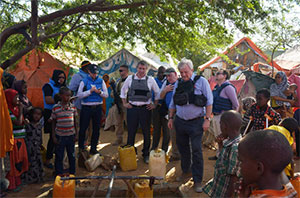 UN Emergency Relief Coordinator Visits Somalia. Credit: UN Photo/Tobin Jones
In recent years, conflicts have broken out across the world with no sign of slowing down or stopping. In times like this, millions of people globally are in dire need of humanitarian aid. Famine, warfare, natural disasters, and economic decline plague a host of nations, including Palestine, Sudan, Chad, Lebanon, and Haiti, to name a few. Humanitarian aid provides millions of people with critical services including healthcare, food, clean drinking water, psychosocial support, housing, and access to education. UN agencies such as the UNDP, UNICEF, the World Food Programme (WFP), UNHCR, UNRWA, and UNEP work with the UN Office for the Coordination of Humanitarian Aid (OCHA) and local organizations to come up with the best possible strategies to support affected communities. At the same time, humanitarian aid and those working on the frontlines are consistently threatened by both actors directly involved in conflict as well as those who are meant to contribute to the international humanitarian regime at large. The near-collapse of United States international aid structures in 2025, including the termination of 83% of USAID’s 6,300 global initiatives, has left millions of people without access to vital humanitarian assistance. 98 million people in 2025, only 65% of people targeted for humanitarian assistance, received the help they needed. In contrast, 123 million people received some form of humanitarian assistance in 2024, and OCHA’s 2026 Global Humanitarian Overview estimates that 239 million people are in need of assistance in 2026. IPS is well-positioned to discuss current initiatives to provide aid and relief through in-depth reporting and opinion content.

The Week with IPS

NEXT STOP - SDGs
Tracking global progress towards a sustainable world
Tracking global progress towards a sustainable world
