Languages
Wednesday, October 21, 2026



News and Views from the Global South
Aid

Least Developed Countries’ Vulnerabilities Make Graduation Difficult
Last month, over two thousand high-level participants from across the world met in Antalya, Turkey for the Midterm Review of the Istanbul Programme of Action, an action plan used to guide sustainable economic development efforts for Least Developed Countries for the 2011 to 2020 period. The main goal was to understand the lessons learnt by the world’s Least Developed Countries (LDCs) over the past five years and apply the knowledge moving forward.
Cotton Crisis
Pakistan’s economy is in grave trouble. According to the Pakistan Economic Survey 2015-16, it failed to meet the growth target of 5.5pc in FY2016. GDP grew by 4.7 pc. This was mainly due to the ‘major setback’ (to use the finance minister’s words) in agriculture.Women’s Health Takes Center Stage at UN Population Awards
Social Scientist, Carmen Barroso and Polish Organisation, Childbirth in Dignity received the United Nations Population Awards here Thursday for their outstanding work in population, improving individuals’ health and welfare, and specifically for their decades-long leadership in women's rights.
Disagreement Continues Over Global Drug Policy
A new report has found that global drug use largely remains the same, but perspectives on how to address the issue still vary drastically.
Let 5-year-old Sherry Tell You How Handwashing with Soap Saves Lives
For twenty-six year old Eunice from Migori County,Kenya, celebrating her daughter Sherry’s fifth birthday is a milestone that few of her friends have enjoyed. As with many areas of Africa, a child born in Migori is seven times more likely to die before the age of five, compared to a child in Europe.
Bringing Back Our Girls Is Not The End of The Story
"Wherever war reaches there is rape, and wherever rape is there is trauma, pain and terror” Zainab Bangura, Special Representative of the Secretary General on Sexual Violence in Conflict said here last week.
Worldwide Displacement At Levels Never Seen Before
Displacement has increased to unprecedented levels due to war and persecution, the UN Refugee Agency (UNHCR) has found.
Latin America and the Caribbean: What does it take to prevent people from falling back into poverty
Latin America and the Caribbean countries have experienced historic economic and social transformation in recent years. This has led to a considerable reduction in poverty and inequality and to advances in closing gender, labor and education gaps. These achievements are the result of a favorable economic environment as well as proactive social inclusion policies.
Aquaculture Meets Agriculture on Bangladesh’s Low-Lying Coast
A continuous influx of sea water is threatening agriculture and food security in vast coastal areas of Bangladesh, but farmers are finding ways to adapt, like cultivating fish and crops at the same time.
What is Missing on the Global Health Front?
The last World Health Assembly (WHA) in Geneva (23-28 May) discussed the manifold global health crises that require urgent attention, and adopted resolutions to act on many issues. We are currently facing many global health related challenges, and as such multiple actions must be taken urgently to prevent these crises from boiling over.
Mixed Progress at UN on Rights of Persons with Disabilities
Nearly 10 years after UN members adopted a progressive Convention on the Rights of Persons with Disabilities (CRPD), progress implementing the convention has been mixed, even at the UN itself, say disability advocates.
Fences and Walls: A Short-sighted Response to Migration Fears?
European nations from which millions once left to escape hardship and hunger – Greece, Ireland, Italy - are today destinations for others doing the same.
Children of a Lesser God: Trafficking Soars in India
Sunita Pal, a frail 17-year-old, lies in a tiny bed in the women’s ward of New Delhi’s Ram Manohar Lohia Hospital. Her face and head swathed in bandages, with only a bruised eye and swollen lips visible, the girl recounts her ordeal to a TV channel propped up by a pillow. She talks of her employers beating her with a stick every day, depriving her of food and threatening to kill her if she dared report her misery to anybody.
Majority of Vulnerable Refugees Will Not Be Resettled in 2017
Only a small percentage of the world’s most vulnerable refugees will be resettled in 2017, according to new figures released by the UN High Commission for Refugees (UNHCR) this week.
New Guidelines Aim to Help Migrants Experiencing Crises
When conflicts or natural disasters occur, migrants are often the “the first hurt and last saved”, Colin Rajah of the Global Coalition on Migration (GCM) said here Wednesday. Rajah was speaking at the launch of a new set of guidelines which have been developed to address the problems migrants face when crises hit their host countries.
Building Africa’s Energy Grid Can Be Green, Smart and Affordable
It’s just after two p.m. on a sunny Saturday and 51-year-old Moses Kasoka is seated outside the grass-thatched hut which serves both as his kitchen and bedroom.
The 50 Essential Products That Could Help People With Disabilities
Wheelchairs, hearing aids, white canes and braille typewriters are just some of the products that help people with disabilities to participate fully in everyday life.
Western Nations, Blaming Cash Crunch, Pull out of UNIDO
The 134-member Group of 77, the largest single coalition of developing countries, has expressed serious concern over the “unprecedented” withdrawal of nine member states from the Vienna-based UN Industrial Development Organization (UNIDO).
Drought Dries Up Money from Honey
“It is everything” is how smallholder farmer Nyovane Ndlovu describes beekeeping, which has long been an alternative sweet source of income for drought-beaten farmers in Zimbabwe.
Governments Slow to Respond to Elder Abuse
Although instances of elder abuse are widespread around the world, many government responses have been inadequate.
Climate-Proofing Agriculture Must Take Centre Stage in African Policy
After over a year of extreme weather changes across the world, causing destruction to homes and lives, 2015-16 El Niño has now come to an end.« Previous Page — Next Page »





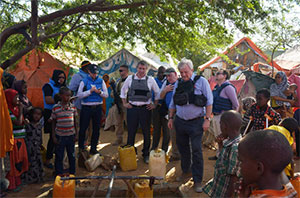 UN Emergency Relief Coordinator Visits Somalia. Credit: UN Photo/Tobin Jones
In recent years, conflicts have broken out across the world with no sign of slowing down or stopping. In times like this, millions of people globally are in dire need of humanitarian aid. Famine, warfare, natural disasters, and economic decline plague a host of nations, including Palestine, Sudan, Chad, Lebanon, and Haiti, to name a few. Humanitarian aid provides millions of people with critical services including healthcare, food, clean drinking water, psychosocial support, housing, and access to education. UN agencies such as the UNDP, UNICEF, the World Food Programme (WFP), UNHCR, UNRWA, and UNEP work with the UN Office for the Coordination of Humanitarian Aid (OCHA) and local organizations to come up with the best possible strategies to support affected communities. At the same time, humanitarian aid and those working on the frontlines are consistently threatened by both actors directly involved in conflict as well as those who are meant to contribute to the international humanitarian regime at large. The near-collapse of United States international aid structures in 2025, including the termination of 83% of USAID’s 6,300 global initiatives, has left millions of people without access to vital humanitarian assistance. 98 million people in 2025, only 65% of people targeted for humanitarian assistance, received the help they needed. In contrast, 123 million people received some form of humanitarian assistance in 2024, and OCHA’s 2026 Global Humanitarian Overview estimates that 239 million people are in need of assistance in 2026. IPS is well-positioned to discuss current initiatives to provide aid and relief through in-depth reporting and opinion content.

The Week with IPS

NEXT STOP - SDGs
Tracking global progress towards a sustainable world
Tracking global progress towards a sustainable world
