Languages
Tuesday, October 20, 2026



News and Views from the Global South
Aid
‘Monster’ El Niño Subsides, La Niña Hitting Soon
As if human-made armed conflicts, wickedness, rights abuse, gender violence, cruel inequality and climate catastrophes were not enough, now the saying “God Always Forgives, Men Sometimes, Nature Never” appear to be more true than ever. See what happens.
What can Development Banks do to Protect Human Rights?
In a petition signed by 150 NGOs, the Coalition for Human Rights in Development have called for development banks to make sure that human rights are respected by their beneficiaries.
South Sudan Tense but Calm Following Intense Fighting: UN
The situation in Juba, South Sudan on Thursday was "tense" but "calm" following recent intense fighting, UN Spokesperson for the Secretary General Stephane Dujarric told journalists here Thursday.
New Study on Earthquake
A new study using ground and satellite GPS monitors have concluded that the north-eastern corner of the Indian subcontinent encompassing Bangladesh, eastern India and parts of Myanmar is at risk of a major earthquake, and the effect when it occurs would be on a massive scale (8.2 to 9 on the Richter scale). The study conducted at the Lamont-Doherty Earth Observatory at Columbia University should be taken seriously, particularly by Bangladesh which has several issues going against it in the event of a major quake.
Civil Society Organizations Worried About Declining Involvement
Less than a year after the adoption of the global Sustainable Development Goals (SDGs), non-government organizations (NGOs) are concerned about declining possibilities for participation, both at the UN and in national politics.
Fighting Violence Against Children as a Global Problem
One billion children experienced physical, sexual or psychological violence in the last year, according to the US Centers for Disease Control and Prevention (CDC), prompting the launch of a new global partnership to tackle the problem here Tuesday.
What Does it Really Mean to “Leave No One Behind”?
Although “leave no one behind” has become a central rallying cry around the UN's Sustainable Development Goals, more needs to be done for it to be put into practice, civil society said during a review conference of progress made on the Post-2030 agenda here this week.
Large-Scale Rainwater Harvesting Eases Scarcity in Kenya
Rainwater harvesting in Kenya and other places is hardly new. But in this water-stressed country, where two-thirds of the land is arid or semiarid, the quest for a lasting solution to water scarcity has driven useful innovations in this age-old practice.
The Future of Food in Cities: Urban Agriculture
Habitat III, the UN’s conference on cities this coming October will explore urban agriculture as a solution to food security, but here in New York City, it has shown potential for much more.
Human Security a Must in a Chaotic, Confused World – Japan
The question is simple and the answer, short: does eating more mean being better nourished?... Not Necessarily!
Malagasy Children Bear Brunt of Severe Drought
Voahevetse Fotetse can easily pass for a three-year-old even though he is six and a pupil at Ankilimafaitsy Primary School in Ambovombe district, Androy region, one of the most severely affected by the ongoing drought in the South of Madagascar.
Closing the Gaps in Sexual Education for People with Disabilities
From forced sterilisation to sexual abuse, young women and men with disabilities are much more likely to have their sexual and reproductive health rights violated than other people.
Is Federalism Pro-poor?
Poverty, according to the United Nations, is “a denial of choices and opportunities, a violation of human dignity. It means lack of basic capacity to participate effectively in society. It means not having enough to feed and clothe a family, not having a school or clinic to go to, not having the land on which to grow one’s food or a job to earn one’s living, not having access to credit. It means insecurity, powerlessness and exclusion of individuals, households and communities. It means susceptibility to violence, and it often implies living in marginal or fragile environments, without access to clean water or sanitation.”
Five Years After Independence South Sudan Faces Myriad Challenges
South Sudan, the world’s newest country faces myriad problems five years after achieving independence, aid agencies warned this week.
Preventable Child Deaths Not Always Linked to Poorest Countries: UNICEF
Millions of children still die before reaching their fifth birthday every year, according to the 2016 State of The World’s Children Report released here Tuesday by the UN Children's Fund (UNICEF).
The Case for Cash in Humanitarian Emergencies
Currently only six percent of humanitarian aid worldwide comes in the form of cash handouts, yet many aid organisations believe that cash transfers should be seen as the rule, not the exception.
Biogas Brings Heat and Light to Pakistan’s Rural Poor
Nabela Zainab no longer chokes and coughs when she cooks a meal, thanks to the new biogas-fueled two-burner stove in her kitchen.
Civil Society Under Serious Attack
Despite their contribution to social justice, civil society organisations came under “serious attack” in 109 countries in 2015, according to a new report published by CIVICUS Monday.
Women’s Cooperatives Ease Burden of HIV in Kenya
Seventy-three-year-old Dorcus Auma effortlessly weaves sisal fronds into a beautiful basket as she walks the tiny path that snakes up a hill. She wound up her farm work early because today, Thursday, she is required to attend her women's group gathering at the secretary’s homestead.
Making Sustainability Part of the Corporate DNA
Companies, governments and non-profit actors agree that economic growth and sustainable development have to go hand in hand to shape our increasingly globalised world in a fair way.
Can Better Technology Lure Asia’s Youth Back to Farming?
Farming and agriculture may not seem cool to young people, but if they can learn the thrill of nurturing plants to produce food, and are provided with their favorite apps and communications software on agriculture, food insecurity will not be an issue, food and agriculture experts said during the Asian Development Bank (ADB)’s Food Security Forum from June 22 to 24 at the ADB headquarters here.« Previous Page — Next Page »





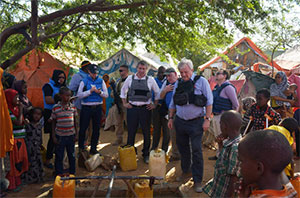 UN Emergency Relief Coordinator Visits Somalia. Credit: UN Photo/Tobin Jones
In recent years, conflicts have broken out across the world with no sign of slowing down or stopping. In times like this, millions of people globally are in dire need of humanitarian aid. Famine, warfare, natural disasters, and economic decline plague a host of nations, including Palestine, Sudan, Chad, Lebanon, and Haiti, to name a few. Humanitarian aid provides millions of people with critical services including healthcare, food, clean drinking water, psychosocial support, housing, and access to education. UN agencies such as the UNDP, UNICEF, the World Food Programme (WFP), UNHCR, UNRWA, and UNEP work with the UN Office for the Coordination of Humanitarian Aid (OCHA) and local organizations to come up with the best possible strategies to support affected communities. At the same time, humanitarian aid and those working on the frontlines are consistently threatened by both actors directly involved in conflict as well as those who are meant to contribute to the international humanitarian regime at large. The near-collapse of United States international aid structures in 2025, including the termination of 83% of USAID’s 6,300 global initiatives, has left millions of people without access to vital humanitarian assistance. 98 million people in 2025, only 65% of people targeted for humanitarian assistance, received the help they needed. In contrast, 123 million people received some form of humanitarian assistance in 2024, and OCHA’s 2026 Global Humanitarian Overview estimates that 239 million people are in need of assistance in 2026. IPS is well-positioned to discuss current initiatives to provide aid and relief through in-depth reporting and opinion content.

The Week with IPS

NEXT STOP - SDGs
Tracking global progress towards a sustainable world
Tracking global progress towards a sustainable world
