Languages
Thursday, October 22, 2026



News and Views from the Global South
Aid

New International Accord to Tackle Illegal Fishing
A new international accord to tackle illegal and under-reported fishing will come into force on June 5.
Malawi’s Drought Leaves Millions High and Dry
It’s Saturday, market day at the popular Bvumbwe market in Thyolo district. About 40 kilometers away in Chiradzulu district, a vegetable vendor and mother of five, Esnart Nthawa, 35, has woken up at three a.m. to prepare for the journey to the market.
UNFPA Funding Cuts Threaten Women’s Health in Poorer Nations
The UN Population Fund (UNFPA), which has played a key role in ensuring maternal health and promoting reproductive rights of millions of women world-wide, is expected to suffer over $140 million in funding cuts by Western donors this year.
Poorest Countries Have Progressed but Fragile Countries Lag Behind
The world's poorest countries are making development gains, yet challenges remain, particularly for so-called fragile countries affected by conflict or other disasters.
New and Old Vaccines Still Out of Reach for Many
While long-awaited new vaccines for malaria and dengue may finally be within reach, many of the world’s existing vaccines have remained unreachable for many of the people who need them most.
Least Developed Countries Still Face Significant Challenges
Since the establishment of the Least Developed Countries (LDCs) category in 1971, the international community has worked hand in hand to support its most vulnerable members.
Water Woes Put a Damper on Myanmar’s Surging Economy
The central plains of Myanmar, bordered by mountains on the west and east, include the only semi-arid region in South East Asia – the Dry Zone, home to some 10 million people. This 13 percent of Myanmar’s territory sums up the challenges that the country faces with respect to water security: an uneven geographical and seasonal distribution of this natural resource, the increasing unpredictability of rain patterns due to climate change, and a lack of water management strategies to cope with extreme weather conditions.
Bangladeshi Shrimp Farmers See Big Money in Small Fry
Frozen tiger shrimp exports from Bangladesh, mainly to the United States and the European Union, have grown substantially over the years and the demand keeps increasing.
Water Security Critical for World Fastest-Growing Economy
Lack of water management and limited access to data risk hindering Myanmar’s economic growth, making water security a top priority of the new government.
Economic Interests Harming Global Health: WHO Chief
Putting economic interests over public health is leading the world towards three slow-motion health disasters, Margaret Chan, Director-General of the World Health Organization’s warned the world’s health ministers on Monday.
Natural Capital Investment Key to Africa’s Development
Plugging Africa’s funding gaps to accelerate social and economic development requires a fresh approach to using its natural capital, environment experts said on Monday.
Bangladesh’s Urban Slums Swell with Climate Migrants
Abdul Aziz, 35, arrived in the capital Dhaka in 2006 after losing all his belongings to the mighty Meghna River. Once, he and his family had lived happily in the village of Dokkhin Rajapur in Bhola, a coastal district of Bangladesh. Aziz had a beautiful house and large amount of arable land.
Species Loss, the Migration Hiding in Plain Sight
Two months ago, I was in Agadez, a city in the middle of the famous Ténéré Desert of Niger. Agadez has become a major transit point on a hazardous journey for the hundreds and thousands of desperate people from all over West Africa trying to make it to the Mediterranean coast every year.What do Aid Organisations Want from the Humanitarian Summit
The UN World Humanitarian Summit takes place in Istanbul, 23-24 May. So what hopes do the humanitarian organisations, which deliver aid on the ground, have for the outcomes?
Humanitarian Summit Must Address Weapons Shipments Too
Boats carrying refugees and boats carrying aid supplies will be on the agenda at the World Humanitarian Summit this week, but advocates say discussing the free flow of shipments carrying bombs and guns might be even more critical.
Myanmar Seeks to Break Vicious Circle of Flood and Drought
It has been two weeks now since the village of Htita, with its few bamboo houses hemmed in by parched, cracked earth and dried-out ponds, has enjoyed the novelty of its first ever water well.The Heavens Poured and Atlas Shrugged
Sri Lankan parliamentarians appear to have been moved to unseemly mirth regarding the floodwaters which devastated the country this week, causing more than sixty three officially reported deaths and thousands more missing, with even greater numbers rendered homeless and destitute.
When Emergencies Last for Decades
For the millions of people whose lives have been uprooted by conflict and natural disasters the average amount of time before they can return home is now 17 years.
Refugees Bring Economic Benefits to Cities
Refugees are now more likely to live in cities than in refugee camps, bringing with them planning challenges but also opportunities for economic growth.
A Precarious Fate for Climate Migrants in India
After the sea swallowed up her home and family in the Bangladeshi coastal district of Bhola along the Bay of Bengal, farmer Sanjeela Sheikh was heartbroken. Stripped of all her belongings, her fields swamped and her loved ones dead, she contemplated suicide.
Humanitarian Situation in Yemen Seriously Deteriorating
The humanitarian crisis in Yemen is very seriously deteriorating, said Office of the Coordination for Humanitarian Affairs’ (OCHA) Operations Director John Ging.« Previous Page — Next Page »





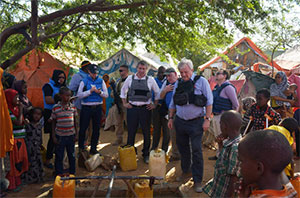 UN Emergency Relief Coordinator Visits Somalia. Credit: UN Photo/Tobin Jones
In recent years, conflicts have broken out across the world with no sign of slowing down or stopping. In times like this, millions of people globally are in dire need of humanitarian aid. Famine, warfare, natural disasters, and economic decline plague a host of nations, including Palestine, Sudan, Chad, Lebanon, and Haiti, to name a few. Humanitarian aid provides millions of people with critical services including healthcare, food, clean drinking water, psychosocial support, housing, and access to education. UN agencies such as the UNDP, UNICEF, the World Food Programme (WFP), UNHCR, UNRWA, and UNEP work with the UN Office for the Coordination of Humanitarian Aid (OCHA) and local organizations to come up with the best possible strategies to support affected communities. At the same time, humanitarian aid and those working on the frontlines are consistently threatened by both actors directly involved in conflict as well as those who are meant to contribute to the international humanitarian regime at large. The near-collapse of United States international aid structures in 2025, including the termination of 83% of USAID’s 6,300 global initiatives, has left millions of people without access to vital humanitarian assistance. 98 million people in 2025, only 65% of people targeted for humanitarian assistance, received the help they needed. In contrast, 123 million people received some form of humanitarian assistance in 2024, and OCHA’s 2026 Global Humanitarian Overview estimates that 239 million people are in need of assistance in 2026. IPS is well-positioned to discuss current initiatives to provide aid and relief through in-depth reporting and opinion content.

The Week with IPS

NEXT STOP - SDGs
Tracking global progress towards a sustainable world
Tracking global progress towards a sustainable world
