Languages
Friday, October 23, 2026



News and Views from the Global South
Aid

Humanitarian Situation in Yemen Seriously Deteriorating
The humanitarian crisis in Yemen is very seriously deteriorating, said Office of the Coordination for Humanitarian Affairs’ (OCHA) Operations Director John Ging.
A Refugee Crisis with No End in Sight
"We don't want charity, we want a long-term solution."
Industrial-Level Aid Logistics in Colombia’s Decades-Long Humanitarian Disaster
“If you’re going to talk about Colombia and the peace process, do it somewhere else,” was heard at a regional preparatory meeting for the World Humanitarian Summit, according to Ramón Rodríguez, with the Colombian government’s Unit for Attention and Integral Reparation for Victims (UARIV).
Bees and Silkworms Spin Gold for Ethiopia’s Rural Youth
Beekeeping and silkworm farming have long been critical cogs of Ethiopian life, providing food, jobs and much needed income.
Justice for Berta Caceres Incomplete Without Land Rights: UN Rapporteur
The murder of Honduran Indigenous woman Berta Caceres is only too familiar to Victoria Tauli-Corpuz, the UN’s Special Rapporteur on the Rights of Indigenous Peoples.
Progress of The World’s Least Developed Countries to be Reviewed
The United Nations will undertake a major review of progress made in the world’s 48 Least Developed Countries (LDCs) later this month.
Raising Walls Against the Sea
Facing the bleak prospect of millions of its citizens being displaced in coming years due to storms and sea level rise caused by climate change, Bangladesh is building up existing coastal embankments in a bid to protect coastal lands and people.
Fund Launched to Help Mountain People Face Climate Change Threat
Jake Norton was on a glacier in northern India. A seemingly impenetrable fortress of sweeping ridges and towering walls of granite, capped by hanging glaciers. It seemed, he said, that nothing could touch it, nothing could beat it down.
Why Peacebuilding is Part of the Sustainable Development Agenda
We tend not to worry when things are going well. If people can take care of their daily business and send their kids to school without fear of violence, resolve disputes through a functioning justice system when the need arises, express their views both in private discussions and in public processes, feel they can truly contribute to decisions that affect their lives, and know effective institutions are in place to deliver basic services to their families and communities without interruption or the need for bribes, chances are they will be broadly content with the way their society is managed.
OPINION: Greece, the Punching Ball of Germany
Greece is again in the media, because a new negotiation is due between the embattled country and its creditors. The North-South divide of Europe is coming back with force (while the East-West relationship is increasingly looking as beyond repair). The German minister of Finance, Wolfgang Schäuble , has come back with his peculiar view of the economy as a branch of moral and ethical discipline, and not as a reading of reality. He has asked the Greeks “to not get distracted” by the refugees crisis, and not forget their primary task, which is to pay their debt. The request is to cut 2% of the Gross National Product; in case there will not be a 3.5% budget surplus within 2018.
Kenyan Refugee Camp Closures will have Disastrous Consequences
The Kenyan government's decision to close its refugee camps will have disastrous consequences and must be reconsidered, international organisations have stated.
UN Releases Plan to Increase Refugee Responsibility Sharing
The UN wants to create a new Global Compact to encourage countries to share the responsibility for hosting the 19 million refugees who have fled their home countries.
WFO Calls for Farmer-Centred Sustainable Development
Over 600 delegates representing at least 570 million farms scattered around the world gathered in Zambia from May 4-7 under the umbrella of the World Farmers' Organisation (WFO) to discuss climate change, land tenure, innovations and capacity building as four pillars on which to build agricultural development.
MSF Withdrawal Part of Ongoing Debate Over Humanitarian Aid
Aid organisations have differing views about the upcoming World Humanitarian Summit, after Médecins Sans Frontières (MSF) pulled out last week some still hope the Summit will help bring about much needed change.
Let’s Not Forget Disaster Risk as we Rush to Adapt to Climate Change
Helping at-risk communities adapt to climate change impacts is an important part of the Paris Climate Change agreement, but adaptation will not be complete without considering disaster risk.
Nobel Peace Laureates to Help Achieve Food Security
The Food and Agriculture Organisation (FAO) believes that ongoing military conflicts, which have also devastated agricultural crops and livestock, are one of the primary causes of food shortages in war zones in Africa and the Middle East.
Farmers Can Weather Climate Change – With Financing
Merian Kalala, a farmer in Solwezi, capital of the North-Western Province of Zambia, knows firsthand that climate change is posing massive problems for agricultural productivity.
No Farmers, No Food — True But Not Enough
Agriculture is the primary sector of all economies. It is the sector responsible for granting food and nutrition security to all human beings. Consequently it is responsible for social stability and health. And it provides work opportunities to families, men, women and youth, and largely contributes to the country Gross Domestic Product (GDP).
Farmers Hold Keys to Ending Poverty, Hunger, FAO Says
With recent data showing that 793 million people still go to bed hungry, ending hunger and poverty in 15 years is the next development challenge that world leaders have set for themselves.
Seeking a New Farming Revolution
As the World Farmers' Organization meets for its annual conference in Zambia to promote policies that strengthen this critical sector, IPS looks at how farmers across the globe are tackling the interconnected challenges of climate change, market fluctuations, water and land management, and energy access.
Is the System Broke or Broken?
Though the upcoming World Humanitarian Summit may seem timely, a debate ensues on an important question: is the world humanitarian system broke or broken?« Previous Page — Next Page »





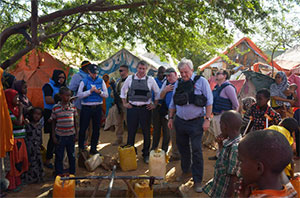 UN Emergency Relief Coordinator Visits Somalia. Credit: UN Photo/Tobin Jones
In recent years, conflicts have broken out across the world with no sign of slowing down or stopping. In times like this, millions of people globally are in dire need of humanitarian aid. Famine, warfare, natural disasters, and economic decline plague a host of nations, including Palestine, Sudan, Chad, Lebanon, and Haiti, to name a few. Humanitarian aid provides millions of people with critical services including healthcare, food, clean drinking water, psychosocial support, housing, and access to education. UN agencies such as the UNDP, UNICEF, the World Food Programme (WFP), UNHCR, UNRWA, and UNEP work with the UN Office for the Coordination of Humanitarian Aid (OCHA) and local organizations to come up with the best possible strategies to support affected communities. At the same time, humanitarian aid and those working on the frontlines are consistently threatened by both actors directly involved in conflict as well as those who are meant to contribute to the international humanitarian regime at large. The near-collapse of United States international aid structures in 2025, including the termination of 83% of USAID’s 6,300 global initiatives, has left millions of people without access to vital humanitarian assistance. 98 million people in 2025, only 65% of people targeted for humanitarian assistance, received the help they needed. In contrast, 123 million people received some form of humanitarian assistance in 2024, and OCHA’s 2026 Global Humanitarian Overview estimates that 239 million people are in need of assistance in 2026. IPS is well-positioned to discuss current initiatives to provide aid and relief through in-depth reporting and opinion content.

The Week with IPS

NEXT STOP - SDGs
Tracking global progress towards a sustainable world
Tracking global progress towards a sustainable world
