Languages
Friday, October 23, 2026



News and Views from the Global South
Aid
New Generation Aims to Plug Africa’s Research Deficit
The tonnes of uncollected garbage piling up on the streets of her home in Cairo was a brain wave for Sherien Elagroudy.
What Can Be Done for Victims Still Fighting for Survival?
Three years have elapsed since the collapse of Rana Plaza, Savar, on a fine morning of April 24, 2013. The disaster, one of the deadliest in the world's industrial history in two centuries, claimed the lives of 1,135 men and women and injured another 2,500, nearly 200 of whom severe enough to keep them hospitalised for months.
Will the IMF Facility Be a Turning Point in the Economy?
The IMF Extended Fund Facility (EFF) of US$ 1.5 billion with an agreement on an economic program supported by the IMF is now imminent. This could be a turning point in the economic fortunes of the country. The IMF facility would replenish the reserves, add confidence in the economy and have a salutary effect on capital inflows.
How the Definition of Development Aid is Being Eroded
The traditional definition of aid is being eroded at the same time that governments have committed to achieving the UN's ambitious Sustainable Development Goals (SDGs), Jeffrey Sachs special adviser to the UN Secretary-General on development told IPS Thursday.
Developing countries left out of global tax decisions
Over one hundred developing countries continue to be left out of global tax cooperation negotiations despite leaks such as the Panama papers showing the high cost of tax avoidance.
OPINION: Wake Up! We Need Statesman and Values but We Get Selfish Politicians and Cynicism…
A total indifference has accompanied the number of refugees injured by Macedonian police in Idomeni, where more than 12 000 people, including 4 000 children have been trapped, since Austria asked Macedonia, Serbia, Croatia and Slovenia, to prevent the continuing passage of refugees. Austria has now informed the Italian government that it will send several hundred troops to its border with Italy.
More Children Displaced, Used for Suicide Attacks by Boko Haram
A dire humanitarian and security crisis continues to worsen in the Lake Chad Basin with severe consequences for youth, said Regional Humanitarian Coordinator for the Sahel Toby Lanzer.
Plan for Poorer Countries to Fund HIV Response Raises Concerns
Calls for low and middle income countries to contribute an additional 6.1 billion dollars to the global HIV response by 2020 could see some vulnerable groups left behind, said HIV activists meeting at the United Nations last week.
OPINION: Learning from History for Progress
The Chinese character for crisis combines the characters for ‘danger’ and ‘opportunity’. Our ability to improve the human condition depends critically on our ability to recognize and address dangers, but also to seize opportunities made possible by recognizing that crises offer rare opportunities to pursue extraordinary options not normally available.Yemen’s Health Crisis is “Critical,” Says WHO
The health situation in Yemen has severely deteriorated and is critical, the World Health Organisation (WHO) has reported.
Quake Fear Stalks Kathmandu
Early evening, there is a play of light and shadow over Kathmandu’s famous Durbar Square. The rising monuments, damaged by the April 2015 earthquake, appear as dark silhouettes while large flash lights streak through in between them.DIHAD 2016 Closes With Calls For Better Future Of Those Faced With Wars And Catastrophes
The 13th Dubai International Humanitarian Aid and Development Conference and Exhibition (DIHAD) ended today with keynote speakers drawn from International organizations, technical experts, diplomats and the private sector calling for building a better future and more development for those who are suffering from crisis, wars and catastrophes.
DIHAD Emphasizes Relief and Development Efforts to Meet Humanitarian Challenges
The Dubai International Humanitarian Aid and Development Conference and Exhibition (DIHAD) opened today with key speakers emphasizing the urgency to discuss innovative solutions to be applied in humanitarian operations. Under the patronage of HH Sheikh Mohammed Bin Rashid Al Maktoum, Vice-President, Prime Minister of United Arab Emirates, Ruler of Dubai, the 13th edition of DIHAD was inaugurated by HE Mr. Ibrahim Bumelha, Cultural and Humanitarian Advisor of HH Sheikh Mohammed Bin Rashid Al Maktoum, and Chairman of DIHAD Higher Committee, President of DISAB, on behalf of UN Messenger of Peace and Chairperson of International Humanitarian City HRH Princess Haya Bint Al Hussein, wife of HH Sheikh Mohammed Bin Rashid Al Maktoum, Vice-President and Prime Minister of the UAE and Ruler of Dubai.
Malawi’s Refugee Crisis
Imagine fleeing from your home because you feel unprotected by the people who are required to do so by law. And when you get to where you feel safer, the very same people come to persuade your keepers to let you come back with them, claiming you are running away from nothing! Well, this is the situation some 5,800 Mozambican nationals have found themselves in. Hundreds of them, including unaccompanied children, have been fleeing from Tete Province, near the Malawi border, since late last year following renewed fighting between government forces and opposition Renamo fighters.
UN Chief Focuses on World’s First Humanitarian Summit
As the global humanitarian crisis continues to devastate civilian lives in conflict zones, UN Secretary-General Ban Ki-moon appealed to the international community to ensure “no-one in conflict, no-one in chronic poverty, and no-one living with the risk of natural hazards and rising sea levels, is left behind.”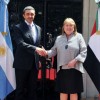
Argentina and United Arab Emirates Open New Stage in Bilateral Relations
With United Arab Emirates’ foreign minister Sheikh Abdullah bin Zayed Al Nahyan’s visit to Argentina, the two countries launched a new stage in bilateral relations, kicked off by high-level meetings and a package of accords.
Activists Accuse India of Violating UN Convention on Child Rights
Civil rights groups and child welfare activists have strongly protested against the enactment of a new Juvenile Justice Act by the Indian parliament, lowering the age of a legally defined juvenile for trial from 18 to 16- years old in heinous crimes cases.New Year, New Fight Against Inequality
With New Year’s resolutions already fading fast for most people, attention turns to what 2016 will really hold. And so it is for those wanting to tackle the world’s biggest problems.
Military Conflicts Threaten to Undermine Battle Against Rural Poverty
The ongoing battle against rural poverty is in danger of being undermined by a growing number of insurgencies and political upheavals – mostly in Africa.SYRIA: Give Peace a Chance
(WAM) - The Gulf Today, a United Arab Emirates (UAE) newspaper has said that years of strife and with millions of its people scattered across the globe, peace is what Syrians yearn for. The country is in ruins and the spreading of radicalism poses major security challenges regionally and globally.
Mexico to Export Nixtamalisation of Grains to Africa
Every day in the wee hours of the morning Verónica Reyes’ extended family grinds corn to make the dough they use in the tacos they sell from their food truck in Mexico City.« Previous Page — Next Page »





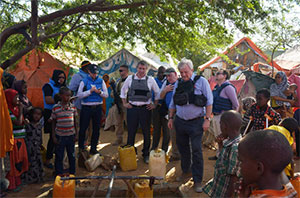 UN Emergency Relief Coordinator Visits Somalia. Credit: UN Photo/Tobin Jones
In recent years, conflicts have broken out across the world with no sign of slowing down or stopping. In times like this, millions of people globally are in dire need of humanitarian aid. Famine, warfare, natural disasters, and economic decline plague a host of nations, including Palestine, Sudan, Chad, Lebanon, and Haiti, to name a few. Humanitarian aid provides millions of people with critical services including healthcare, food, clean drinking water, psychosocial support, housing, and access to education. UN agencies such as the UNDP, UNICEF, the World Food Programme (WFP), UNHCR, UNRWA, and UNEP work with the UN Office for the Coordination of Humanitarian Aid (OCHA) and local organizations to come up with the best possible strategies to support affected communities. At the same time, humanitarian aid and those working on the frontlines are consistently threatened by both actors directly involved in conflict as well as those who are meant to contribute to the international humanitarian regime at large. The near-collapse of United States international aid structures in 2025, including the termination of 83% of USAID’s 6,300 global initiatives, has left millions of people without access to vital humanitarian assistance. 98 million people in 2025, only 65% of people targeted for humanitarian assistance, received the help they needed. In contrast, 123 million people received some form of humanitarian assistance in 2024, and OCHA’s 2026 Global Humanitarian Overview estimates that 239 million people are in need of assistance in 2026. IPS is well-positioned to discuss current initiatives to provide aid and relief through in-depth reporting and opinion content.

The Week with IPS

NEXT STOP - SDGs
Tracking global progress towards a sustainable world
Tracking global progress towards a sustainable world
