Languages
Sunday, November 8, 2026



News and Views from the Global South
Education
SOUTH AFRICA: Gender Loses Out in Basic Education Crisis
With the 15th-year review of the 1995 Beijing World Conference on Women taking place at the ongoing Commission on the Status of Women in New York, South African teachers and education experts say they fear that a special focus on the advancement of girls is getting lost amidst the growing levels of poverty in the country.EDUCATION-TANZANIA: Pregnant Teens Forced Out of School
Pregnancy is the leading cause of dropouts for school girls in Tanzania. And a national law forbidding young mothers to return to school after giving birth did not make it any easier for them to continue their education.
EDUCATION-URUGUAY: Gardens of Knowledge
"Nature is wise, and if we take the time to observe it, we can learn so much" is the underlying philosophy of a number of innovative programmes being carried out in Uruguayan schools that are using gardens as a teaching resource, explained Edith Moraes, director of the national Primary Education Board.GUATEMALA: Off Track for Millennium Development Goals
Guatemala knows that when it comes time to demonstrate compliance with the Millennium Development Goals (MDGs), a set of global anti-poverty and development target to be met by 2015, it will make a poor showing.
ZIMBABWE: Informal Sector Lures University Graduates
From the rickety old buses that miraculously make long cross-border journeys to the frustrating red tape at the border post, from fending off sexual advances from bus crews and customs officials to losing goods worth thousands of dollars, 28-year-old Irene Moyo has seen it all.
RIGHTS: Women More Educated, Not More Equal
When it comes to female education rates, progress has been made around the world, and in many countries girls and young women have outnumbered and outperformed boys and men at all levels of schooling for decades. Nevertheless, these advances have yet to translate into greater equity in employment, politics and social relations.
SWAZILAND: Long-distance Learning Certificate for Caregivers
Every Tuesday you will find 70-year-old Precious Dlamini under a tree, weighing children and babies from her local community as she monitors their health and nutrition.
EDUCATION-NEPAL: Unique School Aims to Be a Ticket to Equality
Had Uttam Sanjel stayed on in the Indian city of Mumbai to pursue his dream of becoming a Bollywood director years ago, the Samata (‘equality) schools that he set up here in Nepal may not be around today.
MALAWI: Free Education At What Price
He fishes by night and sells his catch by day. He's the breadwinner for his family of six. Maliko Malombe is nine years old.URUGUAY: Making the Secret Shame of Illiteracy a Thing of the Past
"Excuse me, I forgot my glasses, could you tell me what that sign says?" This was one of the ruses commonly used by Juan Gómez, who was too embarrassed to admit that at the age of 77, he had never learned to read or write.RIGHTS: U.N. Goals on Education Under Widespread Attack
The relentless attacks on educational institutions in war zones - along with growing threats against academics, teachers and school-going children - have jeopardised one of the U.N.'s Millennium Development Goals (MDGs) - education for all by 2015.VIETNAM: Hard Times Put Lunar New Year on Hold for Children
There will be no Tet (Lunar New Year) for Doan Hung this year. As festivities heat up for the Year of the Tiger, which starts on Feb. 14, the 12-year-old boy is busy selling lottery tickets on the streets.
SWAZILAND: Dating in a Time of HIV
Jabulile Dlamini* is sweet sixteen and has never been kissed. And she is not expecting to be kissed any time soon or to even receive any gifts this Valentine’s Day.
EDUCATION-INDONESIA: Mobile Classes a Lifeline to Dropouts
Two years after the economic recession forced her out of school, 20-year-old Nurul Kumala is now back in classes – mobile classes, that is.
MUSIC-BRAZIL: ‘Enchanted’ Guitars for Social Change
Perfectly in tune, in spite of the off-key world of Terra Encantada ("Enchanted Land"), a shanty town in this Brazilian city, the guitars of Daniel Sant'Anna's orchestra strike up the "Ode to Joy", played by children and teenagers who are looking for a way forward in their lives.PAKISTAN: Community Midwives Gain Recognition But Concerns Remain
As Kanwal Gul, 25, lay on the delivery table a year ago, preparing to give birth to her first child, she made sure the traditional birth attendant (TBA) assisting her knew exactly what to do. Put on the gloves, she instructed her.
ROMANIA: Starting Early on Human Rights With School Textbook
A textbook on human rights activism, being introduced in Romanian schools this year, steers away from preaching and uses interviews with global and local rights activists to suggest how young people may get involved.HAITI: Universities Feel Strain After Earthquake
Astride Auguste was late for an exam at Quiskeya University on that fateful Tuesday, Jan. 12, when the earthquake - or "the event", as Haitians have come to call it - struck this capital city.
Q&A: "Being Poor and White Is Not the Same as Being Poor and Black" in Cuba
The elimination of racism remains unfinished business in Cuba today. "We have to admit that the problem exists, determine its impact on the social model that we defend, and tackle it in depth," says Esteban Morales, an Afro-Cuban economist, political scientist and author of numerous articles and essays on the subject.INDIA: Mobilised by Old Clothes, Poor Folk Stand Up, Take Action
Salidhana village, a mere blip on the vast and arid landscape of India’s central state of Madhya Pradesh, was devoid of life’s most basic necessity – water. Until last year, there was no well in this hamlet of about a hundred families. Women would trudge hours daily to fetch water from distant areas, often losing their balance on the hilly village’s treacherous slopes.
WORLD SOCIAL FORUM: Another Kind of Economics Is Possible
Democratising economics as well as politics is essential for ending irrationality and discrimination as part of the struggle for social and environmental justice, said participants at one of the panels of the seminar assessing the World Social Forum's (WSF) first 10 years.« Previous Page — Next Page »





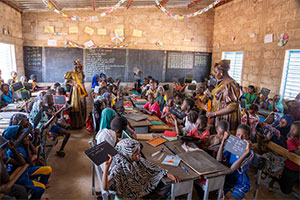 Two teachers work in a classroom in Forces Vives School in Dori, Burkina Faso. Credit: UNICEF/UNI978361
Safe and uninterrupted education is a fundamental right for all children. Education is paramount to global development, as it has been proven that investing in education – especially for girls and children – contributes significantly to economic growth and prosperity. Although more than 1 billion children go to school, many are subjected to conditions that are not conducive to a proper learning environment, including makeshift facilities, a lack of supplies, violence in classrooms, inadequate sanitation, untrained instructors, and widespread school closures. Since 2015, there have been immense gains in education with an increase of 109 million children in school. However, as of 2023, 272 million children are still out of school.
High poverty levels in developing countries also impede children’s access to a proper education. For example, from the early to mid 2000s, Sub-Saharan African nations witnessed a dramatic decline in trained teachers due to inadequate funding in the education sector. Furthermore, major cuts to United States international aid threaten an estimated 23 million additional children's access to education, as USAID‑funded school programmes across Africa and Asia face closure.
Various other factors contribute to the decline of education, notably hunger, which has increased as conflict and climate change interfere with global food production and dissemination. Meanwhile, certain social and cultural practices also impede children’s access to education, with gender inequality, discrimination, child labour, and child marriages preventing millions of children from attending school. Economic conditions such as the inaccessibility of higher education also affect disenfranchised communities across the world. In extreme situations, such as warfare where educational facilities are destroyed in their totality, notably in Gaza and Sudan, entire generations of children might grow up without access to education. Rebuilding educational infrastructure is a long and arduous process, especially when violence persists across generations, and this significantly stunts the development of societal prosperity and stability.
IPS is dedicated to telling the shocking truths about worldwide education through impassioned opinion pieces and comprehensive articles, highlighting global issues that impede worldwide education and the courses of action being taken by organizations such as UNICEF and Education Cannot Wait.

The Week with IPS

NEXT STOP - SDGs
Tracking global progress towards a sustainable world
Tracking global progress towards a sustainable world
