Languages
Sunday, November 8, 2026



News and Views from the Global South
Education
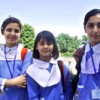
RIGHTS-PAKISTAN: Children Undeterred by Attacks, Want Education
"I don’t feel any fear. My parents do. They instruct me almost every day to stay away from crowded places," said Afaq Ali, a Grade 1 student in this capital city of the militancy-wracked Khyber Pakhtunkhwa province in Pakistan.SRI LANKA: Jaffna Tamils Decry Development Plan of Gov’t
Two cyclists from the minority Tamil community are shooed away by government soldiers as they approach this northern Sri Lankan city’s only Buddhist temple while President Mahinda Rajapaksa is paying a visit.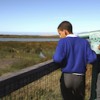
SOUTH AFRICA: Children Help to Assess Water Health
Miss, Miss, there are tiny creatures here in the water!" a Grade 7 pupil shouts excitedly, trying to draw attention to his water sample. At first, the liquid looks clear, but upon closer examination, one can make out a tiny aquatic invertebrate.MEDIA-ASIA: Parents Try to Keep Up with Net-savvy Youngsters
Many parents are scratching their heads as they watch youngsters in the Asia- Pacific region create often-private online worlds, feeling lost over how to be a part of it and oversee their Internet lives.
PHILIPPINES: Women’s College Corrects Gender Miseducation
Flip open a typical textbook used in many Philippine schools and you will likely find images of women illustrating verbs such as ‘cook’ or ‘clean’, but hardly appearing anywhere much in economics and history textbooks.
Q&A: Equality for Women – “The Core of the Problem is Care”
"Women help to reduce poverty and raise family incomes, but they pay too high a price for it, because in every country their working days are longer than men's," said Sonia Montaño, head of the Economic Commission for Latin America and the Caribbean's (ECLAC) Division for Gender Affairs.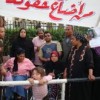
EGYPT: Looking Away From the Disabled
Egyptians find it hard to see past Mahrousa Salem's wheelchair, so they look away.
UGANDA: Information Technology Helps Farmers
Mayuge district has 31,000 farming families served by just nine agricultural extension workers. In Wainha village, an internet centre run by the Busoga Rural Open Source and Development Initiative is more than filling the gap in assisting farmers.
RIGHTS-PERU: Generals on Trial for Murders of 37 Students
There is more than enough evidence to convict three generals and other army officers in the kidnapping and murder of 36 university students from the highlands city of Huancayo in Peru between 1989 and 1993, Víctor Lizárraga of the National Human Rights Coordinator (CNDDHH) told IPS.
KENYA: Primary Education Under the Gun
The children are afraid. There are armed bandits hiding with stolen animals in the thickets behind Nawoyaregae Primary School in Kaputir Location.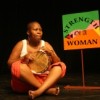
ARTS-SOUTHERN AFRICA: Women Dancers Can Fill Granaries
"Some said, how can women dancers tell us about climate change? Some said, how can dancers talk about planting trees? Others asked, how can women dancers build schools? But now the government says a drum has managed to fill our granaries, a dancer has managed to build schools."
ARGENTINA: Homemade Portraits of Life Behind Bars
"I wanted to take a self-portrait, and I thought about keeping a straight face, but it came out all weird, with these very long arms," says Liliana Cabrera about the photo she took with a camera she made herself, out of a condensed milk tin, at a workshop in an Argentine prison.EDUCATION-AFRICA: “Change the System to Fit the Child”
Teachers in Africa need to be trained to teach pupils from multiple grades simultaneously because although this is a common form of instruction on the continent, many teachers are not educated to do this.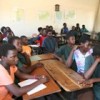
ZAMBIA: School Policy for Teen Mothers a Partial Success
Naomi Mulenga is determined to beat the odds by finishing her school education and becoming a nurse – despite being a teenage mother.
EDUCATION-MALAWI: Local Language Dictionary Released
The thickest book on secondary school teacher Hellen Ndalama’s desk is her indigenous language dictionary. It is also her most-used book.EDUCATION-SIERRA LEONE: Government Ignores Demands for Additional Teachers
Ismail Conteh has been teaching for the past year-and-a-half at a primary school in Sierra Leone’s capital Freetown – without receiving a single cent. He is one of hundreds of teachers recruited by schools to match the ever-growing number of pupils.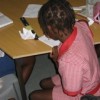
NAMIBIA: “If You Kiss for Five Minutes You Get It”
"At home we have a bar," says grade seven learner David Bravo* (14). "When my mother puts on the music I cannot concentrate on (my) schoolwork anymore. Sometimes, in the middle of the night, I just sit there and watch the people."
SWAZILAND: Budget Cuts Ahead but More Money for Education and Health
Her swollen feet are a constant reminder to Sanele Matsebula that she needs to take her medication.
MALAWI: Rural Communities Jointly Care for Orphans
At the age of 66, village headman Kamwala of Dedza district in central Malawi is starting to feel the effects of ageing. He gets tired easily and needs frequent naps but says he cannot afford this luxury. He and his wife are caregivers to a one-year-old orphan.MEXICO: Music and Dance Classes Foster Tolerance, Self-Esteem
Ten-year-old Jessica Algoneda leaps in the air, raising her arms and spinning around at her primary school in the Mexican capital, as if in honour of Terpsichore, the Greek muse of dance and poetry.EGYPT: Population Growth Overtakes Literacy Rise
Literacy programmes are teaching millions of Egyptians to read, but are struggling to keep up with the country's high population growth.« Previous Page — Next Page »





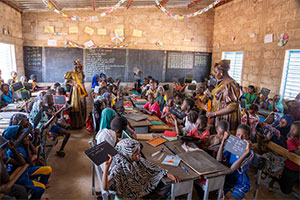 Two teachers work in a classroom in Forces Vives School in Dori, Burkina Faso. Credit: UNICEF/UNI978361
Safe and uninterrupted education is a fundamental right for all children. Education is paramount to global development, as it has been proven that investing in education – especially for girls and children – contributes significantly to economic growth and prosperity. Although more than 1 billion children go to school, many are subjected to conditions that are not conducive to a proper learning environment, including makeshift facilities, a lack of supplies, violence in classrooms, inadequate sanitation, untrained instructors, and widespread school closures. Since 2015, there have been immense gains in education with an increase of 109 million children in school. However, as of 2023, 272 million children are still out of school.
High poverty levels in developing countries also impede children’s access to a proper education. For example, from the early to mid 2000s, Sub-Saharan African nations witnessed a dramatic decline in trained teachers due to inadequate funding in the education sector. Furthermore, major cuts to United States international aid threaten an estimated 23 million additional children's access to education, as USAID‑funded school programmes across Africa and Asia face closure.
Various other factors contribute to the decline of education, notably hunger, which has increased as conflict and climate change interfere with global food production and dissemination. Meanwhile, certain social and cultural practices also impede children’s access to education, with gender inequality, discrimination, child labour, and child marriages preventing millions of children from attending school. Economic conditions such as the inaccessibility of higher education also affect disenfranchised communities across the world. In extreme situations, such as warfare where educational facilities are destroyed in their totality, notably in Gaza and Sudan, entire generations of children might grow up without access to education. Rebuilding educational infrastructure is a long and arduous process, especially when violence persists across generations, and this significantly stunts the development of societal prosperity and stability.
IPS is dedicated to telling the shocking truths about worldwide education through impassioned opinion pieces and comprehensive articles, highlighting global issues that impede worldwide education and the courses of action being taken by organizations such as UNICEF and Education Cannot Wait.

The Week with IPS

NEXT STOP - SDGs
Tracking global progress towards a sustainable world
Tracking global progress towards a sustainable world
