Languages
Sunday, November 8, 2026



News and Views from the Global South
Education

INDIA: Kashmir Youth Fight – to Save the Environment
Now that the armed conflict between Indian security forces and Kashmiri militants has eased considerably, youngsters are coming out to fight a new threat – environmental degradation – that looms over this beautiful valley often termed ‘paradise on earth’.
THAILAND: Sexuality 101 Exhibit Says It Straight
Teenage boys gape at a coloured photograph of a vagina, while girls give embarrassed smiles as they watch a cartoon that showed penises 'talking' about masturbation. Young girls crowd around a display panel about love and relationships, as a boy embraces a female mannequin with all his might in order to measure the strength of his hug.ARGENTINA: Poorest First Served with Free Digital TV
In contrast to what has happened in most countries that have switched from analogue to digital television, in Argentina the technological leap has begun with the poorest households.
ECUADOR: Like Mother, Like Multi-Tasking Daughter
In Ecuador, girl workers conform to universal statistics: they drop out of school less than boy workers, because they learn from an early age to juggle earning an income with looking after younger siblings and getting an education.CHINA: Alarming School Dropout Rate Blamed on Teaching Methods
In Chinese education, the examination is paramount.
Despite Gains, South Korean Women Still Struggle for Equality
Forty-six year-old language professor Kwon Hye Yang views her life as a typical example of the growing confidence of modern women in her home country, South Korea.
UGANDA: Too Young to Know, Yet Too Young to Die
Thirteen-year-old Jacinta Okello and her fellow primary school classmates call it "doing bad manners". But when you ask her what she knows about sex, she breaks into a shy smile, looks to her feet and giggles.URUGUAY: Incubating Businesses and ICT Job Prospects
"Without this opportunity, I might never have been able to get a higher education," says Paolo Carabajal, one of the beneficiaries of a digital development plan in this city in northwestern Uruguay.EDUCATION: EnGendering Awareness in Trainee Teachers
The teacher seats the most attentive girls in the front row and the troublesome boys at the back of the classroom. He punishes the liveliest pupil and lets the withdrawn one be. Dark-skinned boys sit with dark-skinned girls, boys play with boys and girls with girls.BURMA: Public Education a Drain on Family Incomes
Once again, parents in military-ruled Burma are counting the cost of a primary education for their children in public schools. It is an annual ritual that comes with the beginning of a new school year, which coincides with the onset of the monsoon rains in June.
INDIA: Muslim Women Explore Opportunity in Non-Traditional Fields
In a small, dingy and humid room in Metiabruz, a poor Muslim-dominated locality in Kolkata in eastern India, at least 20 Muslim women are talking with excitement about their aspirations and why they decided to study information technology (IT), a short-term course offered for a minimal fee by a non- government organisation operating in their locality.
AFRICA: Renewing the Promise of Education for All
The World Cup is wreaking havoc with a key millennium development goal in South Africa: as the football tournament hit its stride, not a single child across the nation attended school.ARGENTINA: Football Referee School Offers Way Out of Poverty
A new school to train football referees to work amateur-level tournaments in Argentina aims at providing skills and a legitimate source of income for young people from poor homes.
BRAZIL: “Gol de Letra” Scores Goals off the Playing Field
In a country where many poor children dream of "making it big" through football or modeling, retired Brazilian football stars Leonardo and Raí could have simply basked in their fame. But they decided instead to combine sport with education, art and skills training.
Banning Junk Foods in Mexico’s Schools to Fight Obesity
Consumer organisations and experts say the Mexican government's plan to remove junk food from schools is a step in the right direction in the fight against obesity in this country, which has the highest rate of childhood obesity in the world, and the second highest rate for adults, after the United States.JAMAICA: Communities Pay High Price for Soaring Crime Rates
This week's ongoing standoff in Jamaica, in which 73 people have been killed as police search for a wanted gang leader in the Tivoli Gardens neighbourhood of Kingston, is focusing renewed international attention on the island's seemingly intractable violent crime rate.Texas Texts Tilt to the Right
The American Civil Liberties Union has launched a letter-writing campaign designed to persuade book publishers not to use the "ideologically-slanted standards for social studies textbooks" approved by the Texas State Board of Education as a model for use in other states.
Iran’s Hijab Crackdown Intensifies as Election Anniversary Nears
It might be hard to imagine that a woman's attendance at a university would be contingent upon the way she dresses.
Universal Education an Empty Promise for Liberia’s Girls
In a small office tucked behind the stairwell in Liberia’s Ministry of Education, the once-proud staff of the Girls’ Education Unit appear defeated.MEXICO: Acrobatics for At-Risk Children
Learning to do aerial acrobatics has not only helped 13-year-old Atenas Padilla overcome her fear of heights, but also to become more tolerant and creative.INDIA: One Woman’s Entrepreneurial Venture Now Employs Thousands
Shameema Wani, 40, never imagined a simple venture, begun from scratch, would grow into the 2,000-strong business enterprise, employing mainly women, that it is today in this capital city of India’s disputed Jammu and Kashmir state.« Previous Page — Next Page »





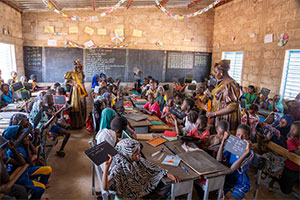 Two teachers work in a classroom in Forces Vives School in Dori, Burkina Faso. Credit: UNICEF/UNI978361
Safe and uninterrupted education is a fundamental right for all children. Education is paramount to global development, as it has been proven that investing in education – especially for girls and children – contributes significantly to economic growth and prosperity. Although more than 1 billion children go to school, many are subjected to conditions that are not conducive to a proper learning environment, including makeshift facilities, a lack of supplies, violence in classrooms, inadequate sanitation, untrained instructors, and widespread school closures. Since 2015, there have been immense gains in education with an increase of 109 million children in school. However, as of 2023, 272 million children are still out of school.
High poverty levels in developing countries also impede children’s access to a proper education. For example, from the early to mid 2000s, Sub-Saharan African nations witnessed a dramatic decline in trained teachers due to inadequate funding in the education sector. Furthermore, major cuts to United States international aid threaten an estimated 23 million additional children's access to education, as USAID‑funded school programmes across Africa and Asia face closure.
Various other factors contribute to the decline of education, notably hunger, which has increased as conflict and climate change interfere with global food production and dissemination. Meanwhile, certain social and cultural practices also impede children’s access to education, with gender inequality, discrimination, child labour, and child marriages preventing millions of children from attending school. Economic conditions such as the inaccessibility of higher education also affect disenfranchised communities across the world. In extreme situations, such as warfare where educational facilities are destroyed in their totality, notably in Gaza and Sudan, entire generations of children might grow up without access to education. Rebuilding educational infrastructure is a long and arduous process, especially when violence persists across generations, and this significantly stunts the development of societal prosperity and stability.
IPS is dedicated to telling the shocking truths about worldwide education through impassioned opinion pieces and comprehensive articles, highlighting global issues that impede worldwide education and the courses of action being taken by organizations such as UNICEF and Education Cannot Wait.

The Week with IPS

NEXT STOP - SDGs
Tracking global progress towards a sustainable world
Tracking global progress towards a sustainable world
